Podcast: Play in new window | Download (Duration: 50:52 — 116.4MB) | Embed
Subscribe Apple Podcasts | Spotify | RSS | More
Nancy Cavey often cites a case out of the University of Virginia system, one she did not personally handle, involving a doctor she recalls as an interventional cardiologist. His disability policy defined “occupation” by which medical board he held, and he had not been boarded in that subspecialty. The carrier’s answer, in Cavey’s telling, was that he could still work, as a cardiologist. She keeps the story close because it shows how completely a policy’s own wording can determine whether a physician’s disability claim pays.
Cavey is the founder of the Law Offices of Nancy L. Cavey in Tampa Bay, Florida, a Board Certified Workers’ Compensation Attorney and certified veterans’ attorney who has represented disability claimants nationwide since 1984, working Social Security Disability and private long-term disability claims side by side.
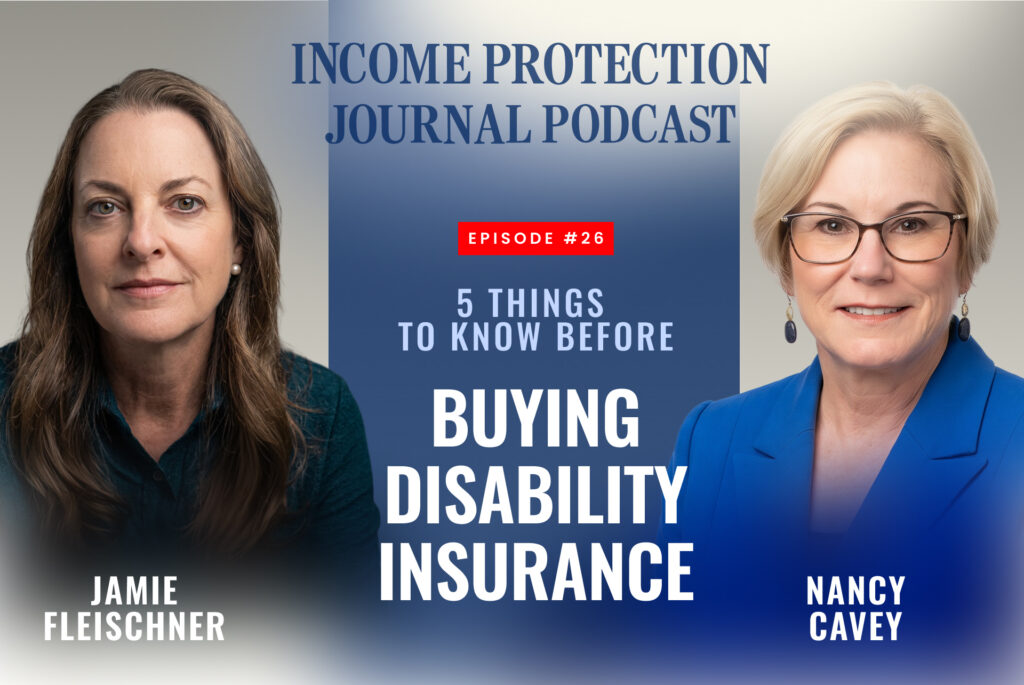
I brought her onto the Income Protection Journal Podcast to run that experience in reverse. Physicians researching disability insurance for physicians usually compare price and the monthly benefit. Cavey’s cases are the reminder that the word “occupation” inside that policy can matter more than either number, because at least four different definitions of it exist, and a carrier is free to use whichever one it wrote into the contract.
Own Occupation Has No Fixed Meaning in an Individual Disability Insurance Policy
Cavey walks new clients through the same first question every time: what does this specific policy say occupation means. The Dictionary of Occupational Titles supplies one common definition, and it has not been revised in about 40 years. A local labor market supplies another. A physician’s own employer can supply a third. And on the policies Cavey calls the worst she has seen, a medical specialty board supplies a fourth, so a doctor who has not finished a subspecialty exam can be told that a broader specialty still counts as the same occupation.
Physicians rarely carry just one policy, and Cavey said that is exactly where the mismatch shows up.
“Own occupation can mean your own occupation as performed for your specific employer… Now, if you have more than one policy, and I see this commonly, I’ll have doctors or physicians or lawyers who have two or three policies, and I’m going from policy to policy to policy because they’re all different.”
Nancy Cavey, who has handled Social Security Disability and private long-term disability claims side by side for more than three decades, speaking on the Income Protection Journal Podcast
That is the mechanism behind the identical-disability, different-outcome problem. Two policies covering the same physician can each specify occupation a different way, so the same injury or diagnosis can satisfy one contract’s definition and fail another’s, even though nothing about the physician’s condition has changed between the two claims.
Physicians With More Than One Disability Policy Face This Twice
This shows up earliest for physicians who build coverage in pieces: a group long-term disability plan through a hospital employer, an individual policy bought during residency or in the first year of practice, and sometimes a third layer added after a partnership buy-in. Each of those was underwritten separately, at a different point in a career, often by a different carrier. Nothing requires the definitions of occupation across the three to match, and Cavey said in practice they usually do not.
The reason it gets missed is not carelessness. A physician buying a fourth or fifth financial product in a single year, on top of malpractice coverage, a mortgage, and a partnership agreement, is trusting a broker to add up the monthly benefit correctly. Cavey has represented CFOs, union stewards, and physicians who could describe exactly how much coverage they were sold and could not describe what the word “occupation” meant inside any of it.
Timing is the part that is hardest to fix after the fact. Reading four separate own-occupation definitions before a disability exists costs an afternoon and, at most, a conversation with an agent about a different rider. Reading them for the first time after a claim has already been filed means living with whatever those definitions happen to say, on top of managing the disability itself.
Cavey said the same blind spot extends past the disability benefit itself, into how a medical practice is structured.
“One of the things I always want to look at is the buyout agreement, because you know normally in buyout agreements there are disability provisions, so the buyout can be different if you’re disabled.”
Nancy Cavey, a board-certified workers’ compensation attorney and certified veterans’ attorney who has represented disability claimants nationwide for more than 35 years, speaking on the Income Protection Journal Podcast
A partnership agreement written years before anyone expected to need it can change the value of a buyout the day a partner becomes disabled, the same way an old policy’s occupation definition can. Neither document announces the change in advance. A physician learns the actual terms only when a claim forces the question.
Cavey’s own introduction to this work came from watching it happen inside her own family, not from a law-school casebook.
“He had enough foresight to buy a disability insurance policy through USFG, never thinking that he would need it. And when I was in junior high school, he was diagnosed with leukemia.”
Nancy Cavey, founder of the Law Offices of Nancy L. Cavey in Tampa Bay, Florida, who has represented disability claimants since 1984, speaking on the Income Protection Journal Podcast
Her father was a disabled World War II naval aviator, and the family lived on that policy after he could no longer work the family insurance business he had joined in Maryland. Cavey has spent more than four decades since on the other side of that same kind of policy, reading the definitions that determined whether other families would have the same outcome.
What stays with me is that the outcome of a claim is usually set years earlier, by a choice nobody thought mattered on the day the policy was bought. Before assuming a policy will pay, read what it actually calls “occupation,” and read it again in every other policy sitting in the same drawer.