
Business Overhead Expense Insurance
Reimburses the practice during owner disability.
BOE Coverage for Practice Owners
Business overhead expense insurance reimburses a small business owner’s practice for fixed monthly operating costs when the owner cannot work. Set for Life Insurance compares BOE policies for owner-operated practices nationwide. Coverage pairs with personal small business disability insurance for full owner protection.

Get Your Customized Business Overhead Expense Quote
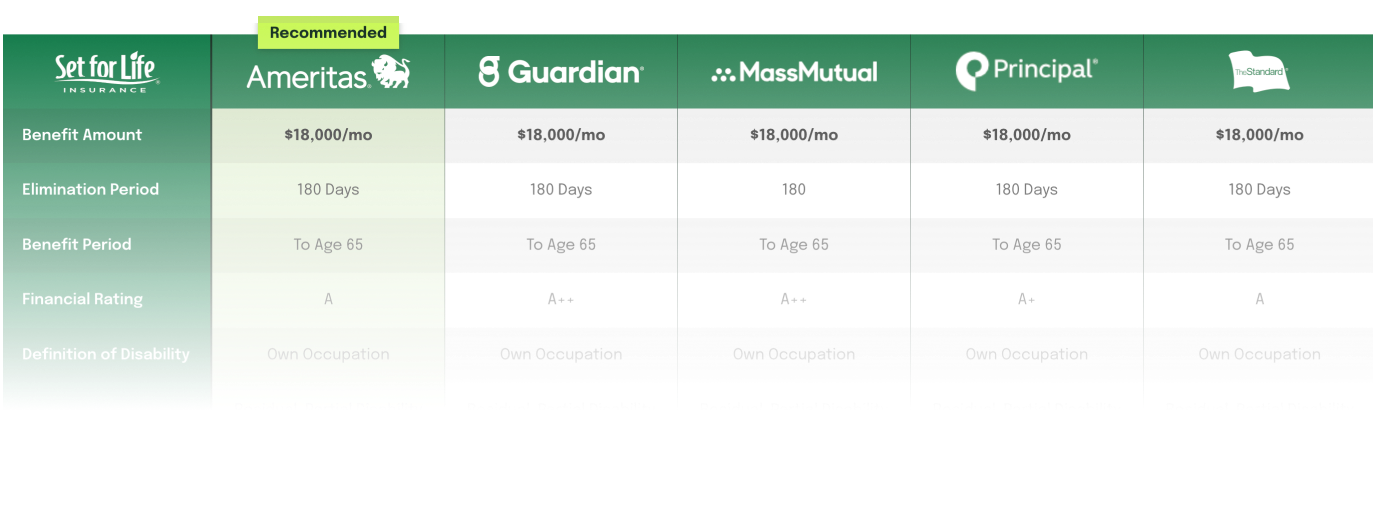
Compare Business Overhead Expense Quotes Side‑by‑Side
"*" indicates required fields
Business Overhead Expense Insurance
What BOE Covers
Business overhead expense insurance reimburses the practice for operating costs that continue when the owner cannot work. The policy pays the practice each month against documented covered expenses. Coverage applies to fixed monthly costs that run an owner-operated practice, including rent, utilities, payroll for non-owner staff, equipment leases and scheduled interest on business debt. It excludes the owner’s personal income or compensation.
The covered-and-excluded distinction follows one principle. BOE pays for costs the owner was normally liable for before disability that continue during the owner’s absence. Costs that depend on the owner’s revenue-generating activity, such as inventory and supplies, or that the owner was not normally liable for, such as income taxes and pay for a family member who was not already on the payroll, fall outside coverage. The premiums, dues and licensing fees a practice pays to stay open are covered, which is the item buyers most often get wrong.
| BOE Covers | BOE Does Not Cover |
|---|---|
| Operating costs that continue during the owner’s absence | Costs the owner was not normally liable for before disability |
| Rent or lease payments for practice space | The owner’s own salary, draw, or other compensation |
| Utilities (heat, water, electricity, telephone) | Salary or compensation for a family member who was not already a paid employee before the disability |
| Payroll and employer-paid benefits for non-owner staff who are not members of the owner’s profession | Income taxes or self-employment taxes |
| Equipment lease payments and equipment financing interest | The cost of inventory, merchandise, products, goods, and services directly attributable to generating revenue |
| Scheduled installment payments of interest on business debt | The cost of supplies, fees, and expenses passed onto clients |
| Depreciation or scheduled installment payments of principal on pre-disability debt | Costs of gifts, charitable donations, meals, and entertainment |
| Legal and accounting fees for routine operations | Premiums waived because of the disability |
| Billing and collection fees | Any expense reimbursed or reimbursable from another source |
| Laundry, janitorial, and maintenance services | Equipment, vehicles, fixtures, or furniture purchased or leased after the disability began |
| Property, liability, malpractice, and other business insurance premiums, unless waived because of the disability | Prepayments or advance payments of a covered expense |
| Professional, trade, and association dues | The share of a shared expense that is another person’s responsibility |
| Licensing fees and continuing education costs required to maintain a professional license | The purchase cost of tools, instruments, or wares used in the profession |
Source: covered and excluded schedules read against all five specimen contracts, Guardian form ICC18 18OE, Principal form ICC25 HH 801 OE, MassMutual BOE-99, The Standard Business Overhead Protector, and Ameritas form 4503NCBOE, plus the Guardian Pub8318 flyer. Coverage scope is substantially similar across the five, with carrier-specific variations on equipment financing principal, the qualifying window for family members already on the payroll, which is 60 days at Guardian and Ameritas and 12 months at MassMutual, and pre-disability versus post-disability obligations. Each policy’s specimen contract is the controlling document.
BOE Across the 5 Major Carriers
Five carriers write BOE coverage for small business owners and practice owners in the United States: Ameritas, which writes BOE on form 4503NCBOE within its DInamic Foundation series; Guardian, through Berkshire Life Insurance Company of America; Principal Financial Group; MassMutual; and The Standard. The comparison below leads with Ameritas because it carries the highest maximum monthly benefit at all three benefit periods.
All five carriers offer the same menu of benefit period options (12, 18, 24 months) and elimination period options (30, 60, 90 days), but each sets its own maximum monthly benefit ceilings, total disability definition, accumulation provision mechanics, and rider availability. Ameritas sets the highest maximum in the group at $100,000 per month for the 12-month benefit period, ahead of Guardian’s $60,000 under form ICC18 18OE, subject to a $1,200,000 aggregate limit counted across all carriers. Principal’s HH 801 OE is the only BOE product written as a standalone policy independent of a base disability contract. MassMutual and The Standard renew to age 67, Guardian and Principal renew to age 65, and Ameritas is non-cancellable to age 65 and then conditionally renewable for life while the owner stays actively at work. The renewability difference matters for older practice owners.
Set for Life Insurance compares all five carriers’ BOE specimen contracts at quoting time and confirms current state availability and form versions per state.
 |
Ameritas DInamic Foundation Form 4503NCBOE |
Guardian Berkshire Life Provider Choice OE |
Principal Income Protector OE |
MassMutual Radius Choice OE |
The Standard Platinum Advantage OE |
|---|---|---|---|---|---|
| Max monthly benefit at 12-month benefit period | $100,000 | $60,000 | $50,000 | $50,000 | $45,000 |
| Policy form ID | 4503NCBOE, and 5503-NCBOE in New York | ICC18 18OE | HH 801 OE | BOE-99 | Platinum Advantage OE |
| Total disability definition | Inability to perform the material and substantial duties of the occupation, with specialty own-occupation language for physicians and dentists | Inability to perform material and substantial duties of the insured’s occupation | Inability to perform substantial and material duties of regular occupation | Inability to perform material duties of own occupation | Inability to perform material duties of regular occupation |
| Benefit period options | 12, 18, 24 months | 12, 18, 24 months | 12, 18, 24 months | 12, 18, 24 months | 12, 18, 24 months |
| Max monthly benefit at 18-month benefit period | $65,000 | $45,000 | $40,000 | $40,000 | $35,000 |
| Max monthly benefit at 24-month benefit period | $50,000 | $35,000 | $30,000 | $30,000 | $25,000 |
| Elimination period options | 30, 60, 90 days | 30, 60, 90 days | 30, 60, 90 days | 30, 60, 90 days | 30, 60, 90 days |
| Accumulation provision | Yes, the shortfall carries forward and is reimbursed in later months | Yes, unused benefit accrues to extend benefit period | Yes | Yes | Yes |
| Renewal structure | Non-cancellable to age 65, then conditionally renewable for life while actively at work | Non-cancellable and guaranteed renewable to age 65 | Non-cancellable and guaranteed renewable to age 65 | Non-cancellable and guaranteed renewable to age 67 | Non-cancellable and guaranteed renewable to age 67 |
| Riders available | FIO, substitute salary expense, business loan repayment, extended residual | FIO, salary continuation, return-of-premium | FIO, salary continuation | FIO, COLA | FIO, COLA |
| State availability | Approved states on 4503NCBOE, New York on 5503-NCBOE, issue ages capped at 60 in Florida | Most states | HH 801 most states; HH 789 substitute | All states with state-specific filings | All states with state-specific filings |
Source: Guardian Pub8318 Business Overhead Expense Protection flyer, Guardian specimen contract form ICC18 18OE, Principal Form HH 801 OE BOE Sample Policy 800-series, MassMutual BOE-99 specimen, Standard Insurance Company product literature, Ameritas DInamic Foundation product guide for form 4503NCBOE. Benefit amounts shown are typical maximum issue limits; actual amounts depend on documented business expense levels and underwriting. Ameritas issue and participation limits apply to occupation classes 6A through 4A and 6M through 3M at issue ages 18 to 60, and count coverage in force with all carriers.
Choosing the Right Benefit Period
BOE policies offer 12-month, 18-month, and 24-month benefit period options. The choice shapes both the maximum monthly benefit the policy can pay and the total amount the policy can pay across the full claim.
The relationship is inverse. The carrier’s total issue limit is spread across the chosen benefit period, so longer periods reduce the maximum monthly benefit. A 12-month benefit period maximizes monthly cash flow during a short, well-defined absence. A 24-month benefit period lowers the monthly maximum but extends coverage through a longer recovery or wind-down. The 18-month period balances both objectives. Because the highest-limit carrier also applies an aggregate cap counted across all carriers, the total a policy can pay lands near the same ceiling at every benefit period.
The right choice depends on the practice’s succession plan, the owner’s expected recovery timeline, and the practice’s monthly fixed-expense load. Practices with a designated successor and a clean transition path often select 12 months. Solo practices with no immediate succession option typically select 18 or 24 months to give the owner time to either recover or arrange a sale.
| Benefit Period | Typical Max Monthly Benefit | Total Maximum Payout | Recommended For |
|---|---|---|---|
| 12 months | Up to ~$100,000 | ~$1,200,000 | Practice owners with a succession plan ready or short-term recovery expectation |
| 18 months | Up to ~$65,000 | ~$1,170,000 | Practice owners needing intermediate recovery time |
| 24 months | Up to ~$50,000 | ~$1,200,000 | Solo practitioners or practices with no immediate successor |










She made updating my files with each life event stress-free. I watched colleagues struggle to communicate with insurance companies, but not me. One email to Jamie and everything is taken care of. My family is protected and done so with ease, all thanks to Jamie. I highly recommend Set For Life!!!
Who Should Consider BOE
BOE coverage applies to any practice or business that carries fixed monthly operating costs the owner is normally responsible for during disability. The four audience segments below describe the exposure rather than the entity type or professional license.
Solo Practitioners and Single-Owner Practices
Solo practitioners in medical, dental, legal, veterinary, mental health, and other licensed professional practices carry the highest BOE exposure because the practice’s revenue depends entirely on the owner’s clinical or professional work. When the owner is sidelined, no co-owner generates revenue. BOE reimburses the rent, utilities, and non-owner staff payroll that continue until the practice transitions or the owner returns.
Solopreneurs and Single-Owner Businesses
Solopreneurs running single-owner businesses outside of licensed professional fields face the same fixed-overhead exposure as solo practitioners. That group includes consultants, agency owners, technology service providers, retail and e-commerce operators with physical locations and other entrepreneurs. Office rent, equipment financing, utilities, and payroll for non-owner staff continue regardless of the owner’s work capacity. BOE reimburses these operating costs during the owner’s disability, even when there is no formal professional practice involved.
Multi-Partner Practices and Owner-Operated Firms
Partnerships and multi-owner firms typically purchase BOE coverage at the practice level, with the policy benefit allocated by ownership share. Each partner’s pro-rata share of fixed operating costs is covered when that partner is disabled, with the surviving partners maintaining the practice during the recovery window.
Practice and Business Owners with Bank Financing
Practice and business owners carrying business loans face overlapping exposures during disability. BOE covers operating costs through the 12 to 24-month window. Business loan protection disability insurance addresses the longer-term debt service obligation. The two policies coordinate without duplicating benefits, and owners with significant debt typically need both.
If you are self-employed without business overhead, see disability insurance for self employed. If you carry a fixed-term business loan, see business loan protection disability insurance.
Business Overhead Expense Insurance FAQ
Buy Business Overhead Expense Insurance
Set for Life Insurance compares BOE coverage for small business owners and owner-operated practices nationwide. BOE coverage works alongside small business disability insurance to address both the owner’s income side and the practice’s operating-cost side of an owner’s disability.