
Disability Insurance for Dentists
Income Protection for Dentists from Top Carriers
Own-Occupation Disability Insurance for Dentists
Apply in minutes. Get same day coverage. Dentists depend on steady hands and precise vision. An unexpected illness or injury can interrupt work and income instantly. That’s why disability insurance for dentists offers critical income protection for dental professionals. Set for Life Insurance, an independent brokerage, structures own-occupation disability insurance through top carriers.

Get Your Customized Dentist Quote
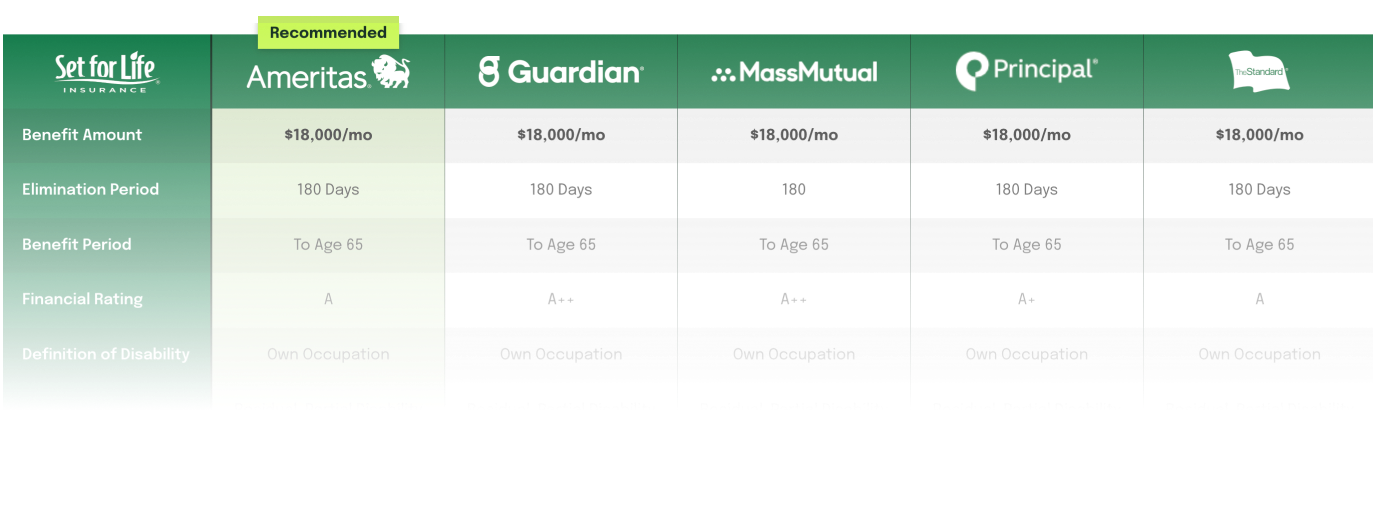
Compare Dentist Disability Coverage Side‑by‑Side
"*" indicates required fields










She made updating my files with each life event stress-free. I watched colleagues struggle to communicate with insurance companies, but not me. One email to Jamie and everything is taken care of. My family is protected and done so with ease, all thanks to Jamie. I highly recommend Set For Life!!!
Dentist Disability Insurance
Own-Occupation Protection for Clinical Dental Procedures
How Own-Occupation Coverage Applies to Clinical Dentistry
Own-occupation disability insurance pays benefits when a dentist can no longer perform the specific clinical duties of dentistry, even if that dentist goes on to earn income in another capacity. A periodontist who develops carpal tunnel syndrome may lose the ability to perform surgical procedures chairside, yet still teach or consult in the same specialty.
Under true own occupation definitions from Guardian, Principal Financial Group, MassMutual, The Standard and Ameritas, offered as a built-in definition at some carriers and as a rider at others, full benefits continue as long as the insured cannot practice chairside dentistry, regardless of whether other income is earned. This is the mechanism that separates individual disability coverage from group plans, which often reduce or deny benefits once any alternate employment begins.
An own occupation rider preserves a dentist’s full income potential rather than forcing a return to any job the insured is medically able to perform. For a specialist whose earning power depends on a narrow set of procedural skills, that distinction determines whether a disability claim pays in full or not at all.
Set for Life Insurance structures this protection around chairside dentistry, the trigger point carriers use to define disability for dental professionals. The carrier-by-carrier own-occupation provisions differ enough between insurers to matter for a buying decision, detailed further below.
Residual Income Protection during Dental Practice Recovery
How Residual Disability Coverage Works for Dentists
Residual disability coverage pays a partial benefit when a dentist’s income drops because illness or injury limits how much of the job the dentist can perform. To trigger a residual claim, a dentist must show a 15 to 20 percent or greater loss of income tied to the sickness or injury, and the policy pays that same proportion of the disability benefit.
A dentist returning part-time after surgery who earns 60 percent of prior income receives a residual benefit covering the remaining 40 percent. This mechanism protects the gap between full income and reduced income during a gradual recovery, rather than requiring total disability before any benefit pays.
Set for Life Insurance structures residual disability riders to give dental professionals income continuity between total disability and full recovery. Disability claims tied to residual riders keep cash flow stable while a practice absorbs reduced patient volume, protecting loan payments, payroll, and other fixed obligations that do not pause during recovery.
Long-term disability insurance policies for dentists typically pay benefits to age 65 or 67, matching income protection to a career’s full working span. Carriers write these insurance policies as non-cancelable and guaranteed-renewable, meaning the policy’s terms and premium cannot be changed and coverage cannot be terminated as long as premiums are paid.
Partial Disability Recovery Benefits after Returning to Practice
A recovery benefit extends protection past the point a dentist resumes work. Several carriers pay a recovery benefit when a dentist has returned to practice, is performing most prior duties, but still shows a measurable loss of income tied to the original disability.
This provision matters most for dentists whose patient base or referral volume takes time to rebuild after a claim period ends. Carrier-by-carrier detail on how each insurer structures the residual trigger, the recovery benefit, and the benefit period appears in the carrier comparison section below.
Qualifying for Dentist Disability Coverage and Discounts
Qualifying as a Self-Employed or Practice-Owner Dentist
Self-employed dentists and practice owners qualify for individual disability insurance using financial documentation such as tax returns and profit-and-loss statements rather than a W-2. Set for Life Insurance structures these applications around whichever income record best demonstrates the practice’s earnings.
Carriers also write business overhead expense coverage alongside the personal disability policy, reimbursing costs such as staff wages, utilities, and rent if the dentist becomes disabled. This keeps the practice operating during recovery instead of forcing a sale or closure.
For a self-employed dentist, this combination of personal income protection and business overhead expense coverage functions as both retirement and business continuity planning. The same qualification pathway extends to practice owners who also carry small business disability insurance for partners, associates, or shared overhead across a multi-dentist practice.
Elimination Periods and Discount Channels
The elimination period is the length of time between the onset of a disability and the date benefits begin, and it directly affects premium cost. A longer elimination period lowers the premium but delays the start of benefits, while a 90-day elimination period is the standard choice.
Set for Life Insurance helps dentists weigh short-term savings against liquidity needs, since the dentist covers expenses out of pocket during the waiting period before benefits start. A 90- or 120-day elimination period often balances affordability against how much emergency cash a practice can hold in reserve.
Group disability plans offered through employers or professional associations, including the American Dental Association, provide a baseline layer of coverage under broader definitions of disability. Dental residents and fellows specifically may access separate discounted individual coverage during training, a path that mirrors disability coverage for residents in training across other medical specialties.
Set for Life Insurance also negotiates multi-life discounts through the American Dental Association and other dental associations, hospitals, and universities, typically ranging from 10 to 15 percent and applying permanently once activated. Carriers also extend these group rates to multi-life arrangements of three or more applicants within the same employer or association.
Disability Income Insurance Provisions for Dentists by Carrier
Set for Life Insurance compares disability income insurance for dentists across six carriers so a dental professional can weigh real differences in provisions rather than relying on a single insurance company’s pitch. Insurance policies from Ameritas, Guardian, Lloyd’s, MassMutual, Principal, and The Standard structure own-occupation triggers, residual mechanics, benefit periods, monthly benefit formulas, and occupation class tiers differently enough to affect what a claim actually pays.
Own-Occupation Provisions by Carrier
 |
Ameritas Life Insurance Corp. 4501NC, Enhanced Residual Rider (AERES) |
Guardian Berkshire Life Insurance Co. of America ICC16 18ID, Provider Choice + Enhanced Partial Rider |
Lloyd’s Petersen International Underwriters PDI111521, Optional Residual Rider |
Mass Mutual Massachusetts Mutual Life Insurance Co. ICC15-XLIS-RC, Extended Partial Disability (EPR) |
Principal Principal Life Insurance Company ICC22-800-IDI, Income Protector |
The Standard Standard Insurance Company B180(7/17), Platinum Advantage + Residual Riders |
|---|---|---|---|---|---|---|
| Dental-Specific Nuances and Notable Provisions | True specialty own occupation confirmed in specimen | Surgical Procedure and Hands-On Patient Care Enhancement confirmed | Specialty own occupation language confirmed in specimen | Participating policy, RetireGuard rider | Specialty own occupation, Annual Increase Rider | Specialty own occupation recognized by ADA |
| Key nuances for dentists | True specialty own occupation for dentists (specimen confirmed) 15% income loss threshold is the lowest tested, ideal for dentists cutting back patient load CPI-U indexing of prior earnings during claim protects against inflation eroding residual benefit Accounting method choice (cash or accrual) accommodates both employed and practice-owner dentists |
Surgical Procedure Enhancement and Hands-on Patient Care Enhancement (confirmed in specimen). If more than 50% of income comes from surgical procedures or hands-on care, total disability is triggered solely by loss of that capacity To Age 70 benefit period available Income includes business profits from privately held entities Prior Income equals best 24 months or best 2-of-3 years |
Lloyd’s specialty own occupation language confirmed in specimen Subjective Pain exclusion applies Residual rider is optional add-on, base policy is total-disability-only Useful as excess or supplemental layer above group DI limits Expiry-date policy, not lifetime renewable in same way as Big 5 carriers |
Participating policy, eligible for dividends (not guaranteed) RetireGuard rider protects retirement contributions during disability, unique to MassMutual Own Occupation Rider available separately from the EPR, both can be elected simultaneously Short-Term Disability Benefits Rider (STR) included within the EPR structure |
Specialty own occupation confirmed, “single professionally recognized specialty in medicine or dentistry” is deemed own occupation True Own Occupation add-on available at additional cost Annual Increase Rider (AIR), automatic 3% benefit increase, no additional cost, to earlier of 20 years or age 50 Pandemic suspension provision, unique feature allowing suspension during declared pandemic |
Specialty own occupation confirmed, “single specialty recognized by ABMS, AOABOS, or ADA” is deemed own occupation Three-tier residual structure, Basic, Enhanced, Short-Term Family Care Benefit pays if working reduced hours to care for a seriously ill family member, no total disability required Survivor Benefit, 3x basic monthly benefit paid to beneficiary if death occurs while benefits are payable Platinum Advantage specimen is for limited states (CT, DE, DC, FL, MT, ND, SD) |
Residual Disability Trigger and Recovery Benefit Mechanics by Carrier
|
Ameritas Life Insurance Corp. 4501NC, Enhanced Residual Rider (AERES) |
Guardian Berkshire Life Insurance Co. of America ICC16 18ID, Provider Choice + Enhanced Partial Rider |
Lloyd’s Petersen International Underwriters PDI111521, Optional Residual Rider |
Mass Mutual Massachusetts Mutual Life Insurance Co. ICC15-XLIS-RC, Extended Partial Disability (EPR) |
Principal Principal Life Insurance Company ICC22-800-IDI, Income Protector |
The Standard Standard Insurance Company B180(7/17), Platinum Advantage + Residual Riders |
|---|---|---|---|---|---|---|
| Independent trigger without prior total disability | Fully independent | Fully independent | Rider-dependent, verify current rider | Fully independent | Fully independent | Fully independent |
| Prior Total Disability Requirement, can residual trigger independently | Fully independent, no prior total disability required (specimen). Ameritas AERES rider states benefits begin the later of the day after the end of the Elimination Period or the day following a period of total disability for which benefits have been paid. Either path is valid. Days of both total and residual disability satisfy the elimination period. | Fully independent, no prior total disability required (specimen). Guardian’s Enhanced Partial Disability Benefit Rider uses its own Elimination or Accumulation Period. The insured must satisfy the Accumulation Period but does not need to first be Totally Disabled. Residual days count toward satisfying the Elimination Period. | Rider-dependent, verify current rider (specimen). Lloyd’s specimen confirms residual is an optional rider. The base policy elimination period can be satisfied by successive periods of Total Disability or Residual Disability, but the rider must be reviewed for independence trigger language. | Fully independent, no prior total disability required (standard). MassMutual’s EPR rider allows residual disability claims to trigger directly after the elimination period without a prior total disability period. Both total and partial disability days satisfy the elimination period. | Fully independent, no prior total disability required (standard). Principal’s residual or partial disability rider triggers after the elimination period regardless of whether any total disability period occurred. The elimination period can be met by residual disability days alone. | Fully independent, no prior total disability required (standard). Standard’s Enhanced Residual Disability Benefit Rider triggers after the Benefit Waiting Period is satisfied, independent of any total disability. Days of Disability during the Benefit Waiting Period need not be consecutive. |
| Recovery benefit, protections after returning to work | Explicit Recovery Benefit provision (specimen). Triggers after a disability benefit period ends if the insured has returned to work, is performing material duties 80% or more of prior time, and still has 15% or more loss of monthly earnings demonstrably caused by the prior disability. Duration continues up to the residual maximum benefit period. | Recovery Benefit, income-loss based, ongoing (specimen). Benefits continue post-recovery as long as Loss of Income persists due to the disability. Guardian uses an income-loss formula, so benefits naturally continue as long as Current Income remains below Prior Income due to the disabling condition. Prior Income protection uses the best 24-month or best-2-of-3-years average. | Recovery benefit per rider, verify current rider (specimen). Lloyd’s base specimen does not contain recovery benefit language. Standard Lloyd’s or PIU residual riders may include recovery provisions, but this must be confirmed against the current executed rider. | Recovery Benefit included in EPR rider (standard). After returning to full-time work following a disability for which EPR benefits were paid, if Monthly Earnings remain below Predisability Earnings due to the disability, a proportional recovery benefit continues. Duration runs up to the remaining Maximum Benefit Period. | Recovery Benefit, proportional, ongoing post-return (standard). Provides recovery benefits when an insured has returned to Full Time Work but Earnings remain below prior levels due to the disability. Benefit calculated using the same proportional formula. | Recovery Benefit included, Enhanced Residual Rider only (specimen). The Basic Residual Rider does not include the Recovery Benefit, the Enhanced version is required. The base policy confirms premiums are waived while Recovery Benefits are payable. The Short-Term Residual Rider does not include a recovery benefit. |
Benefit Period and Duration by Carrier
|
Ameritas Life Insurance Corp. 4501NC, Enhanced Residual Rider (AERES) |
Guardian Berkshire Life Insurance Co. of America ICC16 18ID, Provider Choice + Enhanced Partial Rider |
Lloyd’s Petersen International Underwriters PDI111521, Optional Residual Rider |
Mass Mutual Massachusetts Mutual Life Insurance Co. ICC15-XLIS-RC, Extended Partial Disability (EPR) |
Principal Principal Life Insurance Company ICC22-800-IDI, Income Protector |
The Standard Standard Insurance Company B180(7/17), Platinum Advantage + Residual Riders |
|---|---|---|---|---|---|---|
| Residual benefit period, maximum duration benefits can be paid | Remaining unused portion of the total disability maximum benefit period | Same as total disability, to Age 65, 67, or 70 | Per Schedule of Benefits or rider terms | To Age 65, extended via endorsement | Same as base policy, 2 or 5 years, or to Age 65, 67, 70 | Same as base policy, to Age 67 in this specimen |
| Detail | The Residual Maximum Benefit Period equals the total unused portion of the maximum benefit period for total disability shown on the schedule. Combined total and residual payments cannot exceed this period. Typically to Age 65 or 67 when selected. | Benefit Periods of To Age 70, 67, or 65, or 10, 5, or 2 Years are available. The Enhanced Partial rider benefit period matches the policy benefit period. A To Age 70 option is available, distinctive among carriers. | The residual rider benefit period is set at time of issue and shown on the Schedule of Benefits (Section 1-D). Confirm with current rider. | Specimen shows the coverage end date for Extended Partial Disability corresponding to the policy’s non-cancelable period to age 65. A separate Maximum Benefit Period Endorsement is available with its own premium schedule. | Options include To Age 65, 67, and 70. Residual benefits run within this same period, with To Age 70 available depending on occupation class. | Maximum Benefit Period schedule applies. For example, if disability begins at 62, 60 months apply, and at 63, 48 months apply. The Enhanced Residual Disability Benefit Rider matches the base benefit period. |
Insurance Policy Benefit Formula Calculations by Carrier
|
Ameritas Life Insurance Corp. 4501NC, Enhanced Residual Rider (AERES) |
Guardian Berkshire Life Insurance Co. of America ICC16 18ID, Provider Choice + Enhanced Partial Rider |
Lloyd’s Petersen International Underwriters PDI111521, Optional Residual Rider |
Mass Mutual Massachusetts Mutual Life Insurance Co. ICC15-XLIS-RC, Extended Partial Disability (EPR) |
Principal Principal Life Insurance Company ICC22-800-IDI, Income Protector |
The Standard Standard Insurance Company B180(7/17), Platinum Advantage + Residual Riders |
|---|---|---|---|---|---|---|
| Full benefit floor triggered at loss of income | 75% or greater loss | 100% or greater loss | Rider-dependent, proportional formula typical | 80% or greater loss (20% or less earnings) | 100% or greater loss | 80% or greater loss (20% or less earnings) |
| Residual benefit formula, how the monthly check is calculated | Residual Monthly Benefit equals Loss of Monthly Earnings divided by Prior Monthly Earnings, multiplied by Base Monthly Benefit (specimen). First 6 months minimum is the greater of 50% of base monthly benefit or the formula result. If loss exceeds 75% of prior monthly earnings, treated as 100% loss and full base benefit is paid. Prior earnings average the highest 12-month or 24-month period before disability, indexed annually for CPI-U after year 1. | Partial Disability Benefit equals Loss of Income divided by Prior Income, multiplied by Monthly Benefit (specimen). Prior Income averages either the last 24 calendar months or the two calendar years with highest earnings in the three years before disability, whichever is greater. Current Income counts all income for services during disability, excluding pre-disability earned-but-not-yet-received income. If loss of income is 100% or more of Prior Income, full monthly benefit is paid. | Proportional formula, rider required (specimen). Rider language is not included in this specimen. Lloyd’s or PIU residual riders typically use a proportional income-loss formula, income loss divided by pre-disability income, multiplied by base benefit. Confirm with current rider filing. | EPR Benefit equals Predisability Earnings minus Monthly Earnings, divided by Predisability Earnings, multiplied by Monthly Benefit (standard). Full benefit applies if earnings are less than 20% of predisability earnings. No benefit applies if earnings exceed 80% of predisability earnings. Prior earnings average the 24 months before disability began. | Residual Benefit equals Loss of Earnings divided by Prior Earnings, multiplied by Maximum Monthly Benefit (standard). Prior Earnings average monthly Earnings for the 12 months before disability. Current Earnings count earnings during the disability period, excluding passive or unearned income. Minimum benefit is typically 50% of base benefit for first 6 months. | Residual Benefit equals Predisability Earnings minus Monthly Earnings, divided by Predisability Earnings, multiplied by Basic Monthly Benefit (standard). Full benefit triggers if Monthly Earnings are less than 20% of Predisability Earnings. Basic Residual Rider pays a flat 50% of base benefit when qualifying criteria are met. Enhanced Residual Rider uses the proportional formula above and includes the Recovery Benefit. |
How Insurance Companies Classify Dentist Applicants by Occupation Class
|
Ameritas Life Insurance Corp. Field Underwriting Guide |
Guardian Berkshire Life Insurance Co. of America Provider Choice, IDI Field Underwriting Guide |
Mass Mutual Massachusetts Mutual Life Insurance Co. Radius Choice, Underwriting Guide |
Principal Principal Life Insurance Company Income Protector, Disability Product Guide |
The Standard Standard Insurance Company Platinum Advantage, Product Guide |
|---|---|---|---|---|---|
| Distinct dental class tiers in the underwriting guide | 0, combined with medical classes | 2 (4D, 3D) | 2 (4D, 3D) | 5 (4D+, 3D+, 3D, 2D, 1D) | 1 (3D only) |
| Physicians classified by specialty | Yes, within M classes | Yes, full specialty listing in Section 7-7 | Yes, split among 5P, 4P, 3P | Yes, extensive specialty listing in M classes | Yes, split among 5P, 4P, 4S (surgeons), 3P |
| Dental specialties broken out separately | No, combined into M classes | All specialists at 4D, general dentists at 3D | All specialists at 4D, general dentists at 3D | Specialists at 4D+ or 3D+, general dentists at 3D | All dental occupations consolidated into 3D |
| Working-from-home guidelines | Yes, addressed in occupation guide | Yes, addressed in underwriting rules | Yes, separate guidelines for self-employed vs telecommuter | Yes, addressed in occupation schedule | Yes, 75% home-time threshold triggers underwriting restrictions |
| Entertainment industry handling | Industry category 5.2 with subcategory rules | Special-occupation section | Self-employed 3-year rule, freelancers ineligible | Most entertainment occupations rated “No” | Three eligibility groups (3A, 2A, A) with named occupation lists |
| Government employees (FERS or PERS) | Yes, addressed | Yes, addressed | Yes, 40% offset rule applied to issue or participation limits | Yes, addressed in occupation schedule | Yes, 40% (federal) or 60% (state, local) disability benefit assumption |
| Business owner upgrade path | Yes, Business Owner Upgrade Program | Yes, Move-Up Option criterion N (5+ years ownership) | Yes, five-step income, ownership, employee matrix | Yes, three-tier income matrix (6A, 5A, 3A) | Yes, Business Owner Upgrade and Earned Income Enhancer |
| Label used for uninsurable occupations | “No” | “Class 1” or “Uninsurable” | “N/A” or “IC” (Individual Consideration) | “No” | “NO” |
| Hazardous-exposure handling | Industry-by-industry within the occupation guide | Built into Class 1 definition, heights, chemicals, fumes, extreme temps | Built into Class A definition plus special-occupation list | Built into “No” rules for hazardous occupations | Class B is the floor, anything riskier is rated “NO” |
Source: Field underwriting guides published by each carrier. Edge-case rules are subject to underwriter discretion and may vary by state. Set for Life Insurance confirms applicable rules with each carrier at the time of submission.
Dentistry is one of several occupations where insurance companies apply the same underlying underwriting logic with profession-specific variations. Readers weighing occupation-specific disability coverage for other professions will find the same carrier lineup structuring coverage around a different clinical trigger point.
Choosing a Disability Insurance Provider for Dentists
Disability insurance for dentists preserves the earning power and financial stability of dental professionals across every career stage. Set for Life Insurance was founded by Jamie K. Fleischner, CLU, ChFC, LUTCF, who brings more than three decades of experience serving healthcare professionals nationwide.
Set for Life Insurance tailors own-occupation disability coverage to each dentist’s individual income, specialty, and business structure.