
Disability Insurance for Portfolio Managers
Income Protection for Portfolio Managers
Portfolio Manager Disability Coverage & Income Protection
Coverage Built Around Performance-Fee Income
Set for Life Insurance is an independent disability insurance brokerage, not a life insurance, estate-planning, or cash-value product. Individual disability insurance for portfolio managers replaces income a base-salary-only group plan was never built to see. Performance-fee and incentive-fee pay, the compensation that grows fastest as a fund’s returns and a manager’s own track record compound, moves on a separate track from base salary, while a standard employer plan calculates its benefit from base pay alone. Individual coverage, underwritten to actual earned income rather than a flat plan ceiling, insures the share of compensation the group plan leaves out.

Compare Carriers for Portfolio Managers
Income Protection for Portfolio Managers
"*" indicates required fields
Portfolio Manager Disability Insurance, Compared
What Individual Disability Insurance for Portfolio Managers Covers
Individual disability insurance for portfolio managers, sometimes called income protection, is a personally owned policy that replaces income when a portfolio manager cannot perform their occupation, structured separately from any group long-term disability plan a fund or firm provides. The policy insures the individual, not the employer, so it carries through a fund closure, a move to a new firm, or a shift from a mutual fund to a hedge fund or a registered investment adviser. Coverage for this audience is issued non-cancellable and guaranteed renewable to a stated age, so the carrier cannot cancel the policy or raise the premium once issued.
A portfolio manager who allocates capital and makes buy, sell, and hold decisions for a mutual fund, a pension fund, or a registered investment adviser holds the Chartered Financial Analyst designation awarded by the CFA Institute, a Series 65 license, or Financial Industry Regulatory Authority registration, credentials that document the role’s fiduciary and analytical responsibilities without changing which occupation class a carrier assigns.
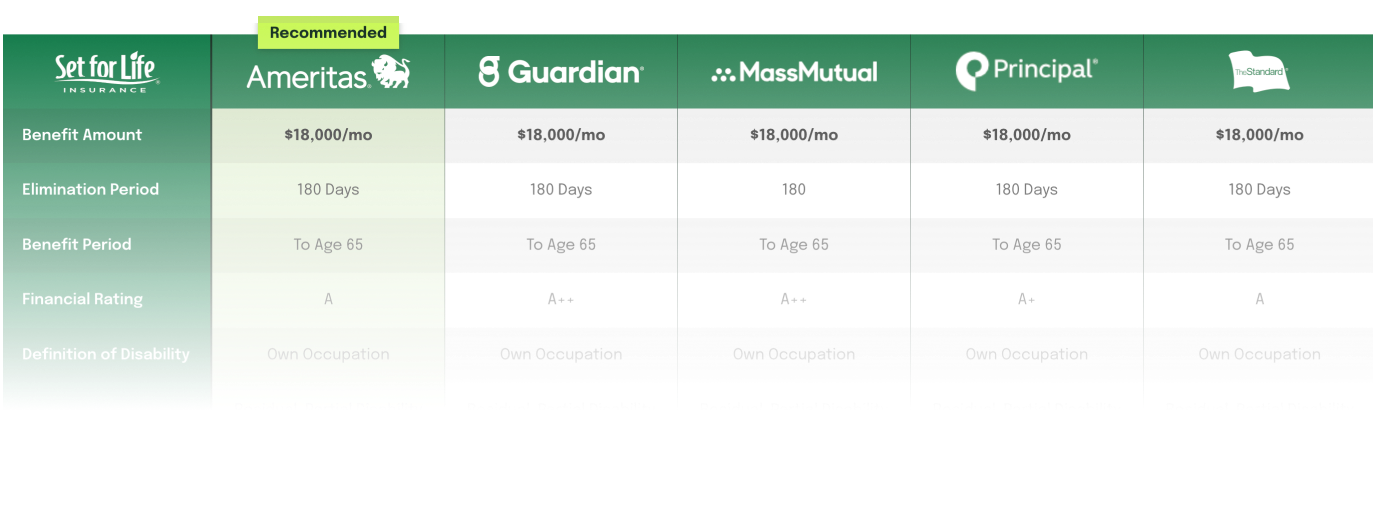
Five carriers underwrite individual disability insurance for portfolio managers. Ameritas (Ameritas Life Insurance Corp., policy form 4501NC), Guardian (Berkshire Life Insurance Company of America, policy form ICC16 18ID Provider Choice), MassMutual (Massachusetts Mutual Life Insurance Company, Radius Choice ICC15-XLIS-RC), Principal (Principal Life Insurance Company, Income Protector ICC22-800-IDI), and The Standard (Standard Insurance Company, Platinum Advantage B180(7/17)). Lloyd’s of London, placed through Petersen International Underwriters, adds supplemental excess coverage above what the five carriers issue individually.
Underwriters classify portfolio managers favorably, and four of the five carriers name the title directly. Ameritas, Guardian, MassMutual, and Principal each list Portfolio Manager on their financial-underwriting eligibility criteria. The Standard does not classify Portfolio Manager as a distinct title, the one point of disclosure difference among the five.
Why Portfolio Managers Face Distinctive Disability Risk
A portfolio manager’s disability risk is financial, not physical. A group long-term disability plan calculated on base salary alone insures the smallest share of a portfolio manager’s income, not the largest. Base salary at most funds and asset-management firms moves slowly and predictably, set within a narrow band by seniority and title. Performance-fee and incentive-fee income, the compensation tied to a fund’s returns and an individual manager’s contribution to those returns, moves on an entirely separate track from base salary, and that separate track becomes a larger share of total pay as a portfolio manager’s track record and assets under management grow.
A standard employer group long-term disability plan defines covered monthly earnings as base salary only, even when a performance fee, an incentive fee, or a year-end bonus tied to fund performance is reported on the identical W-2. It does not follow total compensation upward as a portfolio manager’s book grows or a fund’s returns compound. A portfolio manager’s income can scale with fund performance and the size of assets under management even though no carrier underwrites coverage against assets under management directly, only against the salary and bonus income that scale actually drives.
The mechanism itself is not unique to portfolio management. It runs across disability insurance for financial services executives broadly, wherever incentive-linked pay outgrows a fixed base salary. Base salary rises roughly 3 to 3.5 percent a year across financial services broadly, a slow, predictable climb, while incentive-linked pay moves on a steeper, less predictable curve tied to performance. Portfolio managers share this structure with investment bankers, and disability insurance for investment bankers addresses the identical underlying shortfall, though the bonus there tracks deal flow rather than fund performance. What is distinctive at the portfolio-manager level is how directly performance-fee and incentive-fee income ties to an individual’s own trading and allocation decisions, and how completely a base-salary-only group plan leaves that share uninsured.
How True Own-Occupation Coverage Is Delivered for Portfolio Managers
Own-occupation disability insurance pays a benefit when a portfolio manager cannot perform the material and substantial duties of their specific occupation, even while working in a different one. An any-occupation definition, the test most group long-term disability plans switch to after a fixed period, pays only when the insured cannot work at any job suited to their education and experience. Own-occupation matters most to a portfolio manager whose value lies in judgment and fiduciary decision-making, since a comparison job under an any-occupation test pays far less than managing a fund’s capital ever did.
The five carriers do not deliver true own-occupation the same way, and the difference changes what a portfolio manager actually buys. Two quotes carrying an identical monthly benefit and premium can be structurally different policies depending on which of the five paths delivered the definition, and comparing quotes across all five carriers side by side is the fastest way to see exactly where each one stands before applying.
Own Occupation Definition by Carrier for Portfolio Managers
 |
Ameritas Life Insurance Corp. 4501NC |
Guardian Berkshire Life Insurance Co. of America ICC16 18ID, Provider Choice |
MassMutual Massachusetts Mutual Life Insurance Co. ICC15-XLIS-RC, Radius Choice |
Principal Principal Life Insurance Company ICC22-800-IDI, Income Protector |
The Standard Standard Insurance Company B180(7/17), Platinum Advantage |
|---|---|---|---|---|---|
| How own occupation coverage is delivered | Base contract, choice of true or modified own occupation forms | Base contract, named choice of three definitions | Not in the base definition. A separately priced Own Occupation Rider | Built into the base definition | A separately priced Own Occupation Benefit Rider |
| The clause that changes the definition from true to modified own occupation | Modified form adds “and you are not working in any occupation for wage or profit” (specimen) | Modified form adds “and You are not Gainfully Employed” (specimen) | Own occupation only exists once the rider is elected and itemized on the policy specifications page (specimen) | No such clause. Working in another occupation does not end the benefit (specimen) | Modified form adds “you are not engaged in any other job or occupation for wage or profit” (specimen). The own occupation form drops this clause entirely |
| Total disability definition, verbatim from the specimen | “Totally Disabled means that, solely due to sickness or injury, you are not able to perform the material and substantial duties of your occupation.” | “Totally Disabled means that, solely due to Injury or Sickness, You are not able to perform the material and substantial duties of Your Occupation” (base Own Occupation choice; the modified choice adds the Gainfully Employed clause above) | Not published in the base definition. The rider supplies the own occupation standard once elected | “Totally Disabled even if You are Working in another occupation as long as You are unable to perform the Substantial and Material Duties of Your Own Occupation.” | Rider language supplies the own occupation standard once elected; the base modified-form definition is quoted in the row above |
| Applies to a portfolio manager’s occupation class without a separate election | Yes. Portfolio Managers are named directly, grouped with Fund Managers and Financial Analysts, reaching occupation class 5A at $150,000 a year for two years. The general own occupation definition applies uniformly regardless of which class is reached | Yes. Portfolio Managers are named directly (“Banks – Portfolio Manager,” Class 5 on Guardian’s own numeric scale, not directly comparable to another carrier’s lettered class). All three definition choices are available regardless of occupation class | No. MassMutual names Portfolio Manager directly (5A at $200,000 a year for two years) but the Own Occupation Rider must still be separately elected and priced; reaching a higher occupation class does not remove that requirement | Yes. Principal names Portfolio Manager directly with a three-tier scale (5A at $200,000 a year, 4A at $150,000 a year, 3A base); the built-in own occupation definition applies to all three tiers without election | No. The Standard does not name Portfolio Manager among its classified financial-industry titles at all; regardless of which occupation class a portfolio manager is ultimately assigned under a nearby classification, the Own Occupation Benefit Rider must still be separately elected and priced |
Source: specimen policy contracts held by Set for Life Insurance for Ameritas Life Insurance Corp. (form 4501NC), Berkshire Life Insurance Company of America underwriting for Guardian (form ICC16 18ID, Provider Choice), Massachusetts Mutual Life Insurance Company (form ICC15-XLIS-RC, Radius Choice), Principal Life Insurance Company (form ICC22-800-IDI, Income Protector), and Standard Insurance Company (form B180(7/17), Platinum Advantage). Occupation-class figures come from each carrier’s underwriting guide. Lloyd’s of London is excess coverage, not included here.
Who Should Consider Disability Insurance for Portfolio Managers?
Portfolio management spans a wide income range across a single career, from a junior analyst-turned-manager building a track record to a senior principal whose performance fee dwarfs base salary. The right disability insurance depends on where a portfolio manager sits in that range and how compensation is currently structured.
Junior and Associate Portfolio Managers Building a Track Record
A portfolio manager early in a career, still building the track record that eventually drives performance-fee income, qualifies for a lower occupation class and a smaller issue limit than a senior manager’s, but locking in a policy while young and healthy secures the lowest available premium and preserves the option to raise coverage later through a Future Increase Option rider.
Portfolio Managers With Performance-Fee-Heavy Compensation
A portfolio manager whose performance fee or incentive fee now outweighs base salary is the buyer for whom this page’s own-occupation and underwriting comparisons matter most. A carrier that delivers true own-occupation only through a rider adds a real premium line, and how that same carrier’s underwriting treats fluctuating incentive income directly affects the coverage amount a policy can be issued for.
Senior Portfolio Managers and Fund Principals at Peak Income
A senior portfolio manager or fund principal sits closest to a carrier’s top occupation class and its standard issue-and-participation limit, the exact income tier where base salary contributes the least to total compensation and a group plan’s base-salary-only definition leaves the most income uninsured. High-limit coverage above the standard-issue ceiling, placed through Lloyd’s of London, applies at this income level.
Portfolio Managers Changing Funds or Employers
A portfolio manager moving from one fund to another, from a mutual fund to a hedge fund, or from one asset-management firm to a boutique shop, loses employer group coverage the day employment ends, and a new employer’s group plan starts its own eligibility and pre-existing-condition clock. An individually owned policy stays in force through every one of those moves, since it belongs to the portfolio manager, not the job.
Occupation Class and Underwriting for Portfolio Managers
Occupation class is the underwriting tier a carrier assigns based on a portfolio manager’s actual duties and documented income, not job title alone, and it sets the ceiling on how much monthly benefit a policy can carry. Four of the five carriers name Portfolio Manager directly on their eligibility or classification lists. The Standard is the exception, and does not classify Portfolio Manager as a distinct title anywhere in its occupation classification list.
The income needed to reach each carrier’s top occupation class differs by carrier, and none of the four carriers naming the title publish a minimum-tenure requirement beyond the income threshold. The table below breaks out each carrier’s figures.
Occupation Class for Portfolio Managers by Carrier
|
Ameritas Life Insurance Corp. |
Guardian Berkshire Life Insurance Co. of America |
MassMutual Massachusetts Mutual Life Insurance Co. |
Principal Principal Life Insurance Company |
The Standard Standard Insurance Company |
|---|---|---|---|---|---|
| Top occupation class reachable | 5A | Class 5 (Guardian’s own numeric scale, not a direct equivalent to a lettered class elsewhere on this table) | 5A | 5A | Not published. Portfolio Manager does not appear in the occupation classification list |
| Income required to reach the top class | $150,000 a year for at least two years | No income figure printed next to the title itself. Class 5’s general eligibility requirement, published separately, is at least $60,000 salary including bonus for each of the past two years, at a business with five or more full-time employees | $200,000 a year for the last two years | $200,000 a year for the last two years | Not applicable, the title is not named |
| Lower tier class and its threshold | 4A below $150,000 a year | No published tiered scale under this title | 4A below $200,000 a year | 4A at $150,000 a year for two years; a base occupation class of 3A applies below that | Not applicable, the title is not named |
| How the guide names the title | Named directly as Portfolio Managers, grouped with Fund Managers, Financial Analysts, and Investment Bankers in the same finance classification bucket | Named directly, “Banks – Portfolio Manager,” in the alphabetized occupation list | Named directly, PORTFOLIO MANAGER, in the occupation-title table | Named directly, “Portfolio manager,” in the occupation-title table | Not named anywhere in the occupation classification list. The nearest financial-occupation bucket (Bank, Credit Union, Finance, Savings and Loan, Title and Escrow) does not include Portfolio Manager among the titles it lists |
Source: producer-facing field underwriting and product guides held by Set for Life Insurance for Ameritas Life Insurance Corp., Berkshire Life Insurance Company of America underwriting for Guardian, Massachusetts Mutual Life Insurance Company, Principal Life Insurance Company, and Standard Insurance Company. These figures come from underwriting guidance, not policy contract language, so no policy form ID applies to this table. The Standard does not classify Portfolio Manager as a distinct title in the guide sections reviewed; this reflects the guide as searched, not a claim that no coverage path exists. Class assignment is subject to underwriter review at the time of application.
Elimination Period and Cost of Living Adjustment Options
The elimination period is the length of time a portfolio manager must be disabled before benefit payments begin, and it varies by carrier. Ameritas offers the widest range, from 30 to 730 days, with the available options tied to the benefit period selected. Guardian offers 30 to 720 days, though its longest options carry state and benefit-period restrictions. Principal, The Standard, and MassMutual all offer a choice of 60, 90, 180, or 365 days. The Standard calls this provision a Benefit Waiting Period rather than an elimination period, a naming distinction required by California law but used company-wide in its own materials.
A Cost of Living Adjustment rider increases the monthly benefit each year a claim continues, keeping pace with inflation on a long-term disability. Guardian, Ameritas, Principal, and The Standard each let a buyer choose between a 3 percent and a 6 percent maximum annual increase, tied to the Consumer Price Index. MassMutual’s rider applies a fixed 3 percent compound increase with no higher option. Most carriers require a full year of disability before the adjustments begin.
Mental Health and Burnout Risk for Portfolio Managers
The industry term mental and nervous applies exclusively to psychological diagnoses, depression, anxiety, addiction, and PTSD among them, never to neurological conditions. A stroke, a traumatic brain injury, or another neurological event that ends a portfolio manager’s ability to sustain the judgment a book or fund demands is covered under the same terms as any other physical disability, at full benefit, with no cap. This limitation covers only burnout, depression, and comparable psychological claims, a real risk in a role built on sustained decision-making accountability under market pressure.
Whether the limitation is mandatory or elective, and for how long, varies by carrier. Ameritas bakes a longer limitation into its higher occupation classes than its lower ones. The Standard makes it elective, with a discount, at the classes a portfolio manager is most likely to reach. Principal’s rider is a no-cost election regardless of class; MassMutual’s guide does not address the provision.
Mental and Nervous Disorder Benefit Limitation for Portfolio Managers by Carrier
|
Ameritas Life Insurance Corp. Product Guide |
Guardian Berkshire Life Insurance Co. of America IDI Field Underwriting Guide |
Mass Mutual Massachusetts Mutual Life Insurance Co. Underwriting Guide |
Principal Principal Life Insurance Company Disability Product Guide |
The Standard Standard Insurance Company Product Guide |
|---|---|---|---|---|---|
| Mandatory or elective at the occupation classes a portfolio manager typically reaches (5A, or Class 5 at Guardian) | Mandatory on the non-cancellable policy at classes 6A, 5A and 4A specifically | Mandatory on every package; the duration depends on which package tier is purchased, not on occupation class | Not addressed in the guide on file | Elective at every occupation class, no cost to add | Elective, with a discount, at classes 5A, 4A and 3A. Mandatory only for classes below 3A and for California policies |
| Duration if imposed or elected | 5-year cumulative limitation on the non-cancellable (NC) policy for non-medical classes 6A, 5A and 4A; 2 years for classes 3A and 2A on the same policy. A flat 2 years on the Guaranteed Renewable (GR) product regardless of class. No elective override documented in the guide on file | 12 months on the Essential package; a choice of 12 or 24 months on the Select package; a choice of 12, 24 months, or unlimited on the Premier package. A mandatory 24-month limitation overrides this choice in California and for a named list of medical specialties that does not include financial or analytical occupations | Not addressed in the guide on file; confirm directly with the carrier | 24-month lifetime benefit for mental and nervous or substance abuse claims when the no-cost MNSA rider is elected; without it, benefits are payable through the normal maximum benefit period | 24-month limitation by endorsement when elected at classes 5A, 4A and 3A; without it, benefits are payable through the full maximum benefit period. The same 24-month limitation is required, not elective, for classes 3D, 3P, 2A, 2P, A and B and for all California policies |
| Discount for accepting a limitation | Not applicable. The limitation is built into the base policy’s benefit schedule by occupation class, not elected, and no discount is stated in the guide on file | Discount scales with the duration elected: roughly 6 to 10 percent for a 24-month limitation up to 10 to 15 percent for a 6-month limitation, depending on the benefit period selected | Not addressed in the guide on file | Up to 10 percent. The MNSA rider itself carries no added cost | 10 percent premium rate discount when the 24-month limitation is elected |
Source: field underwriting and product guides published by Ameritas Life Insurance Corp., Berkshire Life Insurance Company of America (Guardian), Principal Life Insurance Company, and Standard Insurance Company. Massachusetts Mutual Life Insurance Company’s underwriting guide on file does not document mental and nervous disorder limitation terms; confirm directly with the carrier. State variations apply to every carrier’s provisions, and Guardian’s mandatory-limitation override list is built around specific medical specialties and California policies rather than financial or analytical occupations.
How Carriers Treat Performance-Fee and Incentive-Fee Income at Underwriting
Performance-fee and incentive-fee income is the vocabulary a portfolio manager uses. Bonus and incentive income is the vocabulary a carrier’s underwriting guide uses, and how a carrier treats that income when setting the coverage amount at application is where the two vocabularies meet.
Three of the five carriers show real, differently structured mechanics. Ameritas smooths a fluctuating pattern with a three-year weighted average once fluctuation occurs. Guardian applies a two-year qualifying test plus employer verification. Principal applies an asymmetric rule, a three-year average when income rises, the lower recent figure when it falls. MassMutual and The Standard did not surface a general rule for this mechanic, disclosed here rather than assumed.
How Underwriting Treats Bonus and Incentive Income When Setting Coverage for Portfolio Managers
|
Ameritas Life Insurance Corp. |
Guardian Berkshire Life Insurance Co. of America |
MassMutual Massachusetts Mutual Life Insurance Co. |
Principal Principal Life Insurance Company |
The Standard Standard Insurance Company |
|---|---|---|---|---|---|
| Whether and how bonus or incentive income qualifies as earned income | Included in general earned income; the underwriter evaluates whether the income pattern is stable and supported by history, with no separate qualifying test stated for bonus or incentive amounts specifically | Counted only if it is a “regular feature” of income, meaning it has been earned for the last two years with an indication it will continue; requires employer verification of two years of bonus history | The guide sections reviewed this pass address a salaried employee’s earned income generally, based on tax-reportable income, but do not publish a distinct bonus- or incentive-income qualifying rule | Salary and bonus both count as earned income for a non-owner employee, documented on Form 1040, line 1, and Form W-2 | The bonus- and incentive-income language located in the guide sections reviewed this pass applies to a separate new-business-owner underwriting program, not to a salaried employee generally |
| How the benefit amount is set when that income fluctuates year to year | A weighted average of the past three years is used once fluctuation has occurred, rather than the current single-year figure | No distinct averaging methodology found in the sections reviewed; Guardian’s stated mechanism is the two-year qualifying test above | Not addressed in the guide sections reviewed this pass | A three-year average is used when income rises significantly or swings from year to year; a decrease instead uses the lower, more recent figure rather than an average | Not addressed for a salaried employee in the guide sections reviewed this pass |
Source: producer-facing field underwriting and product guides held by Set for Life Insurance for Ameritas Life Insurance Corp., Berkshire Life Insurance Company of America underwriting for Guardian, Massachusetts Mutual Life Insurance Company, Principal Life Insurance Company, and Standard Insurance Company. These figures come from underwriting guidance, not policy contract language. MassMutual’s and The Standard’s cells reflect a keyword search, not a claim of no provision.
The qualifying tests and averaging methods above govern the coverage amount at application, a different moment from how a residual disability claim is calculated after a partial disability. A portfolio manager’s performance fee can swing from zero to several multiples of base salary year to year, so which method a carrier applies can change the issued figure.
How Disability Carriers Calculate Residual Benefits for Performance-Fee and Bonus-Heavy Income
Residual disability coverage pays a partial benefit when a portfolio manager loses income to a disability without becoming totally unable to work, a scenario a performance-fee-driven career produces more frequently than an all-or-nothing claim. Because incentive-fee income varies year to year, how each carrier calculates prior earnings before disability matters as much as the benefit formula itself. Each method affects a portfolio manager whose income swings with fund performance differently, and the difference shows up in the size of a residual check.
The table below covers five areas common to every occupation this benefit applies to, the income-loss threshold, the benefit formula, whether residual can trigger without a prior total disability, the benefit period, and recovery-benefit provisions after returning to work. A sixth section on physician- and dentist-specific provisions does not apply to portfolio managers and is not shown here.
How Disability Carriers Calculate Residual Benefits for Portfolio Managers
|
Ameritas Life Insurance Corp. 4501NC · Enhanced Residual Rider (AERES) |
Guardian Berkshire Life Insurance Co. of America ICC16 18ID · Provider Choice + Enhanced Partial Rider |
Lloyd’s Petersen International Underwriters PDI111521 · Optional Residual Rider |
Mass Mutual Massachusetts Mutual Life Insurance Co. ICC15-XLIS-RC · Extended Partial Disability (EPR) |
Principal Principal Life Insurance Company ICC22-800-IDI · Income Protector |
The Standard Standard Insurance Company B180(7/17) · Platinum Advantage + Residual Riders |
|---|---|---|---|---|---|---|
| 1 · Income Loss Threshold That Triggers Residual Benefits | ||||||
| Minimum income loss required % of prior earnings that must be lost before residual benefits begin |
15% loss of monthly earnings (Specimen) One of the lowest thresholds available. Rider text states: loss must be “at least 15% of your prior monthly earnings” due to sickness or injury. |
Loss of Income due to disability (Specimen) Guardian’s Enhanced Partial rider defines “Loss of Income” as the difference between Prior Income and Current Income attributable solely to the Injury or Sickness. No explicit percentage floor in the base rider. Benefit scales proportionally with income loss. Must be Gainfully Employed. |
Optional rider, threshold per rider terms (Specimen) Base Lloyd’s specimen (PDI111521) notes “Residual Disability is an optional benefit that only applies if the rider was purchased.” Rider text not included in this specimen. Typical Lloyd’s/PIU residual riders require income loss and inability to perform all material duties. |
20–80% loss of Predisability Earnings (Standard) EPR benefit is payable when Monthly Earnings fall to 20%–80% of Predisability Earnings. Below 20% earnings remaining triggers full benefit. Above 80% earnings remaining, no EPR benefit is paid. |
Loss of Earnings from own occupation (Specimen) Principal’s Residual Disability Benefit Rider requires a loss of Earnings due to Disability. The specimen confirms “Earnings” excludes unearned income. No explicit minimum percentage floor. Benefit scales pro-rata with the earnings loss ratio. |
20% loss of Predisability Earnings (Enhanced); 15–20% for Short-Term version (Specimen) Specimen lists Basic, Enhanced, and Short-Term Residual riders. Enhanced Residual: benefit payable when Monthly Earnings are 20%–80% of Predisability Earnings. |
| 2 · Monthly Benefit Calculation Formula | ||||||
| Residual benefit formula How the monthly residual check is calculated |
Residual Monthly Benefit = (Loss of Monthly Earnings / Prior Monthly Earnings) x Base Monthly Benefit (Specimen) First 6 months minimum: The greater of (a) 50% of base monthly benefit OR (b) the formula result. 75%+ loss rule: If loss exceeds 75% of prior monthly earnings, treated as 100% loss and full base benefit is paid. Prior earnings: Average of highest 12-month or 24-month period before disability, indexed annually for CPI-U after year 1. |
Partial Disability Benefit = (Loss of Income / Prior Income) x Monthly Benefit (Specimen) Prior Income: Average monthly income for either (a) last 24 calendar months, or (b) the two calendar years with highest earnings in the three years before disability, whichever is greater. Current Income: All income for services during disability, excluding pre-disability earned-but-not-yet-received income. Full benefit floor: If loss of income is 100% or more of Prior Income, full monthly benefit is paid. |
Proportional formula, rider required (Specimen) Rider language not included in this specimen. Lloyd’s/PIU residual riders typically use a proportional income-loss formula: (income loss / pre-disability income) x base benefit. Confirm with current rider filing. |
EPR Benefit = [(Predisability Earnings – Monthly Earnings) / Predisability Earnings] x Monthly Benefit (Standard) Full benefit if earnings are less than 20% of predisability earnings. No benefit if earnings are greater than 80% of predisability earnings. Prior earnings: Average of the 24 months before disability began. |
Residual Benefit = (Loss of Earnings / Prior Earnings) x Maximum Monthly Benefit (Standard) Prior Earnings: Average monthly Earnings for the 12 months before disability. Current Earnings: Earnings during the disability period, excludes passive/unearned income. Minimum benefit: Typically 50% of base benefit for first 6 months. |
Residual Benefit = [(Predisability Earnings – Monthly Earnings) / Predisability Earnings] x Basic Monthly Benefit (Standard) Full benefit trigger: If Monthly Earnings are less than 20% of Predisability Earnings, full Basic Monthly Benefit is paid. Basic Residual Rider: Flat 50% of base benefit when qualifying criteria met. Enhanced Residual Rider: Proportional formula above; includes Recovery Benefit. |
| 3 · Prior Total Disability Requirement and Whether Residual Can Trigger Independently | ||||||
| Independent trigger Does residual require a prior period of total disability, or can it trigger on its own? |
Fully independent, no prior total disability required (Specimen) Ameritas AERES rider states benefits begin the later of: (1) the day after the end of the Elimination Period, OR (2) the day following a period of total disability for which benefits have been paid. Either path is valid. Days of both total and residual disability satisfy the elimination period. |
Fully independent, no prior total disability required (Specimen) Guardian’s Enhanced Partial Disability Benefit Rider uses its own Elimination/Accumulation Period. The insured must satisfy the Accumulation Period but does not need to first be Totally Disabled. Residual days count toward satisfying the Elimination Period. |
Rider-dependent, verify current rider (Specimen) Lloyd’s specimen confirms residual is an optional rider. The base policy elimination period can be satisfied by successive periods of Total Disability or Residual Disability, but rider must be reviewed for independence trigger language. |
Fully independent, no prior total disability required (Standard) MassMutual’s EPR rider allows residual disability claims to trigger directly after the elimination period without a prior total disability period. Both total and partial disability days satisfy the elimination period. |
Fully independent, no prior total disability required (Standard) Principal’s residual/partial disability rider triggers after the elimination period regardless of whether any total disability period occurred. The elimination period can be met by residual disability days alone. |
Fully independent, no prior total disability required (Standard) Standard’s Enhanced Residual Disability Benefit Rider triggers after the Benefit Waiting Period is satisfied, independent of any total disability. Days of Disability during the Benefit Waiting Period need not be consecutive. |
| 4 · Benefit Period for Residual Disability | ||||||
| Residual benefit period Maximum duration for which residual benefits can be paid |
Remaining unused portion of the Total Disability Maximum Benefit Period (Specimen) The Residual Maximum Benefit Period equals the total unused portion of the maximum benefit period for total disability shown on the schedule. Combined total and residual payments cannot exceed this period. Typically to Age 65/67 when selected. |
Same Benefit Period as Total Disability, to Age 65, 67, or 70 (Specimen) Benefit Periods of To Age 70/67/65 or 10/5/2 Years are available. The Enhanced Partial rider benefit period matches the policy benefit period. To Age 70 option available for physicians, distinctive among carriers. |
Per Schedule of Benefits / rider terms (Specimen) The residual rider benefit period is set at time of issue and shown on the Schedule of Benefits (Section 1-D). Confirm with current rider. |
To Age 65 (base); Extended to Age 65 via Maximum Benefit Period Endorsement (Specimen) Specimen shows coverage end date for Extended Partial Disability corresponding to the policy’s non-cancellable period to age 65. A separate Maximum Benefit Period Endorsement is available with its own premium schedule. |
Same as base policy Maximum Benefit Period, 2 years, 5 years, To Age 65/67/70 (Specimen) Options include To Age 65, 67, and 70. Residual benefits run within this same period. To Age 70 available depending on occupation class. |
Same as base policy Maximum Benefit Period, to Age 67 in this specimen (Specimen) Maximum Benefit Period schedule applies (e.g., if disability begins at 62: 60 months; at 63: 48 months). Enhanced Residual Disability Benefit Rider matches base benefit period. |
| 5 · Recovery Benefit Provisions | ||||||
| Recovery benefit Protections after returning to work, continued payments if income remains depressed |
Explicit Recovery Benefit provision (Specimen) Triggers after a disability benefit period ends if the insured has returned to work, is performing material duties 80% or more of prior time, and still has 15% or more loss of monthly earnings demonstrably caused by the prior disability. Duration: Continues up to the residual maximum benefit period. |
Recovery Benefit, income-loss based, ongoing (Specimen) Benefits continue post-recovery as long as Loss of Income persists due to the disability. Because Guardian uses an income-loss formula, benefits naturally continue as long as Current Income remains below Prior Income due to the disabling condition. Prior Income protection: Uses the best 24-month or best-2-of-3-years average. |
Recovery benefit per rider, verify current rider (Specimen) Lloyd’s base specimen does not contain recovery benefit language. Standard Lloyd’s/PIU residual riders may include recovery provisions, but this must be confirmed against the current executed rider. |
Recovery Benefit included in EPR rider (Standard) After returning to full-time work following a disability for which EPR benefits were paid, if Monthly Earnings remain below Predisability Earnings due to the disability, a proportional recovery benefit continues. Duration: up to the remaining Maximum Benefit Period. |
Recovery Benefit, proportional, ongoing post-return (Standard) Provides recovery benefits when an insured has returned to Full Time Work but Earnings remain below prior levels due to the disability. Benefit calculated using the same proportional formula. |
Recovery Benefit included, Enhanced Residual Rider only (Specimen) The Basic Residual Rider does not include the Recovery Benefit. The Enhanced version is required. The base policy confirms premiums are waived while Recovery Benefits are payable. Short-Term Residual Rider: does not include recovery benefit. |
Source: specimen policy contracts and riders held by Set for Life Insurance, Ameritas Life Insurance Corp. (form 4501NC, Enhanced Residual Rider, AERES), Berkshire Life Insurance Company of America underwriting for Guardian (form ICC16 18ID, Provider Choice, Enhanced Partial Disability Benefit Rider), Petersen International Underwriters for Lloyd’s of London (form PDI111521, Optional Residual Rider), Massachusetts Mutual Life Insurance Company (form ICC15-XLIS-RC, Radius Choice, Extended Partial Disability Rider, EPR), Principal Life Insurance Company (form ICC22-800-IDI, Income Protector), and Standard Insurance Company (form B180(7/17), Platinum Advantage, Enhanced Residual Disability Benefit Rider). Terms shown are subject to underwriter review at the time of application.
How Group Long-Term Disability Compares to an Individual Policy for Portfolio Managers
A portfolio manager already covered by a fund’s or firm’s group long-term disability plan still needs individual disability insurance, because the two protect different things for performance-fee-heavy income. Group long-term disability narrows the own-occupation definition over time, caps the benefit at a flat dollar ceiling, and ends the moment employment does, since the Employee Retirement Income Security Act of 1974 (ERISA) makes it the employer’s plan, not the portfolio manager’s. An individual policy stays own-occupation for the full benefit period, sets its benefit by occupation class and income, including performance-fee and incentive-fee pay a group plan excludes, and travels with the portfolio manager through every firm change.
Taxability compounds the shortfall for this audience. Under Internal Revenue Code Section 104(a)(3), a group long-term disability benefit is taxable to the employee whenever the employer paid the premium, the standard arrangement. An individual policy, paid for with after-tax dollars, pays a tax-free benefit instead.
Group Long-Term Disability Versus an Individual Policy
| What the coverage does | Group Long-Term Disability | Individual Disability Insurance |
|---|---|---|
| How long the own-occupation definition lasts | Usually converts to an any-occupation test after 24 months of disability | True own-occupation for the full benefit period, delivered in base contract language at some carriers and through a rider at others |
| What income the plan actually insures | Most plans define covered earnings as base salary and exclude incentive pay, bonuses, commissions, and in some cases stock compensation. A smaller number reach a broader figure closer to total cash compensation | Earned income at the time of application, evaluated against the carrier’s own issue-and-participation limits and income documentation requirements |
| How the maximum monthly benefit is set | A flat dollar ceiling built into the employer’s plan. Group LTD maximums examined for Disability Coverage Stops at Base Salary ranged from $3,000 to $20,000 a month, unrelated to the insured’s occupation class or income growth after enrollment | An issue-and-participation limit tied to occupation class and income. Principal’s Income Protector (form ICC22-800-IDI) carries a $35,000 monthly issue limit for occupation classes 6A+ through 3A at ages 18 to 60 |
| Whether the benefit is taxable | Taxable to the employee under Internal Revenue Code Section 104(a)(3) when the employer pays the premium, the standard group arrangement | Tax-free when the insured pays the premium with after-tax dollars |
| What happens to coverage at a job change | Ends with employment. A new employer’s plan starts its own eligibility and pre-existing-condition clock | Stays in force regardless of employer. The policy belongs to the insured, not the job |
Source: Disability Coverage Stops at Base Salary, the Set for Life Insurance 2026 report (group LTD findings across contracts examined for that report, none from a financial services employer directly, all underwritten by carriers active in this sector); Principal Life Insurance Company’s Disability Product Guide, form ICC22-800-IDI, Income Protector; and Internal Revenue Code Section 104(a)(3). The individual-policy maximum monthly benefit shown is Principal’s own published limit, not a figure common to all five carriers SFL represents. Group plan terms vary by employer and are subject to underwriter review at the time of application.
A Hypothetical Example
Consider a portfolio manager earning $300,000 in base salary and $500,000 in performance-based incentive compensation, $800,000 total. A group long-term disability plan built around base salary alone would insure only the $300,000, and even that is typically capped well below what the plan’s own percentage formula would suggest. The $500,000 in performance-linked pay, the majority of this manager’s income, is not covered at all.
Figures are hypothetical and for illustration only. They are not a quote or a guarantee of coverage.
Disability Insurance for Portfolio Managers FAQ
Sources and Industry References
Disability insurance for portfolio managers draws on carrier specimen contracts, riders, field underwriting guides, federal statute, and Disability Coverage Stops at Base Salary, the Set for Life Insurance 2026 report.
- Ameritas Life Insurance Corp., Guardian underwritten by Berkshire Life Insurance Company of America, MassMutual, Principal Life Insurance Company, and Standard Insurance Company each supply the specimen policy contracts, riders, and field underwriting guides this page cites by form number.
- Lloyd’s of London, placed through Petersen International Underwriters, a licensed managing general agent, underwrites the excess disability coverage referenced above what the five standard-issue carriers write.
- Disability Coverage Stops at Base Salary, the Set for Life Insurance 2026 report, supplies the group long-term disability findings cited for benefit caps, own-occupation duration, and taxability.
- Internal Revenue Code Section 104(a)(3) governs the taxability of a group long-term disability benefit paid on an employer-paid premium, cited above.
- The Employee Retirement Income Security Act of 1974 governs employer-sponsored group long-term disability plans and explains why individual coverage stays in force after a job change.
Disclaimer
The information on this page is for general informational purposes only and does not constitute legal, financial, or tax advice. Coverage availability, underwriting terms, and eligibility requirements vary by occupation, income structure, health history, and state of residence. Policy terms described on this page are drawn from specimen policy language and are subject to change. Actual policy terms govern in all cases.
Excess disability coverage above standard carrier issue limits is underwritten by certain underwriters at Lloyd’s of London and accessed through Petersen International Underwriters, a licensed managing general agent. Compensation figures and occupation-class examples referenced on this page are illustrative only. Set for Life Insurance is a licensed insurance producer.