
Disability Insurance for Self-Employed
Income protection without an employer plan
Disability Insurance Coverage for Sole Proprietors, Single Member LLCs & Independent Contractors
Disability insurance for the self-employed replaces a 1099 earner’s or sole proprietor’s income when injury or sickness prevents work. Self-employed buyers have no employer-paid group disability plan; individual coverage is the only option. Set for Life Insurance writes individual DI. Coverage pairs with small business disability insurance for owners with practice overhead. When a self-employed earner becomes disabled, individual disability insurance is the only path to income replacement.

Get Your Side-by-Side Quote
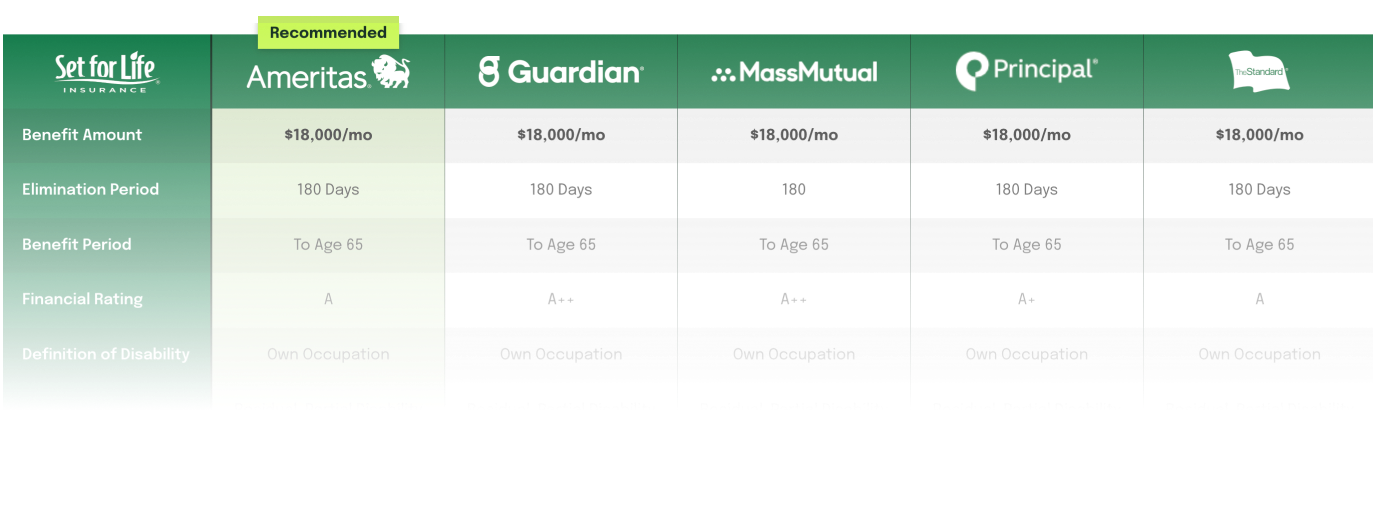
Compare Self-Employed Disability Quotes Side‑by‑Side
"*" indicates required fields
Disability Insurance for the Self-Employed
IRS Tax Treatment of Disability Insurance Premiums by Entity Type
Self-employed buyers face a tax treatment for individual disability insurance that depends on the business entity structure. Sole proprietors, single-member LLC owners, partners, S-corporation shareholder-employees, and C-corporation owners each face different rules for premium deductibility and benefit taxability.
The general principle: when after-tax premiums are paid from personal funds, the disability benefit is tax-free to the owner.; when premiums are paid through the business as a deductible expense, the benefit becomes taxable. Most self-employed buyers prefer the after-tax-premium / tax-free-benefit treatment because it protects more of the income during disability. S-corporation shareholder-employees can preserve the tax-free benefit through a bonus-pay premium structure.
| Entity Type | Premium Deductible? | Benefits Taxable to Owner? | Practical Implication |
|---|---|---|---|
| Sole Proprietor (Schedule C) | No, must be paid with after-tax personal dollars | No, benefits are tax-free to the owner | Business overhead and owner income flow through the same Schedule C; no entity separation |
| Single-Member LLC (default disregarded entity) | No, taxed like sole proprietor unless S-corp election is made | No, benefits tax-free | Same tax treatment as sole proprietor by default |
| Partnership or Multi-Member LLP | No, each partner pays premium from K-1 distributions with after-tax dollars | No, benefits tax-free | Each partner owns individual coverage independent of the partnership |
| S-Corporation Shareholder-Employee | Yes through the corporation if structured as a bonus plus after-tax personal payment | Depends on premium-payment structure | Bonus-pay structure preserves tax-free benefit treatment for the owner |
| C-Corporation Owner | Yes through the corporation as a business expense | Yes, taxable to the owner as ordinary income | Corporate tax bracket considerations apply; owner-paid alternative may produce better net outcome |
Source: IRS Publication 535 (Business Expenses) on premium deductibility, IRS Publication 525 (Taxable and Nontaxable Income) on benefit taxability, IRS Section 162 on ordinary and necessary business expenses. Entity-specific structure decisions and S-corporation premium-payment structuring should be confirmed with a tax advisor. Set for Life Insurance does not provide tax advice; the framework above is general reference for shopping comparison.
Social Security Disability Insurance and the Self-Employed Income Gap
Self-employed workers fund Social Security through self-employment tax, paying both the employee and employer share of FICA under SECA in the amount of 15.3 percent of their net earnings up to the annual wage base.
Those employment taxes build work credits that determine SSDI eligibility, but qualifying for SSDI benefits does not solve the income replacement problem.
The Social Security Administration applies a substantial gainful activity test to determine whether a disabled worker can still perform compensable work. For self-employed claimants, the SSA uses a countable income calculation that deducts business expenses and the value of any unpaid help, which can produce results that differ significantly from gross revenue.
Even when SSDI benefits are approved, the monthly payment replaces only a portion of prior net earnings. A self-employed professional earning $120,000 annually receives a benefit calculated from average lifetime earnings, not recent income, and no payment arrives until after the five-month waiting period.
Individual disability insurance fills this gap. A private policy replaces a defined percentage of documented income, uses an own-occupation definition of total disability, and begins paying after the elimination period the insured selected at application.
How 1099 Self-Employed Workers Qualify for Disability Insurance
Individual disability insurance underwriters calculate the benefit for self-employed applicants from net earnings documented on Schedule C, K-1 distributions, or 1099 income reported on tax returns, rather than a from a W-2.
The maximum monthly benefit available is tied to documented net income, which means a sole proprietor with two years of filed returns can qualify for income protection comparable to what a salaried employee receives through a group disability insurance plan.
A self-employed earner with no employer-paid group plan has two income protection layers: SSDI and individual disability insurance. SSDI replaces a fraction of income after a five-month wait and applies the substantial gainful activity threshold. Individual disability insurance replaces income from the first day after the elimination period and pays through the end of the benefit period the insured selected. For most self-employed earners, individual disability insurance is the primary safety net. SSDI alone is insufficient to replace professional income.
Individual Disability Insurance Across Guardian, Principal, MassMutual, Ameritas and The Standard
Five carriers write individual disability insurance for self-employed buyers in the United States. Guardian (through Berkshire Life Insurance Company of America) writes the Provider Choice product line. Principal Financial Group writes the Income Protector line. MassMutual writes Radius Choice. The Standard writes Platinum Advantage. Ameritas writes DInamic Cornerstone. All five carriers underwrite on documented self-employment income from Schedule C net profit, K-1 distributions, 1099 forms, or shareholder-employee W-2.
The carriers share common product structures: non-cancellable and guaranteed renewable contracts, own-occupation total disability definitions, benefit period options from 2 years to age 70, elimination periods from 30 to 365 days, and Future Increase Option riders that allow benefit increases as documented income grows.
Residual disability and partial disability benefits are available on all five carrier products, paying a proportional benefit when documented income loss falls between 15 and 80 percent of pre-disability earnings. A cost of living adjustment rider increases the monthly benefit annually during a paid claim to offset inflation.
The carriers differ on maximum issue limits, occupation class assignment for self-employed buyers, and rider availability. These policies are portable. Individual disability insurance follows the insured regardless of future business structure changes.
 |
Guardian Berkshire Life Provider Choice |
Principal Income Protector |
MassMutual Radius Choice |
Ameritas DInamic Cornerstone |
The Standard Platinum Advantage |
|---|---|---|---|---|---|
| Total disability definition | True own-occupation (insured’s specific occupation) | True own-occupation | True own-occupation | True own-occupation | True own-occupation |
| Benefit period options | 2-year to age 70 | 2-year to age 67 | 2-year to age 67 | 2-year to age 67 | 2-year to age 67 |
| Elimination period options | 30 to 365 days | 30 to 365 days | 30 to 365 days | 30 to 365 days | 30 to 365 days |
| Renewal structure | Non-cancellable and guaranteed renewable to age 65 | Non-cancellable and guaranteed renewable to age 65 | Non-cancellable and guaranteed renewable to age 67 | Non-cancellable and guaranteed renewable to age 65 | Non-cancellable and guaranteed renewable to age 67 |
| Future Increase Option rider | Yes | Yes | Yes | Yes | Yes |
| COLA rider | Yes | Yes | Yes | Yes | Yes |
| Self-employment underwriting | 2-year Schedule C / K-1 / 1099 average | 2-year average with growth credit | 2-year average | 2-year average; broad self-employed underwriting | 2-year average |
| BOE product available from same carrier | Yes | Yes | Yes | No | Yes |
Source: carrier product literature for Guardian Provider Choice, Principal Income Protector, MassMutual Radius Choice, Ameritas DInamic Cornerstone, The Standard Platinum Advantage. Ameritas form 4501NC is the individual DI contract. Ameritas also writes business overhead expense on form 4503NCBOE, with business loan protection available through the Business Loan Repayment rider on that policy. Benefit amounts shown are typical underwritten ranges; actual issue limits depend on documented self-employment income and occupation class.
Disability Insurance for the Newly Self-Employed Without Business Tax Returns
A professional who leaves a salaried job to open a practice or firm usually cannot show the two years of business tax returns underwriters normally use to set a benefit. Four of the carriers Set for Life Insurance represents will instead underwrite a newly self-employed applicant on the salary earned as an employee in the same profession, documented on a recent W-2 or, with some carriers, a 1099. These programs let a new owner secure individual coverage during the first year on their own, when income is least documented and a disability would be hardest to absorb.
| Carrier | Program | Income used to qualify | Share of prior earnings | Core eligibility |
|---|---|---|---|---|
| The Standard | Newly Self-Employed Business Owners | Prior W-2 in the same profession | 75% | Business established within 12 months; three years in the same capacity earning at least $50,000; occupation classes 5A, 5P, 4A, 4P, 4S, 3P, 3D |
| Principal | New-owner income provision | Prior W-2 in the same job field | 75% | Entering ownership in the same field; first year considered case by case, then on the year’s verified income |
| Guardian | Start-Up Savvy | Prior W-2 or 1099 in the same occupation | 70% physicians and most occupations, 50% dentists | Ages 30 to 50; at least three years of industry experience; real estate and financial services excluded |
| MassMutual | New self-employed contractor provision | Most recent W-2 or pay stub in the same occupation | 80% physicians and dentists, 75% all others | Self-employed within the past 12 months in a similar occupation; working at least 30 hours a week |
Ameritas, also represented on this page, offers no named new-owner program and instead assesses a recent occupation changer’s prior earnings individually, without crediting projected income. These are current underwriting guidelines rather than policy guarantees, and an underwriter can request additional financial information in any case.
The benefit is set as a share of the applicant’s prior earnings, so a physician who earned $200,000 as an employee and qualifies at 70 percent could be considered for coverage reflecting $140,000 of income, within each carrier’s issue limits. The Standard caps the newly self-employed benefit at $10,000 a month for its top occupation classes, and Guardian at $10,000 for physicians and most occupations and $5,000 for dentists.
Program details come from the field underwriting and product guides each carrier publishes for producers, held on file by Set for Life Insurance. Terms are subject to underwriter review at the time of application and can change.










She made updating my files with each life event stress-free. I watched colleagues struggle to communicate with insurance companies, but not me. One email to Jamie and everything is taken care of. My family is protected and done so with ease, all thanks to Jamie. I highly recommend Set For Life!!!
Who Should Consider Self-Employed DI
Self-employed disability insurance applies to any earner whose income depends on the earner’s ability to work and who has no employer-paid group disability plan. The four audience segments below describe the income-replacement exposure, not the entity identity.
Earners with No Employer-Paid Group LTD
The base case for self-employed disability insurance is the absence of an employer-paid long-term disability plan. W-2 employees at large firms typically receive employer-paid basic LTD; self-employed buyers do not. Individual disability insurance fills the income-replacement gap that would otherwise exist when injury or sickness prevents work.
Income Documented Through Schedule C, K-1, or 1099 Forms
Self-employed buyers document income through Schedule C net profit, K-1 distributions from partnerships, or 1099 forms from contracted work, rather than through W-2 employer payroll. Individual disability insurance underwriting evaluates the 2-year history of this self-employment income to determine the maximum monthly benefit.
Practice or Business Owners Without Practice Overhead
Self-employed buyers without significant practice overhead need only the personal income side of disability coverage. That group includes consultants working from home, freelancers without office space and contract professionals without staff. The income-replacement need is the same as for traditional practice owners, but the business overhead exposure that BOE covers is minimal or absent.
Owners Considering S-Corp Tax Planning
Owners who have elected S-corporation treatment for their LLC face premium-payment structuring decisions that affect benefit taxability. The bonus-pay structure preserves tax-free benefits while letting the corporation deduct the bonus expense. Owners considering or in S-corp election should structure the premium payment with a tax advisor before issue to lock in the preferred tax outcome.
If you carry significant practice overhead, see business overhead expense insurance. If you carry a fixed-term business loan, see business loan protection disability insurance.
Self-Employed Disability Insurance FAQ
Buy Disability Insurance for the Self-Employed
Set for Life Insurance places individual disability income insurance for self-employed professionals, sole proprietors, single-member LLC owners, and 1099 earners.
A self-employed buyer’s disability policy should reflect the specific income structure, entity type, and financial obligations of the insured. Disability insurance cost varies based on the benefit amount selected, the length of the day elimination period chosen, the benefit period, and the occupation class the carrier assigns.
A true own occupation definition pays full benefits when the insured cannot perform the insured’s specific occupation, even if the insured earns income in another field. Optional riders including the Future Increase Option and a cost of living adjustment can be added at issue to address income growth and inflation over the life of a long-term policy.
Longer elimination periods produce lower premiums by excluding shorter disabilities the buyer can self-fund. Shorter elimination periods produce higher premiums but reduce the cash reserve the buyer must carry before disability coverage begins.
Benefit payments continue through the end of the selected benefit period as long as the insured remains disabled and unable to perform the material and substantial duties of the insured’s occupation. Set for Life Insurance compares all five carriers side by side at quoting time.