
Compare the Best Disability Insurance Companies
Independent disability insurance brokers helping physicians, dentists, CRNAs, and high-income professionals evaluate policy options.
Disability Insurance Comparison
Compare True Own-Occupation Disability Insurance Coverage
Set for Life Insurance provides independent guidance and a Side‑by‑Side Quote comparison tool that lets you evaluate disability insurance policies from leading carriers including Guardian, MassMutual, Principal, Ameritas, and The Standard. This comparison allows you to review key policy features such as benefit amounts, elimination periods, benefit periods, and disability definitions in one place. Our specialists help you interpret those differences so you can choose a disability insurance policy aligned with your income, occupation, and long-term protection needs.

Get Your Customized Disability Insurance Quote
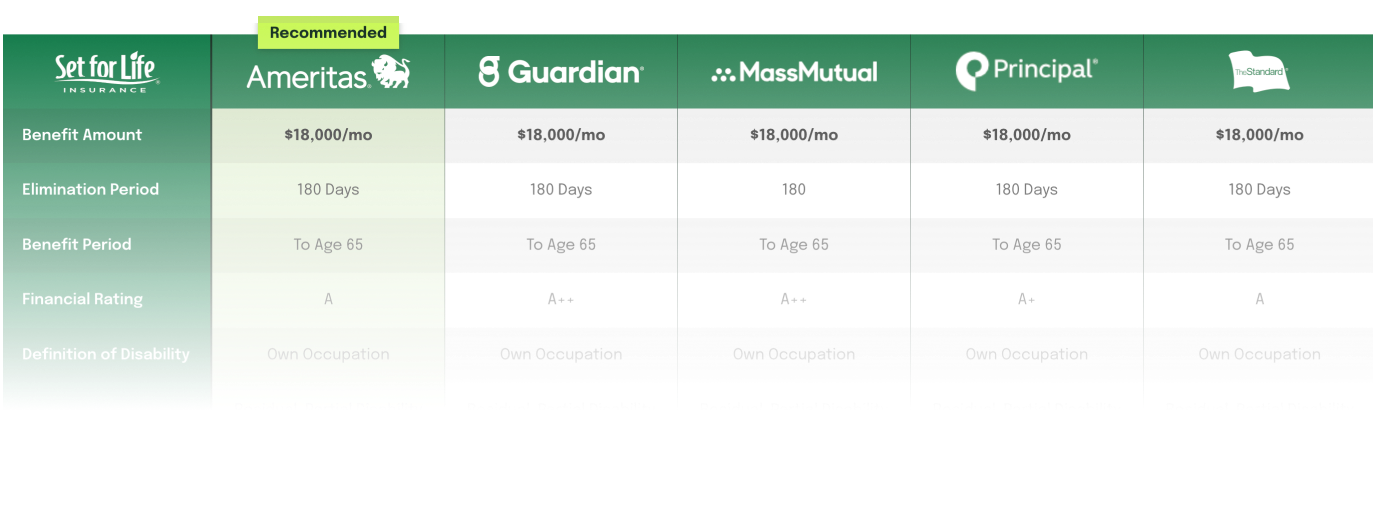
Compare Disability Insurance Quotes Side‑by‑Side
"*" indicates required fields










She made updating my files with each life event stress-free. I watched colleagues struggle to communicate with insurance companies, but not me. One email to Jamie and everything is taken care of. My family is protected and done so with ease, all thanks to Jamie. I highly recommend Set For Life!!!
Disability Insurance Brokers
Disability Income Insurance Coverage and How Benefits Are Defined
Disability Benefits and How Coverage Terms Are Defined
Disability insurance is income protection that replaces a portion of your earnings when a covered disability prevents you from working. Disability insurance benefits are defined by the terms of your individual disability insurance policy, including disability definitions, benefit amounts, and eligibility requirements. This form of disability income insurance helps maintain financial stability during periods of reduced or lost income.
A disability insurance policy pays monthly disability insurance benefits after you meet the elimination period and satisfy the insurer’s definition of disability. Benefits continue through the benefit period while eligibility is maintained. The disability insurance claim process may include medical review, occupational evaluation, and periodic verification of ongoing disability.
Disability Coverage Protections Against Income Loss
Disability insurance replaces a portion of your income when an injury or illness prevents you from working. The right policy helps you maintain financial stability by covering monthly living expenses, medical costs, long-term financial obligations, and savings and retirement contributions.
With options that include long-term disability coverage, partial and residual disability benefits, customizable elimination periods, and multiple benefit periods, you can create a policy that fits your financial needs. Disability coverage applies to illnesses, injuries, or medical conditions that restrict your ability to perform occupational duties.
Eligibility is determined through underwriting, disability definitions, and exclusions outlined in your long-term disability insurance plan. Some policies also include provisions for recurrent disabilities or related conditions.
Elimination Periods, Waiting Periods, and How They Shape Premiums
The elimination period is the waiting period before disability insurance benefits begin. Common elimination periods include 30, 60, 90, 180, or 365 days.
Your elimination period affects disability insurance premiums and should be selected based on available savings or employer short term disability insurance.
Own-Occupation Disability Insurance and What It Pays For
Own-occupation disability insurance pays benefits when you cannot perform the substantial and material duties of your occupation, even if you can work in another capacity. This definition offers enhanced disability income protection for individuals whose earnings rely on specialized skills.
Disability Insurance Policy Types and Benefit Structure
Benefit Periods, Premiums, and Partial Disability Provisions
Benefit periods for long-term disability insurance may span two years, five years, ten years, or extend to retirement age. Longer benefit periods provide stronger income replacement and long-term financial protection. Selecting the appropriate duration depends on your financial needs and risk tolerance.
Disability insurance premiums are based on age, health history, occupation class, benefit amount, benefit period, and elimination period. Insurers also consider riders, coverage structure, and underwriting outcomes. Policies with enhanced disability definitions or stronger income protection features generally have higher premiums.
Many individual disability insurance policies include residual or partial disability benefits. These provisions provide income replacement when reduced work capacity causes lower earnings. Residual benefits help support financial stability as you transition back to full-time responsibilities.
Benefit amounts represent the monthly income replacement available during a qualifying disability. Insurers determine allowable benefit amounts based on income, occupation class, and underwriting results. Higher benefit amounts increase the strength of your disability insurance coverage and support essential financial obligations.
Supplementing Employer Disability Insurance with an Individual Policy
An individual disability insurance policy can increase income replacement percentages, improve disability definitions, and provide portable disability insurance coverage that remains in force if you change employers. Supplemental disability insurance strengthens long-term protection beyond group plan limitations.
Disability insurance benefits may also coordinate with employer disability benefits, workers’ compensation, or Social Security Disability Insurance. Individual disability income insurance is typically structured to supplement these programs for consistent long-term income replacement.
Short-Term and Long-Term Disability Insurance Plans Compared
Short term disability insurance provides income replacement for limited durations, while long-term disability insurance offers extended disability insurance benefits with stronger protection features. Individual disability insurance plans often provide more flexibility in benefit structure and disability definitions.
Underwriting Standards That Determine Eligibility
Underwriting evaluates occupation class, income documentation, medical history, and lifestyle factors to determine eligibility for disability insurance coverage. Underwriting results may influence premium levels, exclusions, or modifications within an individual disability insurance policy.
Riders That Expand Disability Insurance Coverage
Common riders include cost-of-living adjustments, residual disability riders, catastrophic disability benefits, and future increase options. These riders strengthen disability insurance coverage by expanding benefit potential, protecting purchasing power, and allowing increases to your disability insurance policy as income rises.
Guaranteed Renewable and Non-Cancelable Policy Features
Many individual disability insurance policies are guaranteed renewable, ensuring insurers continue offering disability insurance coverage as long as premiums are paid. Some policies are non-cancelable, guaranteeing premiums and disability benefits will not change. These features enhance long-term security in your disability income insurance plan.
Individual Disability Policy Compared with Group Coverage
Anyone who depends on their income is a candidate for disability insurance, but particularly working professionals. If your ability to work is essential to maintaining your lifestyle and meeting financial obligations, disability insurance plays a critical role in protecting your future.
Group and Individual Disability Insurance Policies
There are two main types of coverage, group disability insurance and individual disability insurance. Each serves a different purpose and offers different levels of protection.
Group disability policies are often offered by employers or large practices. These policies typically replace about 60 percent of income, often capped at $10,000 to $15,000 per month. Because group policies must cover everyone in the group, they tend to offer more limited benefits and fewer customization options.
Many professionals choose to supplement group coverage with an individual policy. An individual policy can help close coverage gaps, provide higher benefit amounts, and offer stronger definitions and protections tailored to your profession.
Disability Insurance Providers for Physicians, Attorneys, and Other Professionals
Set for Life Insurance focuses on helping working professionals protect their future income. We provide customized disability insurance solutions for individuals with complex income structures and career-specific risks.
Disability Insurance Assistance Across Professions
We provide specialized income protection across professions, including disability insurance for physicians, disability insurance for medical residents, CRNA disability insurance, disability insurance for dentists, veterinarian disability insurance, disability insurance for attorneys, small business disability insurance, disability insurance for professional athletes, and executive disability insurance for bankers, computer scientists, and other key executives.
Disability Insurance Plans for Medical and Dental Professionals
We have extensive experience designing specialty-specific disability insurance plans for the medical and dental community, accounting for the earning trajectories, licensing requirements, and occupational risks unique to clinical practice.
Medical professionals often have high earning potential, significant student loan obligations, and specialty-specific risks. A disabling condition can interrupt income while financial obligations continue. Properly structured disability insurance helps protect long-term earning power.