
Own Occupation Disability Insurance for Attorneys
Attorney Disability Insurance
Attorney Disability Coverage & Income Protection
True Own-Occupation Coverage
Attorneys shopping for their own income protection, not a lawyer to fight a denied claim, are this page’s intended reader. Attorneys and lawyers invest years building high-income legal careers, and a sudden illness or injury halts billable hours and ends earned income overnight. Many law firms offer group long-term disability insurance, but group coverage caps monthly benefits and rarely reflects the income of high-earning attorneys or law firm partners. Most group plans are not portable and skip true own-occupation protection. Individual disability insurance for attorneys pays a non-cancellable, portable monthly benefit that attorneys fund directly, protecting earning capacity with stronger income protection than employer-sponsored coverage provides.

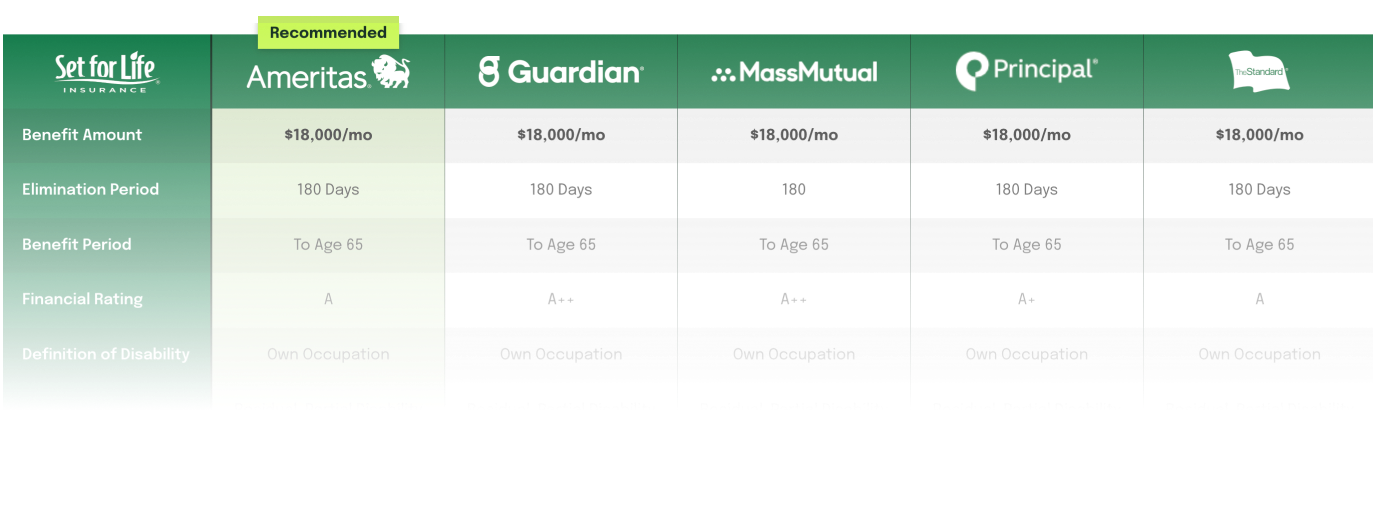
Compare Lawyer Disability Insurance Side by Side
Get Your Customized Attorney Quote
"*" indicates required fields










She made updating my files with each life event stress-free. I watched colleagues struggle to communicate with insurance companies, but not me. One email to Jamie and everything is taken care of. My family is protected and done so with ease, all thanks to Jamie. I highly recommend Set For Life!!!
Disability Insurance for Legal Professionals
What Attorney Disability Insurance Covers
Attorneys shopping for their own income protection are the intended reader of this page. Attorney disability insurance replaces a portion of a lawyer’s income when illness or injury prevents the attorney from performing the material and substantial duties of practicing law. The coverage described here is a policy an attorney buys before a claim exists, not a referral for a lawyer to fight a denied claim.
Individual disability insurance for attorneys pays a monthly benefit set at underwriting, funded by premiums the attorney pays directly. Ameritas (Ameritas Life Insurance Corp., policy form 4501NC), Guardian (Berkshire Life Insurance Company of America, the disability underwriting arm of The Guardian Life Insurance Company of America, policy form ICC16 18ID Provider Choice), MassMutual (Massachusetts Mutual Life Insurance Company, policy form ICC15-XLIS-RC Radius Choice), Principal (Principal Life Insurance Company, a Principal Financial Group company, policy form ICC22-800-IDI Income Protector), and The Standard (Standard Insurance Company, a StanCorp Financial Group company, policy form B180(7/17) Platinum Advantage) each underwrite this coverage for attorneys, structuring the total disability definition, the residual disability formula, and the benefit period differently enough to change what a claim pays.
Own-occupation disability insurance for attorneys is the feature that separates an attorney-specific policy from a generic income-protection product. The definition ties benefits to the material and substantial duties of the attorney’s legal specialty rather than to any occupation the attorney is physically able to perform, so a litigator unable to appear in court due to a voice or mobility impairment keeps receiving benefits while teaching or consulting. Residual disability riders extend that protection to partial income loss, paying a proportional benefit when an attorney returns to reduced hours at reduced pay instead of requiring a full stop of work before any check arrives.
Riders extend the base contract to match an attorney’s career stage and debt load. A future purchase option lets an associate raise the benefit as compensation rises without new medical underwriting, a cost of living adjustment increases the benefit annually during a long claim, and a student loan repayment rider directs a monthly payment toward law school debt while a claim is open. Each rider changes the premium and is elected at issue, not added automatically.
A group long-term disability plan through a law firm, a bar association plan, and an individually underwritten policy are three distinct products with different definitions, different portability, and different tax treatment, compared in full further down this page.
Why Attorneys Face Distinctive Disability Risk
Attorneys carry a disability risk profile shaped by cognitive and stress-linked conditions rather than the physical injuries that dominate manual occupations. Mental health conditions, including anxiety, depression, and substance-use disorders, are among the leading causes of long-term disability claims across knowledge-work professions, and litigation-heavy practice areas add sustained deadline pressure, adversarial proceedings, and irregular hours on top of the baseline stress load carried by any high-billable-hour career.
Social Security Disability Insurance (SSDI) program data shows that a substantial share of workers experience a disabling condition well before retirement age, and an attorney’s earning capacity is disproportionately exposed to that risk because legal income depends on the ability to bill hours, appear before a court or a client, and meet filing deadlines under a state bar’s professional-responsibility rules. A disability that leaves physical capacity intact can still end an attorney’s ability to practice, since cognitive stamina, sustained attention, and verbal precision are as essential to legal work as physical mobility is to a manual trade.
Law school debt compounds the exposure. The American Bar Association and multiple law school surveys document six-figure average debt loads for private-school graduates, and that debt continues on its original repayment schedule regardless of whether the borrower can still earn a legal income. An associate or solo practitioner carrying $150,000 or more in student debt against a single income source has less capacity to absorb an income interruption than an attorney further along in a paid-down career, which is why early-career purchase limits exist and why a student loan repayment rider addresses a real, carrier-recognized exposure rather than a hypothetical one.
Group long-term disability coverage through a firm rarely covers this exposure in full. Most employer plans cap the monthly benefit well below what a senior associate or partner earns, tax the benefit because the firm pays the premium, and end the moment the attorney leaves the firm, retires, or is asked to leave the practice of law altogether.
Individual Disability Insurance for Attorneys
Monthly Benefit Amounts for Attorney Income Replacement
Attorneys insure 60% to 70% of gross earned income through individual disability insurance. Employer group long-term disability plans replace only a fraction of total income, leaving high-earning attorneys exposed to an income shortfall during a disability.
Set for Life Insurance evaluates each attorney’s income, bonus structure, and existing group LTD benefits to calculate the eligible monthly benefit. Coordinating policies across multiple carriers helps attorneys balance premiums, benefit duration, and elimination periods for long-term protection.
The application process for attorney disability coverage begins with a consultation that reviews income, existing benefits, and coverage objectives before Set for Life Insurance compares carriers side by side.
Law firm partners and general counsel whose income already exceeds group LTD caps need high-income disability coverage for executives instead of, or alongside, an attorney-specific policy.
Own Occupation Coverage for Legal Specialties
Own occupation coverage pays benefits when an attorney cannot perform the material and substantial duties of a legal specialty, even if the attorney works in a different capacity. A litigator unable to appear in court due to a voice or mobility impairment keeps receiving full benefits while consulting or teaching law, a result an any-occupation or total-disability definition would not produce.
The five carriers deliver this protection through different contract mechanisms, not one shared feature. Principal writes true own occupation into the base contract. Guardian offers a named choice of three definitions in the base contract. Ameritas applies its own occupation language to every occupation class, reserving a physician and dentist-only specialty enhancement for those two professions. MassMutual and The Standard deliver own occupation through a separately priced rider rather than base language, so the definition and the premium both change depending on whether the rider is elected.
Own Occupation Definition by Carrier for Attorneys
 |
Ameritas Life Insurance Corp. 4501NC |
Guardian Berkshire Life Insurance Co. of America ICC16 18ID, Provider Choice |
MassMutual Massachusetts Mutual Life Insurance Co. ICC15-XLIS-RC, Radius Choice |
Principal Principal Life Insurance Company ICC22-800-IDI, Income Protector |
The Standard Standard Insurance Company B180(7/17), Platinum Advantage |
|---|---|---|---|---|---|
| How own occupation coverage is delivered | Base contract, choice of true or modified own occupation forms | Base contract, named choice of three definitions | Not in the base definition, separately priced Own Occupation Rider | Built into the base definition | Separately priced Own Occupation Benefit Rider |
| The clause that changes the definition from true to modified own occupation | Modified form adds “and you are not working in any occupation for wage or profit” (specimen) | Modified form adds “and You are not Gainfully Employed” (specimen) | Own occupation only exists once the rider is elected and itemized on the policy specifications page (specimen) | No such clause. Working in another occupation does not end the benefit (specimen) | Modified form adds “you are not engaged in any other job or occupation for wage or profit” (specimen). The own occupation form drops this clause entirely |
| Total disability definition, verbatim from the specimen | “Totally Disabled means that, solely due to sickness or injury, you are not able to perform the material and substantial duties of your occupation.” | “Totally Disabled means that, solely due to Injury or Sickness, You are not able to perform the material and substantial duties of Your Occupation” (base Own Occupation choice; the modified choice adds the Gainfully Employed clause above) | Not published in the base definition. The rider supplies the own occupation standard once elected | “Totally Disabled even if You are Working in another occupation as long as You are unable to perform the Substantial and Material Duties of Your Own Occupation.” | Rider language supplies the own occupation standard once elected; the base modified-form definition is quoted in the row above |
| Applies to an attorney’s occupation class without a separate election | Yes. The general own occupation definition applies to all occupational classes. Only the Specialty Own Occupation enhancement, which narrows “occupation” to a medical or dental sub-specialty, is reserved for physicians and dentists | Yes. All three definition choices are available regardless of occupation class | No. The Own Occupation Rider must be selected and priced at issue; it is not automatic for any occupation class | Yes. The base definition applies to all occupation classes | No. The Own Occupation Benefit Rider must be selected and priced at issue; it is not automatic for any occupation class |
Source: specimen policy contracts held by Set for Life Insurance for Ameritas Life Insurance Corp. (form 4501NC), Berkshire Life Insurance Company of America underwriting for Guardian (form ICC16 18ID, Provider Choice), Massachusetts Mutual Life Insurance Company (form ICC15-XLIS-RC, Radius Choice), Principal Life Insurance Company (form ICC22-800-IDI, Income Protector), and Standard Insurance Company (form B180(7/17), Platinum Advantage). Quoted language is verbatim contract text. Lloyd’s of London coverage, placed through Petersen International Underwriters, is excess and specialty coverage and is not included in this comparison. Terms shown are from specimen policy language and are subject to underwriter review at the time of application.
Two policies with identical benefit amounts and similar premiums can be structurally different contracts once the own occupation delivery mechanism is accounted for, which is why the definition an attorney is buying deserves the same scrutiny as the benefit amount. For a claims-side perspective on how own occupation protects a working attorney, read the Income Protection Journal Podcast conversation on own occupation coverage for practicing attorneys.
Purchasing Disability Insurance for Solo Attorneys Early in a Legal Career
Third- and fourth-year law students can purchase up to $2,000 per month in benefit without proof of income. Attorneys in their first year out of law school can purchase up to $4,000 per month regardless of income and without proof of employment.
No labs, meaning blood and urine testing, are necessary when purchasing less than $10,000 per month in benefit. Purchasing a policy at this stage locks in a rate at the applicant’s current age and health, which is the least expensive point in a legal career.
Disability insurance for solo attorneys and first-year associates follows the same purchase-limit structure, since underwriting treats early-career income as provisional until tax returns confirm it. A policy bought during law school or the first year of practice can be increased later without answering new medical questions.
Disability Insurance for Law Firm Partners and Solo Practitioners
Residual Disability Rider and Other Attorney Policy Riders
Riders enhance flexibility and tailor protection to an attorney’s professional needs. Four riders recur most frequently in attorney disability coverage.
- Residual disability rider. Pays a partial benefit when income drops due to partial disability, letting a recovering attorney keep some income replacement while working reduced hours.
- Future purchase option rider. Allows benefit increases as income grows without new medical exams, useful as a law firm associate’s compensation rises toward partnership.
- Cost of living adjustment rider. Increases benefits annually during a claim to offset inflation over a long-term disability.
- Student loan repayment rider. Covers monthly loan payments during a disability claim, addressing law school debt that continues regardless of income status.
Early in a legal career is the time to stack most or all of the available riders, since that period carries the most potential income growth and the largest amount of law school debt against the least amount of accumulated assets. Set for Life Insurance helps attorneys build a rider set around this vulnerability rather than adding riders only after debt is paid down.
Bar Association and Law Firm Discount Programs
Set for Life Insurance provides access to discounts for attorneys employed at qualifying law firms or members of participating bar associations. Group discounts of 10% to 15% become permanent once established and remain valid even if an attorney changes employers.
American Bar Association member discounts are available through Set for Life Insurance as well, stacking with the law firm and bar association channel to lower premiums for early-career attorneys without reducing benefit quality.
Underwriting Income for Solo Practitioners and Partners
Underwriters document a sole practitioner’s or law firm partner’s income differently than a salaried associate’s. Contingency-fee income and K-1 partnership distributions are averaged over multiple tax years rather than read off a single pay stub, since fee income and partnership draws fluctuate more than a W-2 salary does. A solo practitioner or partner applying for coverage supplies tax returns covering the averaging period a carrier requires, not a single year’s return.
A solo practitioner with no employer group plan faces a different binding constraint than a partner who already carries firm-provided group coverage. Without a group offset to coordinate against, the carrier’s participation limit, the maximum monthly benefit the carrier will issue based on documented income and occupation class, becomes the ceiling on how much individual coverage a solo attorney can buy in one application. A partner layering individual coverage on top of an existing group plan is instead bound by how much total income replacement the combined policies can reach without exceeding the carrier’s income-replacement guidelines.
The shortfall a group plan leaves behind is large enough to matter at partner-level income. A partner earning $500,000 whose firm’s group plan caps benefits at 60% of salary up to a $10,000 monthly maximum receives $120,000 a year if disabled, near 24% of pre-disability income, before any tax owed on the employer-paid premium is subtracted. Individual coverage layered on top of that group benefit is how a partner covers the remaining shortfall rather than replacing the group plan outright.
Solo practitioners and firm partners who also carry practice overhead, rent, staff payroll, and other fixed costs that continue during a disability can review business overhead expense coverage for solo practices that a personal policy does not include.
Bar Association Plans Compared to Individual Coverage
A bar association group plan and an individually underwritten policy answer the same need, income protection for an attorney, through structurally different products. The State Bar of Georgia’s member benefit plan, underwritten by Prudential and administered by Member Benefits, is one documented example of how a bar plan actually works, and its own plan language shows exactly where a group benefit and an individual policy diverge.
State Bar Group Long-Term Disability Plan Versus Individual Disability Insurance for Attorneys
| What the comparison shows | State Bar Group LTD Plan (Prudential, State Bar of Georgia member benefit) |
Individual Non-Cancellable Disability Policy (Ameritas, Guardian, MassMutual, Principal, The Standard) |
|---|---|---|
| Maximum monthly benefit | $10,000 a month, in $500 increments | Underwritten to the carrier’s participation limit based on documented income, commonly well above $10,000 a month for a high-earning attorney |
| Definition of disability | Own occupation with an earnings-limit condition: unable to perform the major duties of the occupation AND unable to earn more than the plan’s maximum allowed income during disability | True own occupation with no earnings-limit condition tied to the definition itself, delivered in base contract language at some carriers and by a separately priced rider at others (see the own occupation comparison table above) |
| Benefit as a share of income | Capped at 60 percent of insured earnings | Typically 60 to 70 percent of gross earned income at underwriting, set by the carrier’s income-replacement guidelines rather than a fixed plan-wide cap |
| Rate guarantee | Age-banded premium increases permitted, and group-wide rate increases allowed. No non-cancellable guarantee | Non-cancellable and guaranteed renewable to a specified age shown on the policy schedule. Premiums cannot be raised or coverage cancelled by the carrier while premiums are paid |
| Portability | Terminates on leaving the firm, leaving the bar association, retirement, or termination of the group policy itself | Fully portable. Coverage stays with the attorney regardless of a change in employer, firm, or bar membership |
| Taxation of the benefit | Premiums are typically paid through the firm or association, which makes the benefit taxable income when it is paid | Premiums are paid personally with after-tax dollars, which makes the benefit income tax-free when it is paid |
| Elimination period options | 90, 180, or 360 days | 30 to 730 days depending on carrier, most commonly elected at 90 days |
| Underwriting at enrollment | No-exam guaranteed enrollment during the open window. Insurability evidence is reserved for late enrollees | Full medical and financial underwriting at application, based on occupation class and documented income |
Source: State Bar of Georgia member benefits portal (gabar.memberbenefits.com), a Prudential-underwritten group long-term disability plan administered by Member Benefits, read 2026-08-08. Individual policy terms are drawn from specimen contracts held by Set for Life Insurance for Ameritas Life Insurance Corp. (form 4501NC), Berkshire Life Insurance Company of America underwriting for Guardian (form ICC16 18ID), Massachusetts Mutual Life Insurance Company (form ICC15-XLIS-RC), Principal Life Insurance Company (form ICC22-800-IDI), and Standard Insurance Company (form B180(7/17)). This table reflects one documented bar plan; state bar and employer group plans vary, and a reader should confirm their own plan’s terms directly. Terms shown are subject to underwriter review at the time of application and to change by the plan administrator.
The earnings-limit condition inside the bar plan’s own occupation definition is the detail an attorney comparing the two products most easily misses. The plan requires both an inability to perform the major duties of the occupation and an inability to earn more than the plan’s maximum allowed income during the disability, a second condition true own occupation coverage under an individually underwritten policy does not carry.
Coordinating Group, Bar Plan, and Individual Coverage
Multiple policies covering the same attorney do not stack without limit. The State Bar of Georgia’s plan caps combined group disability benefits at 60% of insured earnings and caps combined group plus individual benefits at 100% of insured earnings, coordination rules that determine how much individual coverage an attorney can layer on top of existing group or bar-plan coverage before a carrier reduces or declines the additional application. An employer-sponsored group long-term disability plan falls under the Employee Retirement Income Security Act of 1974 (ERISA), while a bar association member plan and an individually underwritten policy fall outside ERISA, a distinction that affects how a claim is administered and appealed but does not change the coordination math above.
How Attorney Coverage Compares Across Carriers
Set for Life Insurance compares long term disability insurance for attorneys across six carriers so a legal professional can weigh real differences in provisions rather than relying on a single insurance company’s pitch. Insurance policies from Ameritas, Guardian, Lloyd’s, MassMutual, Principal, and The Standard structure monthly benefit formulas, residual triggers, income loss thresholds, recovery benefits, benefit periods, and occupation class tiers differently enough to affect what a claim actually pays an attorney.
Financial Underwriting for Attorney Benefit Calculations by Carrier
|
Ameritas Life Insurance Corp. 4501NC, Enhanced Residual Rider (AERES) |
Guardian Berkshire Life Insurance Co. of America ICC16 18ID, Provider Choice + Enhanced Partial Rider |
Lloyd’s Petersen International Underwriters PDI111521, Optional Residual Rider |
Mass Mutual Massachusetts Mutual Life Insurance Co. ICC15-XLIS-RC, Extended Partial Disability (EPR) |
Principal Principal Life Insurance Company ICC22-800-IDI, Income Protector |
The Standard Standard Insurance Company B180(7/17), Platinum Advantage + Residual Riders |
|---|---|---|---|---|---|---|
| Full benefit floor triggered at loss of income | 75% or greater loss | 100% or greater loss | Rider-dependent, proportional formula typical | 80% or greater loss (20% or less earnings) | 100% or greater loss | 80% or greater loss (20% or less earnings) |
| Residual benefit formula, how the monthly check is calculated | Residual Monthly Benefit equals Loss of Monthly Earnings divided by Prior Monthly Earnings, multiplied by Base Monthly Benefit (specimen). First 6 months minimum is the greater of 50% of base monthly benefit or the formula result. If loss exceeds 75% of prior monthly earnings, treated as 100% loss and full base benefit is paid. Prior earnings average the highest 12-month or 24-month period before disability, indexed annually for CPI-U after year 1. | Partial Disability Benefit equals Loss of Income divided by Prior Income, multiplied by Monthly Benefit (specimen). Prior Income averages either the last 24 calendar months or the two calendar years with highest earnings in the three years before disability, whichever is greater. Current Income counts all income for services during disability, excluding pre-disability earned-but-not-yet-received income. If loss of income is 100% or more of Prior Income, full monthly benefit is paid. | Proportional formula, rider required (specimen). Rider language is not included in this specimen. Lloyd’s or PIU residual riders typically use a proportional income-loss formula, income loss divided by pre-disability income, multiplied by base benefit. Confirm with current rider filing. | EPR Benefit equals Predisability Earnings minus Monthly Earnings, divided by Predisability Earnings, multiplied by Monthly Benefit (standard). Full benefit applies if earnings are less than 20% of predisability earnings. No benefit applies if earnings exceed 80% of predisability earnings. Prior earnings average the 24 months before disability began. | Residual Benefit equals Loss of Earnings divided by Prior Earnings, multiplied by Maximum Monthly Benefit (standard). Prior Earnings average monthly Earnings for the 12 months before disability. Current Earnings count earnings during the disability period, excluding passive or unearned income. Minimum benefit is typically 50% of base benefit for first 6 months. | Residual Benefit equals Predisability Earnings minus Monthly Earnings, divided by Predisability Earnings, multiplied by Basic Monthly Benefit (standard). Full benefit triggers if Monthly Earnings are less than 20% of Predisability Earnings. Basic Residual Rider pays a flat 50% of base benefit when qualifying criteria are met. Enhanced Residual Rider uses the proportional formula above and includes the Recovery Benefit. |
Independent Residual Triggers Compared to Any Occupation Requirements
|
Ameritas Life Insurance Corp. 4501NC, Enhanced Residual Rider (AERES) |
Guardian Berkshire Life Insurance Co. of America ICC16 18ID, Provider Choice + Enhanced Partial Rider |
Lloyd’s Petersen International Underwriters PDI111521, Optional Residual Rider |
Mass Mutual Massachusetts Mutual Life Insurance Co. ICC15-XLIS-RC, Extended Partial Disability (EPR) |
Principal Principal Life Insurance Company ICC22-800-IDI, Income Protector |
The Standard Standard Insurance Company B180(7/17), Platinum Advantage + Residual Riders |
|---|---|---|---|---|---|---|
| Independent trigger without prior total disability | Fully independent | Fully independent | Rider-dependent, verify current rider | Fully independent | Fully independent | Fully independent |
| Prior total disability requirement, can residual trigger independently | Fully independent, no prior total disability required (specimen). Ameritas AERES rider states benefits begin the later of the day after the end of the Elimination Period or the day following a period of total disability for which benefits have been paid. Either path is valid. Days of both total and residual disability satisfy the elimination period. | Fully independent, no prior total disability required (specimen). Guardian’s Enhanced Partial Disability Benefit Rider uses its own Elimination or Accumulation Period. The insured must satisfy the Accumulation Period but does not need to first be Totally Disabled. Residual days count toward satisfying the Elimination Period. | Rider-dependent, verify current rider (specimen). Lloyd’s specimen confirms residual is an optional rider. The base policy elimination period can be satisfied by successive periods of Total Disability or Residual Disability, but the rider must be reviewed for independence trigger language. | Fully independent, no prior total disability required (standard). MassMutual’s EPR rider allows residual disability claims to trigger directly after the elimination period without a prior total disability period. Both total and partial disability days satisfy the elimination period. | Fully independent, no prior total disability required (standard). Principal’s residual or partial disability rider triggers after the elimination period regardless of whether any total disability period occurred. The elimination period can be met by residual disability days alone. | Fully independent, no prior total disability required (standard). Standard’s Enhanced Residual Disability Benefit Rider triggers after the Benefit Waiting Period is satisfied, independent of any total disability. Days of Disability during the Benefit Waiting Period need not be consecutive. |
Income Loss Thresholds That Trigger Partial Disability Benefits
|
Ameritas Life Insurance Corp. 4501NC, Enhanced Residual Rider (AERES) |
Guardian Berkshire Life Insurance Co. of America ICC16 18ID, Provider Choice + Enhanced Partial Rider |
Lloyd’s Petersen International Underwriters PDI111521, Optional Residual Rider |
Mass Mutual Massachusetts Mutual Life Insurance Co. ICC15-XLIS-RC, Extended Partial Disability (EPR) |
Principal Principal Life Insurance Company ICC22-800-IDI, Income Protector |
The Standard Standard Insurance Company B180(7/17), Platinum Advantage + Residual Riders |
|---|---|---|---|---|---|---|
| Minimum income loss required to trigger a benefit | 15% of prior monthly earnings | No stated floor, benefit scales with loss | Rider-dependent, verify current rider | 20% to 80% of predisability earnings | No stated floor, benefit scales with loss | 20% to 80% of predisability earnings (Enhanced) |
| Minimum income loss required, % of prior earnings that must be lost before residual benefits begin | 15% loss of monthly earnings (specimen). One of the lowest thresholds available. Rider text states loss must be at least 15% of prior monthly earnings due to sickness or injury. | Loss of Income due to disability (specimen). Guardian’s Enhanced Partial rider defines Loss of Income as the difference between Prior Income and Current Income attributable solely to the Injury or Sickness. No explicit percentage floor in the base rider, benefit scales proportionally with income loss. Must be Gainfully Employed. | Optional rider, threshold per rider terms (specimen). Base Lloyd’s specimen (PDI111521) notes that Residual Disability is an optional benefit that only applies if the rider was purchased. Rider text is not included in this specimen. Typical Lloyd’s or PIU residual riders require income loss and inability to perform all material duties. | 20% to 80% loss of Predisability Earnings (standard). EPR benefit is payable when Monthly Earnings fall to 20% to 80% of Predisability Earnings. Below 20% earnings remaining triggers full benefit. Above 80% earnings remaining, no EPR benefit is paid. | Loss of Earnings from own occupation (specimen). Principal’s Residual Disability Benefit Rider requires a loss of Earnings due to Disability. The specimen confirms Earnings excludes unearned income. No explicit minimum percentage floor, benefit scales pro rata with the earnings loss ratio. | 20% loss of Predisability Earnings (Enhanced), 15% to 20% for Short-Term version (specimen). Specimen lists Basic, Enhanced, and Short-Term Residual riders. Enhanced Residual benefit is payable when Monthly Earnings are 20% to 80% of Predisability Earnings. |
Recovery Benefit Provisions and Elimination Period Mechanics by Carrier
|
Ameritas Life Insurance Corp. 4501NC, Enhanced Residual Rider (AERES) |
Guardian Berkshire Life Insurance Co. of America ICC16 18ID, Provider Choice + Enhanced Partial Rider |
Lloyd’s Petersen International Underwriters PDI111521, Optional Residual Rider |
Mass Mutual Massachusetts Mutual Life Insurance Co. ICC15-XLIS-RC, Extended Partial Disability (EPR) |
Principal Principal Life Insurance Company ICC22-800-IDI, Income Protector |
The Standard Standard Insurance Company B180(7/17), Platinum Advantage + Residual Riders |
|---|---|---|---|---|---|---|
| Recovery benefit availability after return to work | Explicit provision, Enhanced rider | Income-loss based, ongoing | Rider-dependent, verify current rider | Included in EPR rider | Proportional, ongoing post-return | Enhanced Residual Rider only |
| Recovery benefit, protections after returning to work | Explicit Recovery Benefit provision (specimen). Triggers after a disability benefit period ends if the insured has returned to work, is performing material duties 80% or more of prior time, and still has 15% or more loss of monthly earnings demonstrably caused by the prior disability. Duration continues up to the residual maximum benefit period. | Recovery Benefit, income-loss based, ongoing (specimen). Benefits continue post-recovery as long as Loss of Income persists due to the disability. Guardian uses an income-loss formula, so benefits naturally continue as long as Current Income remains below Prior Income due to the disabling condition. Prior Income protection uses the best 24-month or best-2-of-3-years average. | Recovery benefit per rider, verify current rider (specimen). Lloyd’s base specimen does not contain recovery benefit language. Standard Lloyd’s or PIU residual riders may include recovery provisions, but this must be confirmed against the current executed rider. | Recovery Benefit included in EPR rider (standard). After returning to full-time work following a disability for which EPR benefits were paid, if Monthly Earnings remain below Predisability Earnings due to the disability, a proportional recovery benefit continues. Duration runs up to the remaining Maximum Benefit Period. | Recovery Benefit, proportional, ongoing post-return (standard). Provides recovery benefits when an insured has returned to Full Time Work but Earnings remain below prior levels due to the disability. Benefit calculated using the same proportional formula. | Recovery Benefit included, Enhanced Residual Rider only (specimen). The Basic Residual Rider does not include the Recovery Benefit, the Enhanced version is required. The base policy confirms premiums are waived while Recovery Benefits are payable. The Short-Term Residual Rider does not include a recovery benefit. |
Benefit Period for Residual Disability by Carrier
|
Ameritas Life Insurance Corp. 4501NC, Enhanced Residual Rider (AERES) |
Guardian Berkshire Life Insurance Co. of America ICC16 18ID, Provider Choice + Enhanced Partial Rider |
Lloyd’s Petersen International Underwriters PDI111521, Optional Residual Rider |
Mass Mutual Massachusetts Mutual Life Insurance Co. ICC15-XLIS-RC, Extended Partial Disability (EPR) |
Principal Principal Life Insurance Company ICC22-800-IDI, Income Protector |
The Standard Standard Insurance Company B180(7/17), Platinum Advantage + Residual Riders |
|---|---|---|---|---|---|---|
| Residual benefit period, maximum duration benefits can be paid | Remaining unused portion of the total disability maximum benefit period | Same as total disability, to Age 65, 67, or 70 | Per Schedule of Benefits or rider terms | To Age 65, extended via endorsement | Same as base policy, 2 or 5 years, or to Age 65, 67, 70 | Same as base policy, to Age 67 in this specimen |
| Detail | The Residual Maximum Benefit Period equals the total unused portion of the maximum benefit period for total disability shown on the schedule. Combined total and residual payments cannot exceed this period. Typically to Age 65 or 67 when selected. | Benefit Periods of To Age 70, 67, or 65, or 10, 5, or 2 Years are available. The Enhanced Partial rider benefit period matches the policy benefit period. A To Age 70 option is available, distinctive among carriers. | The residual rider benefit period is set at time of issue and shown on the Schedule of Benefits (Section 1-D). Confirm with current rider. | Specimen shows the coverage end date for Extended Partial Disability corresponding to the policy’s non-cancelable period to age 65. A separate Maximum Benefit Period Endorsement is available with its own premium schedule. | Options include To Age 65, 67, and 70. Residual benefits run within this same period, with To Age 70 available depending on occupation class. | Maximum Benefit Period schedule applies. For example, if disability begins at 62, 60 months apply, and at 63, 48 months apply. The Enhanced Residual Disability Benefit Rider matches the base benefit period. |
Occupation Class Underwriting Principles for Attorneys
|
Ameritas Life Insurance Corp. Field Underwriting Guide |
Guardian Berkshire Life Insurance Co. of America Provider Choice, IDI Field Underwriting Guide |
Mass Mutual Massachusetts Mutual Life Insurance Co. Radius Choice, Underwriting Guide |
Principal Principal Life Insurance Company Income Protector, Disability Product Guide |
The Standard Standard Insurance Company Platinum Advantage, Product Guide |
|---|---|---|---|---|---|
| Top-tier annual income required to qualify | ~$75,000+ | ~$75,000+ | ~$250,000+ | ~$200,000+ | ~$150,000+ |
| Classification based on duties, not job title | Yes, explicitly stated | Yes, explicitly stated (Section 7, rule 5) | Yes, “a job title alone is not sufficient” | Yes, explicitly stated (Section 16) | Yes, “specify the duties of the applicant’s occupation, not just the title” |
| Rule for applicants with multiple occupations | Lower occupational class prevails | Lower occupational class prevails | Lower class prevails and applies to the entire contract | Lower class prevails | Occupation with the greatest risk determines the class |
| Minimum hours per week to qualify (full-time threshold) | 30 hours | 30 hours | 30 hours | 30 hours | 30 hours |
| Manual-duty cap for top-tier class | No manual duties | 0% manual (Class 6), up to 10% manual (Class 5) | No manual duties, office only | Office-only for the 6A+ tier | Office-only for the 5A tier |
| Income threshold for top-tier classification | $75,000+ (5A), $100,000+ (6A consultant tier) | $75,000+ (Class 6), $60,000+ (Class 5) | Up to $250,000+ for 5A or 5 corporate executive tier | $200,000+ for the 6A+ business-owner tier | $150,000+ for top-tier insurance producers, varies by occupation |
| Stable-business requirement for top-tier classification | 5 years in business, 10+ employees | 5 years in business, 10+ employees with at least 5 in classes 4 through 6 | 5 years in business with employee and ownership tests | Varies by occupation | 5 years continuous experience, varies by occupation |
| Class upgrade or Move-Up program | Preferred Occupations, 5% premium credit for 6A through 4A | Move-Up Option with named criteria A through P | Business Owner Upgrade and Executive Upgrade Programs | Business Owner Program with three income tiers | Business Owner Upgrade and Earned Income Enhancer |
| Premium discounts available based on class | 5% credit for preferred occupations (6A through 4A) | 10% Preferred Occupation Discount (POD) on eligible specialties | Modifier-based pricing tiers (Radius Choice) | Stackable discounts up to 35% (multi-life GSI), 20% (multi-life), 10% (association) | Multi-life and business owner discounts, gender-neutral options |
Source: Field underwriting guides published by each carrier. Thresholds and discount percentages are subject to change at carrier discretion and may vary by state. Set for Life Insurance verifies current values at the time of quoting.
Solo practitioners and law firm partners with variable or contingency-fee income often qualify at a different occupation class than salaried associates, which is why the income-threshold and stable-business rows above matter most for attorneys weighing eligibility. Readers who want a carrier-agnostic starting point can also compare disability insurance across professions at the Set for Life Insurance hub.
Occupation Class Codes by Carrier for Attorneys
Every competitor description of long term disability insurance for attorneys says attorneys land in the highest occupation class without naming the class or the carrier. Ameritas places attorneys in Class 6A at the top of its non-medical scale. Guardian places attorneys in Class 6. MassMutual’s top non-medical tier is 5A/5 under its Radius Choice modifier system. Principal’s top tier is 6A+. The Standard’s top tier is 5A. Class structure and premium discount programs differ enough by carrier that the class label alone does not tell an attorney what the class is worth.
Occupation Class Structure for Attorneys by Carrier
|
Ameritas Life Insurance Corp. Field Underwriting Guide |
Guardian Berkshire Life Insurance Co. of America Provider Choice, IDI Field Underwriting Guide |
Mass Mutual Massachusetts Mutual Life Insurance Co. Radius Choice, Underwriting Guide |
Principal Principal Life Insurance Company Income Protector, Disability Product Guide |
The Standard Standard Insurance Company Platinum Advantage, Product Guide |
|---|---|---|---|---|---|
| Total distinct insurable classes | ~13 | ~14 | ~17 | ~22 | ~12 |
| Top non-medical class, the tier attorneys typically target | 6A | Class 6 | 5A/5 (with Radius Choice modifier) | 6A+ | 5A |
| Lowest insurable non-medical class | B | Class 2 | A | 1A | B |
| Sub-tier or “plus” modifiers between main classes | None | None | Yes, Radius Choice modifiers (5A/5, 5A/3, 4A/3, 4A/2, 4A/1) | Yes, extensive “+” modifiers (6A+, 2A+) | Limited, 4S (surgeons) is the only intermediate designation and does not apply to a non-medical occupation class |
Source: field underwriting guides published by each carrier, current as of the underwriting guides Set for Life Insurance holds. Class names and product identifiers are taken from the most recently published producer-facing guides. This table shows non-medical class structure only; physician and dental class tracks are covered on Set for Life Insurance’s physician and dentist pages. Class assignments are subject to underwriter review at the time of application and may vary by state.
An attorney with prior claims, a part-time practice, or a trial-heavy caseload can be placed below the top class at some carriers and not others, which is one more reason the side by side comparison above is worth reading in full before choosing a single carrier’s application.
Who Should Consider Disability Insurance for Attorneys?
Every attorney profile below can compare pricing and provisions across all five carriers through the side by side quotes for disability insurance tool.
Solo Practitioners and Small-Firm Owners
A solo practitioner or small-firm owner with no employer group plan depends entirely on an individual policy for income protection, and the carrier’s participation limit, not a group offset, sets the ceiling on how much coverage the attorney can buy in one application. Business overhead expense coverage belongs alongside the personal policy for a solo attorney whose practice carries rent, staff payroll, or a lease.
Law Firm Partners and Senior Associates
A partner or senior associate whose income already exceeds a firm’s group long-term disability cap needs individual coverage layered on top of the group benefit, not in place of it. K-1 partnership distributions and bonus-heavy compensation require the same multi-year income documentation a solo practitioner’s contingency-fee income requires.
Attorneys Early in a Legal Career
A law student or first-year attorney qualifies for a fixed benefit amount without proof of income and locks in a rate at the lowest cost point of a legal career. Riders elected at this stage, including the future purchase option and the student loan repayment rider, address income growth and law school debt before either becomes a larger underwriting factor.
In-House Counsel and General Counsel
In-house counsel and general counsel carry a corporate group long-term disability plan structured like an executive benefit rather than a law firm’s plan, with its own cap and its own definition of disability. Comparing the corporate plan’s own occupation language against an individually underwritten policy tells an in-house attorney whether the employer plan alone replaces individual coverage.
Disability Insurance for Attorneys FAQ
Sources and Industry References
Disability insurance for attorneys draws on carrier specimen contracts, field underwriting guides, a documented bar association plan, and federal and professional-association data.
- Ameritas Life Insurance Corp., Guardian underwritten by Berkshire Life Insurance Company of America, MassMutual, Principal Life Insurance Company, and Standard Insurance Company each supply the specimen policy contracts and field underwriting guides this page cites by form number.
- The State Bar of Georgia member benefits portal, administered by Member Benefits and underwritten by Prudential, documents the group long-term disability plan terms compared against individual coverage above.
- The American Bar Association publishes the member discount program and the law school debt figures cited in the risk and discount sections of this page.
- The Employee Retirement Income Security Act of 1974 governs employer-sponsored group long-term disability plans and explains why bar association and individual coverage fall outside its rules.
- The Social Security Administration’s disability program data supports the disability risk statistics cited for attorneys earlier on this page.
- The Income Protection Journal Podcast interview on own-occupation coverage for practicing attorneys supplies the claims-side perspective linked from the carrier comparison section.