
Disability Insurance for Financial Services Executives
Income Protection for Wall Street Professionals
Wall Street Disability Coverage & Income Protection
Own-Occupation Coverage Above the Group Plan
Set for Life Insurance is an independent disability insurance brokerage, not a life insurance, estate-planning, or cash-value product. Individual disability insurance for financial services executives, investment bankers, portfolio managers, quantitative analysts, asset managers, and securities brokers, replaces income a base-salary-only group plan was never built to see. Bonus, deferred stock, and performance pay move on a separate track from base salary, while a standard employer plan calculates its benefit from base pay alone. Individual coverage, underwritten to actual earned income rather than a flat plan ceiling, insures the share of compensation the group plan was never built to measure.

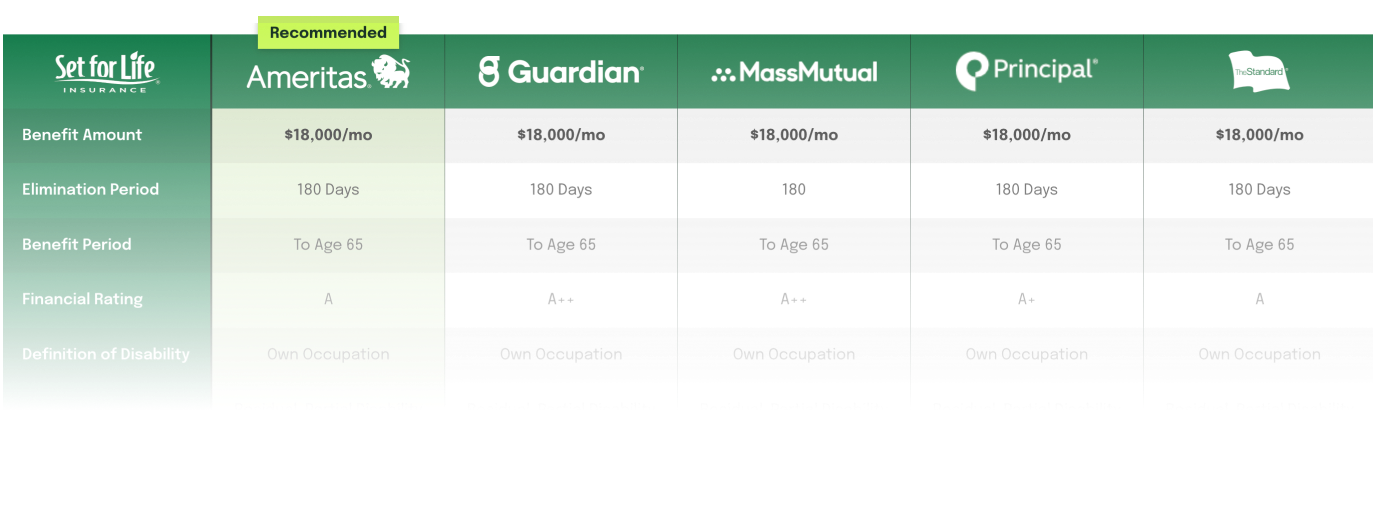
Compare Carriers for Financial Services Executives
Get Your Customized Financial Services Quote
"*" indicates required fields
Disability Insurance for Wall Street Executives
What is the best disability insurance for financial services executives?
The best disability insurance for a financial services executive is not one carrier’s product, since the right fit turns on three things this page already establishes: how the buyer’s pay splits between base salary and bonus, where that income lands against a carrier’s own occupation-class ceiling, and whether the policy’s own-occupation definition is written into the base contract or purchased separately as a rider. Principal, Guardian, and Ameritas deliver true own-occupation in base contract language at no added premium; MassMutual and The Standard deliver it only through a separately priced rider elected at issue, without which their base contracts fall back to a narrower, modified definition. A bonus-heavy investment banker and a commission-based securities broker can land on different carriers for the identical reason, since each carrier’s occupation-class structure and rider requirements fit a different income shape. Working through the comparisons below, rather than reaching for a single named carrier, is what actually identifies the strongest fit for a given executive’s compensation.
What Disability Insurance for Financial Services Executives Covers
Individual disability insurance for financial services executives is a personally owned policy that replaces income when a Wall Street or corporate finance professional cannot perform their occupation, structured separately from any group long-term disability (LTD) plan an employer provides. The policy insures the individual, not the employer, so it stays in force after a job change, a firm acquisition, or a move to a new desk, providing portability across employer changes that a group plan does not. Individual disability insurance in this segment is issued non-cancellable and guaranteed renewable to a stated age, meaning the carrier cannot cancel the policy or raise the premium once it is issued.
Five carriers underwrite individual disability insurance for this audience. Ameritas (Ameritas Life Insurance Corp., policy form 4501NC), Guardian (Berkshire Life Insurance Company of America, underwriting for The Guardian Life Insurance Company of America, policy form ICC16 18ID Provider Choice), MassMutual (Massachusetts Mutual Life Insurance Company, Radius Choice ICC15-XLIS-RC), Principal (Principal Life Insurance Company, a member of Principal Financial Group, Income Protector ICC22-800-IDI), and The Standard (Standard Insurance Company, Platinum Advantage B180(7/17)) each write standard-issue coverage for this occupation group. Lloyd’s of London, placed through Petersen International Underwriters, writes excess disability coverage above what the five carriers issue individually.
Underwriters treat this occupation group favorably. MassMutual’s own underwriting guide places occupations such as investment bankers, stockbrokers, and portfolio managers in its standard, unlimited-consideration tier, while hedge fund managers and venture capitalists require individual underwriter consideration. That distinction sets the boundary for this page. Investment bankers, portfolio managers, quantitative analysts, asset managers, and securities brokers each underwrite on standard terms, a different underwriting path from the hedge fund and private equity tier.
Income Protection for Financial Services Executives Must Look Beyond Base Salary
Base salary at a Wall Street firm rises roughly 3 to 3.5% a year. Incentive pay, bonus, deferred stock, and carried interest at firms that grant it, moves on an entirely separate track, and research on total compensation at major banks found incentive pay growing roughly three times as fast as base salary across a comparable four-year period. A mid-career professional earning $600,000 in total compensation carries a base salary of $250,000 to $300,000, so base salary runs 42% to 50% of total pay. At the managing director level, base salary flattens. A director earning $1.5 million in total compensation and a director earning $5 million in total compensation can carry the identical base salary, because base salary is set by title, firm-wide, within a narrow band, not by individual production.
A standard employer group long-term disability plan defines covered monthly earnings as base salary only, even though bonus, commission, and other variable compensation are also reported on the same W-2. It does not follow total compensation upward as bonus, equity compensation, and deferred compensation grow. Group long-term disability that replaces 60% of covered earnings can replace well under half of a bonus-heavy professional’s actual income, because the plan was never built to see the bonus, the restricted stock unit, or the carried interest in the first place. That shortfall widens further in a strong market, when incentive pay grows even faster relative to a base salary that moves at its own fixed annual pace.
Firms structure executive compensation this way by design, using deferred stock and multi-year vesting schedules, sometimes called golden handcuffs, to keep base salary a small, fixed cost while variable compensation carries both the incentive and the retention function. This mechanism is not unique to Wall Street. Group plans everywhere exclude variable compensation from covered earnings. What makes financial services distinctive is how small a share of total compensation base salary represents at the senior level; nowhere else does base salary shrink to a single-digit percentage of total pay the way it can at the managing director tier. Income protection built around base salary alone leaves the largest share of a financial services executive’s income completely uninsured.
How True Own-Occupation Coverage Is Delivered for Financial Services Executives
Own-occupation disability insurance pays a benefit when a financial services executive cannot perform the material and substantial duties of their specific occupation, even while working in a different one. An any-occupation definition pays only when the insured cannot work at any job suited to their education and experience, the test most group long-term disability plans switch to after a fixed period. True own-occupation matters most to a highly compensated Wall Street professional, since an any-occupation comparison job pays far less than the trading, deal-making, or portfolio work they actually did.
The five carriers do not deliver true own-occupation the same way. Principal and Guardian build it into the base contract, Guardian as a named choice of three definitions. Ameritas offers a similar base-contract choice, with own-occupation language confirmed for physicians and dentists in its specialty enhancement. MassMutual and The Standard deliver true own-occupation only through a separately priced Own Occupation Rider elected at issue; without the rider, each pays only under a modified definition. Two quotes carrying an identical monthly benefit and premium can be structurally different policies depending on which path delivered the definition.
How True Own-Occupation Coverage Is Delivered Across the Big 5 Carriers
 |
Ameritas Life Insurance Corp. 4501NC |
Guardian Berkshire Life Insurance Co. of America ICC16 18ID, Provider Choice |
MassMutual Massachusetts Mutual Life Insurance Co. ICC15-XLIS-RC, Radius Choice |
Principal Principal Life Insurance Company ICC22-800-IDI, Income Protector |
The Standard Standard Insurance Company B180(7/17), Platinum Advantage |
|---|---|---|---|---|---|
| How true own-occupation coverage is delivered | Base contract, choice of true or modified own-occupation forms | Base contract, named choice of three definitions | Not in the base definition. Delivered only through a separately priced Own Occupation Rider | Built into the base definition | Delivered only through a separately priced Own Occupation Benefit Rider |
| What the buyer must do to get it | Nothing extra. Elect the true own-occupation form at application, no separate rider or additional premium line | Nothing extra. All three definition choices sit inside the base contract at no separate premium | Elect and pay for the rider at issue. Without it, the base contract is not a true own-occupation policy | Nothing extra. True own-occupation applies to every occupation class the base contract insures | Elect and pay for the rider at issue. Without it, the base contract pays only under the modified definition |
Source: specimen policy contracts and field underwriting guides for the five carriers named above. Lloyd’s of London excess coverage, via Petersen International Underwriters, is not included here. Full contract language and applicability by occupation class are covered on each profession’s page. Terms shown are subject to underwriter review at application.
Why a Group Long-Term Disability Plan Isn’t Enough for Financial Services Executives
A financial services executive already covered by an employer’s group long-term disability plan still needs individual disability insurance, because the two protect different things. Group long-term disability narrows the own-occupation definition over time, caps the benefit without regard to occupation class, and ends the moment employment does, since the Employee Retirement Income Security Act of 1974 (ERISA) makes it the employer’s plan, not the employee’s. An individual disability policy stays own-occupation for the full benefit period, sets its benefit by occupation class, and travels with the insured through every job change, firm acquisition, and career move.
Taxability compounds the shortfall. Under Internal Revenue Code Section 104(a)(3), a group long-term disability benefit is taxable to the employee whenever the employer paid the premium, the standard arrangement at most financial services firms. An individual policy, paid for with after-tax dollars, pays a tax-free benefit. Both details, the covered-earnings definition and who paid the premium, surface at the moment a claim is filed, when neither can still be changed.
Group Long-Term Disability Versus an Individual Policy
| What the coverage does | Group Long-Term Disability | Individual Disability Insurance |
|---|---|---|
| How long the own-occupation definition lasts | Usually converts to an any-occupation test after 24 months of disability | True own-occupation for the full benefit period, delivered in base contract language at some carriers and through a rider at others |
| What income the plan actually insures | Most plans define covered earnings as base salary and exclude incentive pay, bonuses, commissions, and in some cases stock compensation. A smaller number reach a broader figure closer to total cash compensation | Earned income at the time of application, evaluated against the carrier’s own issue-and-participation limits and income documentation requirements |
| How the maximum monthly benefit is set | A flat dollar ceiling built into the employer’s plan. Group LTD maximums examined for Disability Coverage Stops at Base Salary ranged from $3,000 to $20,000 a month, unrelated to the insured’s occupation class or income growth after enrollment | An issue-and-participation limit tied to occupation class and income. Principal’s Income Protector (form ICC22-800-IDI) carries a $35,000 monthly issue limit for occupation classes 6A+ through 3A at ages 18 to 60 |
| Whether the benefit is taxable | Taxable to the employee under Internal Revenue Code Section 104(a)(3) when the employer pays the premium, the standard group arrangement | Tax-free when the insured pays the premium with after-tax dollars |
| What happens to coverage at a job change | Ends with employment. A new employer’s plan starts its own eligibility and pre-existing-condition clock | Stays in force regardless of employer. The policy belongs to the insured, not the job |
Source: Disability Coverage Stops at Base Salary, the Set for Life Insurance 2026 report (group LTD findings, none from a financial services employer directly); Principal Life Insurance Company’s Disability Product Guide, form ICC22-800-IDI, Income Protector (individual maximum benefit example, not asserted as common to all five carriers); and Internal Revenue Code Section 104(a)(3). Group plan terms vary by employer; all terms are subject to plan documents and underwriter review at application.
A Hypothetical Example
Across the financial services sector, compensation is structured so that base salary is often the smaller share of real income, with the balance paid as bonus, incentive fee, or performance-linked pay. A professional earning $600,000 in total compensation with a $250,000 base salary would see a standard group long-term disability plan replace roughly $12,500 a month, and SFL’s own review of group plans across this sector found monthly maximums as low as $3,000 and rarely above $20,000. In either case, the majority of this professional’s actual earnings goes uninsured.
Figures are hypothetical and for illustration only. They are not a quote or a guarantee of coverage.
Occupation Class and High-Limit Coverage for Financial Services Executives
Occupation class is the underwriting tier a carrier assigns based on the applicant’s actual duties, not their job title, and it sets the ceiling on how much monthly benefit a financial services executive can buy. MassMutual’s own occupation-title table places Broker, Chartered Financial Analyst (CFA), and Portfolio Manager in its top non-medical classes, requiring an income threshold and minimum tenure rather than treating a title alone as sufficient. The five carriers structure their own occupation-class systems differently. The number of distinct classes, the top non-medical tier’s label, and the sub-tier modifiers layered inside each carrier’s structure all vary, which changes how close to a carrier’s own ceiling a given executive’s income places them.
Occupation class matters most to a buyer near the top of a carrier’s standard issue-and-participation limits. A financial services executive whose income clears a carrier’s own top-class threshold qualifies for that carrier’s highest standard monthly benefit; a financial services executive whose income sits below it does not, regardless of how bonus-heavy their total compensation runs. Lloyd’s of London, placed through Petersen International Underwriters, writes excess disability coverage above the standard-issue ceiling for buyers whose income outpaces the five carriers’ own limits.
Occupation Class Structure by Carrier
|
Ameritas Life Insurance Corp. Field Underwriting Guide |
Guardian Berkshire Life Insurance Co. of America Provider Choice · IDI Field Underwriting Guide |
Mass Mutual Massachusetts Mutual Life Insurance Co. Radius Choice · Underwriting Guide |
Principal Principal Life Insurance Company Income Protector · Disability Product Guide |
The Standard Standard Insurance Company Platinum Advantage · Product Guide |
|---|---|---|---|---|---|
| Total distinct insurable classes | ~13 | ~14 | ~17 | ~22 | ~12 |
| Top non-medical class | 6A | Class 6 | 5A/5 (with Radius Choice modifier) | 6A+ | 5A |
| Top physician class | 6M | 6M | 5P/1 | 6M | 5P |
| Top dental class | No separate D track; dentists slotted into M classes | 4D | 4D | 4D+ | 3D |
| Lowest insurable non-medical class | B | Class 2 | A | 1A | B |
| Lowest insurable medical class | M | 2M (1M uninsurable) | 3P / 4P (no lower medical class) | 1M | 4P |
| Separate medical-professional track | Yes, “M” classes (6M, 5M, 4M, 3M, 2M, M) | Yes, “M” classes (6M through 1M) | Yes, uses “P” designation (5P, 4P, 3P, 2P) | Yes, “M” classes (6M through 1M, with “+” modifiers) | Yes, uses “P” designation (5P, 4P, 4S, 3P, 2P) |
| Separate dental-professional track | No; dentists assigned within “M” classes | Yes, 4D and 3D | Yes, 4D and 3D | Yes, five-tier dental track (4D+, 3D+, 3D, 2D, 1D) | Partial, 3D only (one combined dental class) |
| Sub-tier or “plus” modifiers between main classes | None | None | Yes, Radius Choice modifiers (5A/5, 5A/3, 4A/3, 4A/2, 4A/1, 5P/1, 3P/2) | Yes, extensive “+” modifiers (6A+, 5M+, 3M+, 2A+, 2M+, 4D+, 3D+) | Limited; 4S (surgeons) is the only intermediate designation |
Source: Field underwriting guides published by each carrier. Class names and product identifiers are taken from the most recently published producer-facing guides held by Set for Life Insurance. Class assignments are subject to underwriter review at the time of application.
Elimination Period and Cost of Living Adjustment Options
The elimination period is the length of time a financial services professional must be disabled before benefit payments begin, and it varies by carrier. Ameritas offers the widest range, from 30 to 730 days, with the available options tied to the benefit period selected. Guardian offers 30 to 720 days, though its longest options carry state and benefit-period restrictions. Principal, The Standard, and MassMutual all offer a choice of 60, 90, 180, or 365 days. The Standard calls this provision a Benefit Waiting Period rather than an elimination period, a naming distinction required by California law but used company-wide in its own materials.
A Cost of Living Adjustment rider increases the monthly benefit each year a claim continues, keeping pace with inflation on a long-term disability. Guardian, Ameritas, Principal, and The Standard each let a buyer choose between a 3 percent and a 6 percent maximum annual increase, tied to the Consumer Price Index. MassMutual’s rider applies a fixed 3 percent compound increase with no higher option. Most carriers require a full year of disability before the adjustments begin.
Who Should Consider Individual Disability Insurance for Financial Services Executives?
Financial services executives arrive at this decision from five distinct trading floors and back offices, each with its own pay structure, but the same base-salary-versus-total-compensation problem. The professions below share the mechanism above; they differ in how far pay drifts from what a group plan insures.
Investment bankers. Investment bankers earn a base salary that stays largely flat across deal cycles while year-end bonus compensation, tied to closed transactions, can run several multiples of that base. Group long-term disability calculated on base salary alone insures a small fraction of an investment banker’s actual income. See disability insurance for investment bankers for coverage built around deal-cycle bonus compensation.
Portfolio managers. Portfolio managers are compensated on assets under management and fund performance, income a standard group plan’s covered-earnings definition was never built to measure. A portfolio manager evaluating disability coverage needs a policy underwritten to earned income at the time of application, not a fixed employer plan ceiling. See disability insurance for portfolio managers for coverage sized to AUM and performance-based pay.
Quantitative analysts. Quantitative analysts, compensated with a mix of base salary, discretionary bonus, and, at some firms, a share of strategy performance, face the identical covered-earnings exclusion that hits every bonus-heavy Wall Street role. Occupation class underwriting treats a quantitative analyst’s actual duties, not the title’s technical nature, as the basis for classification. See disability insurance for quantitative analysts for occupation-class detail specific to this role.
Asset managers. Asset managers overseeing institutional or retail portfolios carry compensation that scales with fund size and performance fees, income a group plan’s flat monthly ceiling does not follow. Individual disability insurance, underwritten to the asset manager’s actual income, closes that distance. See disability insurance for asset managers for coverage matched to performance-fee income.
Securities brokers. Securities brokers, licensed to sell securities and earning commission-based income tied to production, carry compensation that a base-salary-only group definition does not recognize. A commission-based income stream is exactly the kind of earned income an individual disability policy is underwritten to insure. See disability insurance for securities brokers for coverage built around commission-based production.
Firms. The firm employing any of these professionals carries a parallel exposure. Losing a top producer or partner to disability costs the business the revenue and client relationships that person represents, not just the individual’s own paycheck. See key person disability insurance for coverage a firm buys on its own top producers.
Disability Insurance for the Financial Services Industry FAQ
Sources and Industry References
Disability insurance for financial services executives draws on carrier specimen contracts, field underwriting guides, federal statute, and Disability Coverage Stops at Base Salary, the Set for Life Insurance 2026 report.
- Ameritas Life Insurance Corp., Guardian underwritten by Berkshire Life Insurance Company of America, MassMutual, Principal Life Insurance Company, and Standard Insurance Company each supply the specimen policy contracts and field underwriting guides this page cites by form number.
- Lloyd’s of London, placed through Petersen International Underwriters, a licensed managing general agent, underwrites the excess disability coverage referenced above what the five standard-issue carriers write.
- Disability Coverage Stops at Base Salary, the Set for Life Insurance 2026 report, supplies the group long-term disability findings cited for benefit caps, own-occupation duration, and taxability.
- Internal Revenue Code Section 104(a)(3) governs the taxability of a group long-term disability benefit paid on an employer-paid premium, cited throughout this page.
- The Employee Retirement Income Security Act of 1974 governs employer-sponsored group long-term disability plans and explains why individual coverage stays in force after a job change.
Disclaimer
The information on this page is for general informational purposes only and does not constitute legal, financial, or tax advice. Coverage availability, underwriting terms, and eligibility requirements vary by occupation, income structure, health history, and state of residence. Policy terms described on this page are drawn from specimen policy language and are subject to change. Actual policy terms govern in all cases.
Excess disability coverage above standard carrier issue limits is underwritten by certain underwriters at Lloyd’s of London and accessed through Petersen International Underwriters, a licensed managing general agent. Compensation figures and occupation-class examples referenced on this page are illustrative only. Set for Life Insurance is a licensed insurance producer.