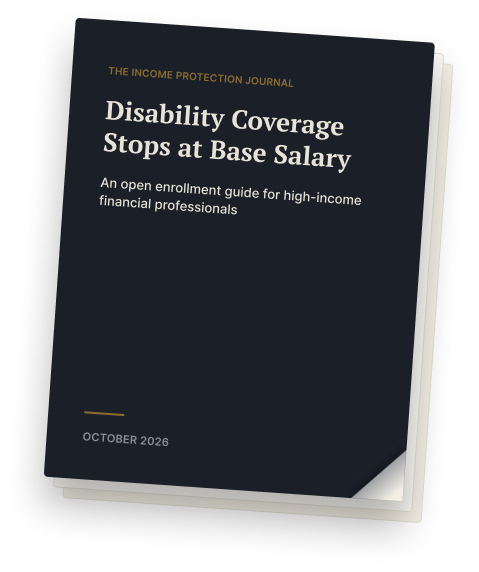
Disability Coverage Stops at Base Salary
What 2,912 Financial Services Employers Show
Fall is open enrollment season, when employees are permitted to change their disability insurance coverage options without a life qualifying event like a marriage, divorce or the birth or adoption of a child.
In the unfortunate event of a catastrophic physical or mental disability, the monthly bills still need to get paid. And while employers insure a portion of their employees’ salaries through group long term disability coverage, professionals who rely on bonuses, commissions or carried interest to meet their monthly nut can secure an individual disability insurance policy to cover the shortfall.
Wall Street is inherently skilled at monetizing risk. But ironically, these same risk-literate professionals are among the least protected against their own downside, not because anyone failed to warn them, but because base-salary-only coverage was never designed with bonus-heavy pay in mind.
This guide is about figuring out how much of a monthly benefit would be required to cover the gap, particularly for professionals in the financial services sector, where the majority of total compensation is bonus pay, rather than salary.
Just as you can’t buy fire insurance while your house is on fire, you can’t buy individual disability insurance after you become disabled. And most group policies have an “actively at work” stipulation, which means an employee must be actively working, full duty, on the day the policy or change is elected in order for the new coverage to take effect.
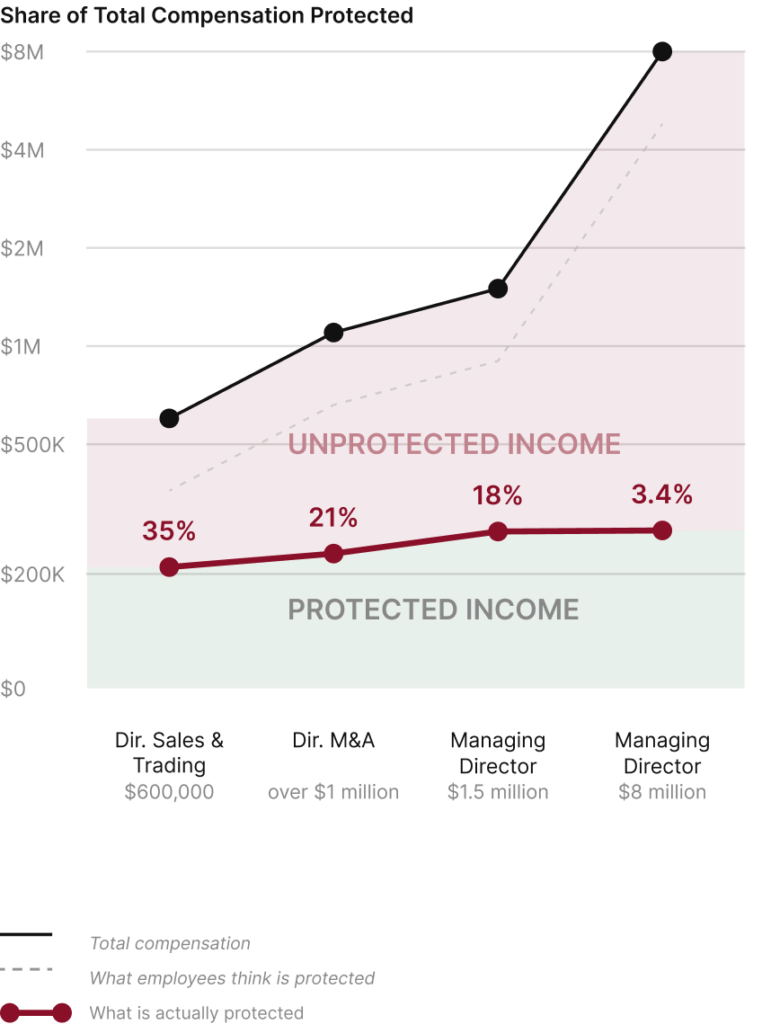
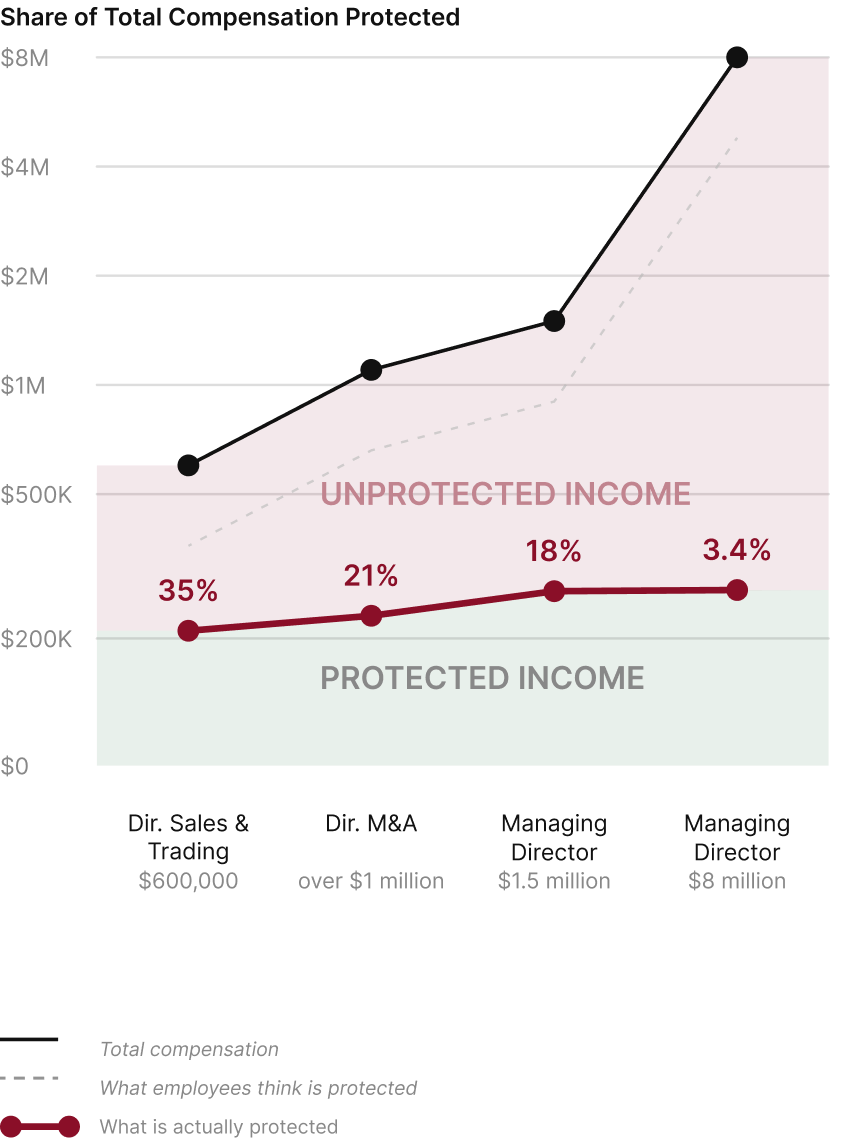
Group long-term disability coverage does not replace a percentage of total compensation. It replaces a percentage of salary, which in financial services is often the smaller share of take-home pay.
A mid-career professional earning $600,000 in total compensation typically draws a base salary of $250,000 to $300,000. A plan advertised at 60% therefore replaces roughly a quarter of that person’s income before taxes, not 60% of it.
For most people in the sector, that plan is the whole of their employer-provided coverage. Of the 2,912 financial services employers that filed a group long-term disability contract with the Department of Labor in the most recently disclosed plan year, 37 also filed a contract providing an individual layer above it. That is 1.3%. Not one of the 37 is a hedge fund or a buyout firm.
“Since most people on Wall Street are relatively young and they believe they’re invincible, I don’t think most people are really even aware of that,” said Alan Johnson, managing director of Johnson Associates, which publishes semi-annual projections of incentive pay across the financial sector and advises banks on what to pay their people.
5 Terms That Decide What Your Group Plan Pays
-
“Covered earnings” decide what the benefit is worth, and there is no industry standard.
Every plan states a percentage. The percentage is applied to a defined term, and that definition varies from one contract to the next. The majority of the contracts examined for this guide define “covered earnings” as base salary and explicitly exclude incentive pay.
-
Group life coverage also excludes bonus and commission pay.
Group life and group disability normally arrive in one bundled contract, and both are typically written on the same earnings definition. If that definition excludes your bonus, your life coverage is sized on base salary too.
-
Base salary set by job title plateaus. Bonus income varies by performance.
Two people at the same firm with the same title and the same base salary can earn vastly different sums, and a disability insurance plan written on base salary insures them identically.
-
Group LTD plans cap the monthly benefit.
In the publicly available plans examined which are not necessarily reflective of the benefit amounts provided by the group plans of financial services firms, maximum benefit payments ranged from $3,000 to $20,000 per month. But what is important to know is that the maximum figure does not rise with income, so above a certain salary the maximum benefit amount, rather than the stated percentage, decides the benefit.
-
Own-occupation protection usually expires.
Coverage that pays when you cannot do the job for which you’re trained typically converts to a harder any-occupation test after a fixed period, commonly 24 months, and that test is measured against the same base-salary figure.
None of this is hidden or unusual. It is how long-term disability group coverage is ordinarily built. What is notable is that it becomes particularly consequential on Wall Street, where the cost of living is exceedingly high, and the majority of pay arrives as a bonus income.
The most vulnerable financial services professionals are not necessarily the top earners, who are also the most underinsured. A managing director earning several million dollars has almost certainly amassed enough capital to withstand the loss of income.
The exposure concentrates one rung down the org chart, among mid-career directors who are high earners, but not yet rich. These are also the ones more likely to have school-age children, college tuition ahead of them, and a more highly leveraged lifestyle.
At this level of seniority, the arithmetic is more unforgiving. A Manhattan household with two children, an Upper East Side apartment, kids in private schools, a house in the Hamptons and full-time childcare would require at least $450,000 a year in after-tax spending for renters, and closer to $721,700 financed at prevailing 2026 jumbo rates for property owners.
Insurance rests on individuals deciding what risk they are willing to carry themselves. This report sets out how a group plan is calculated and what is worth establishing from your own certificate before you re-enroll.
What 2,912 Financial Services Employers Show
Fall is open enrollment season, when employees are permitted to change their disability insurance coverage options without a life qualifying event like a marriage, divorce or the birth or adoption of a child.
In the unfortunate event of a catastrophic physical or mental disability, the monthly bills still need to get paid. And while employers insure a portion of their employees’ salaries through group long term disability coverage, professionals who rely on bonuses, commissions or carried interest to meet their monthly nut can secure an individual disability insurance policy to cover the shortfall.
Wall Street is inherently skilled at monetizing risk. But ironically, these same risk-literate professionals are among the least protected against their own downside, not because anyone failed to warn them, but because base-salary-only coverage was never designed with bonus-heavy pay in mind.
This guide is about figuring out how much of a monthly benefit would be required to cover the gap, particularly for professionals in the financial services sector, where the majority of total compensation is bonus pay, rather than salary.
Just as you can’t buy fire insurance while your house is on fire, you can’t buy individual disability insurance after you become disabled. And most group policies have an “actively at work” stipulation, which means an employee must be actively working, full duty, on the day the policy or change is elected in order for the new coverage to take effect.
Group long-term disability coverage does not replace a percentage of total compensation. It replaces a percentage of salary, which in financial services is often the smaller share of take-home pay.
A mid-career professional earning $600,000 in total compensation typically draws a base salary of $250,000 to $300,000. A plan advertised at 60% therefore replaces roughly a quarter of that person’s income before taxes, not 60% of it.
For most people in the sector, that plan is the whole of their employer-provided coverage. Of the 2,912 financial services employers that filed a group long-term disability contract with the Department of Labor in the most recently disclosed plan year, 37 also filed a contract providing an individual layer above it. That is 1.3%. Not one of the 37 is a hedge fund or a buyout firm.
“Since most people on Wall Street are relatively young and they believe they’re invincible, I don’t think most people are really even aware of that,” said Alan Johnson, managing director of Johnson Associates, which publishes semi-annual projections of incentive pay across the financial sector and advises banks on what to pay their people.
5 Terms That Decide What Your Group Plan Pays
-
“Covered earnings” decide what the benefit is worth, and there is no industry standard.
Every plan states a percentage. The percentage is applied to a defined term, and that definition varies from one contract to the next. The majority of the contracts examined for this guide define “covered earnings” as base salary and explicitly exclude incentive pay.
-
Group life coverage also excludes bonus and commission pay.
Group life and group disability normally arrive in one bundled contract, and both are typically written on the same earnings definition. If that definition excludes your bonus, your life coverage is sized on base salary too.
-
Base salary set by job title plateaus. Bonus income varies by performance.
Two people at the same firm with the same title and the same base salary can earn vastly different sums, and a disability insurance plan written on base salary insures them identically.
-
Group LTD plans cap the monthly benefit.
In the publicly available plans examined which are not necessarily reflective of the benefit amounts provided by the group plans of financial services firms, maximum benefit payments ranged from $3,000 to $20,000 per month. But what is important to know is that the maximum figure does not rise with income, so above a certain salary the maximum benefit amount, rather than the stated percentage, decides the benefit.
-
Own-occupation protection usually expires.
Coverage that pays when you cannot do the job for which you’re trained typically converts to a harder any-occupation test after a fixed period, commonly 24 months, and that test is measured against the same base-salary figure.
None of this is hidden or unusual. It is how long-term disability group coverage is ordinarily built. What is notable is that it becomes particularly consequential on Wall Street, where the cost of living is exceedingly high, and the majority of pay arrives as a bonus income.
The most vulnerable financial services professionals are not necessarily the top earners, who are also the most underinsured. A managing director earning several million dollars has almost certainly amassed enough capital to withstand the loss of income.
The exposure concentrates one rung down the org chart, among mid-career directors who are high earners, but not yet rich. These are also the ones more likely to have school-age children, college tuition ahead of them, and a more highly leveraged lifestyle.
At this level of seniority, the arithmetic is more unforgiving. A Manhattan household with two children, an Upper East Side apartment, kids in private schools, a house in the Hamptons and full-time childcare would require at least $450,000 a year in after-tax spending for renters, and closer to $721,700 financed at prevailing 2026 jumbo rates for property owners.
Insurance rests on individuals deciding what risk they are willing to carry themselves. This report sets out how a group plan is calculated and what is worth establishing from your own certificate before you re-enroll.