
Disability Insurance for Surgeons and Surgical Specialists
Surgeon Disability Insurance
Income Protection for Surgeons
Own-Occupation Coverage for Surgical Specialties
Own-occupation disability insurance for surgeons is written to replace income when injury or illness ends a surgeon’s ability to operate. Whether teaching, consulting or clinic work changes that depends on the policy definition. The carriers define a surgeon’s occupation differently, and one adds a surgical-procedure test for doctors who earn most of their income operating.

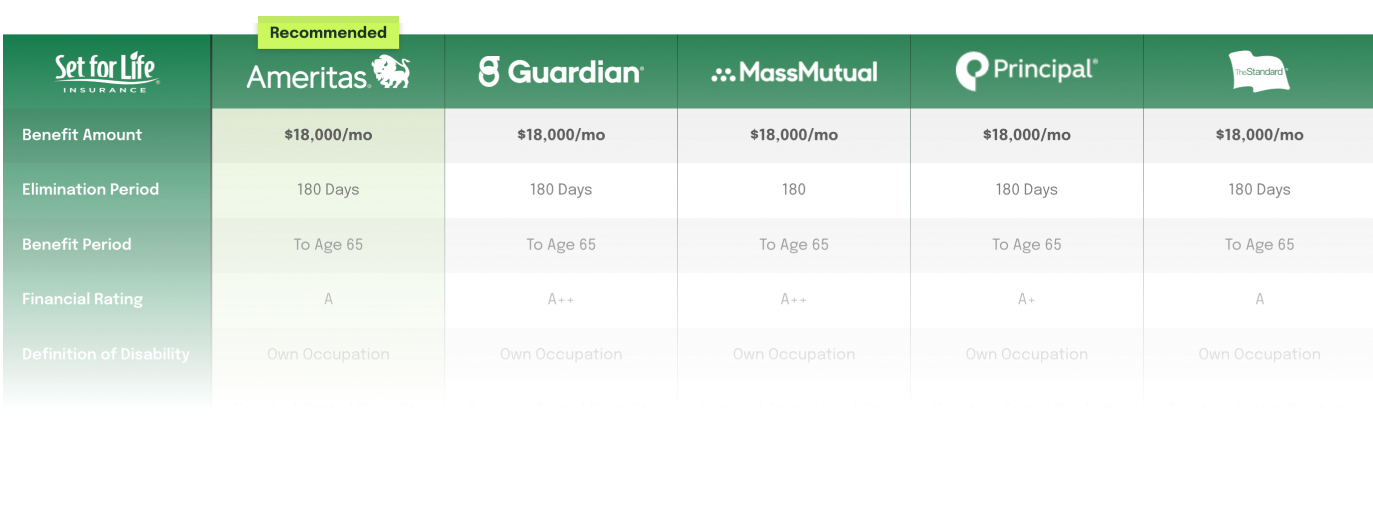
Compare Carriers for Surgeons and Surgical Specialists
Surgeon Disability Insurance: Request a Quote
"*" indicates required fields
Surgeon Disability Insurance, Compared
What Individual Disability Insurance Covers for Surgeons
Who Surgeon Disability Insurance Is Written For
This page is for a surgeon buying individual disability insurance before a disability happens, not one appealing a denied claim. It covers the buying decision only, not how to file, prove or appeal a claim afterward.
How a Disability Insurance Policy Works for a Surgeon
Individual disability insurance (DI) for surgeons, sometimes called surgeon income protection insurance, is a personally owned policy that replaces income when a surgeon cannot perform the material and substantial duties of their occupation. It is separate from any group long-term disability (LTD) plan a hospital or practice provides, and it stays in force through a change of employer, a move to a new practice or a decision to practice independently. Coverage is non-cancellable and guaranteed renewable to a stated age, so the carrier cannot cancel the policy or raise the premium while premiums are paid.
Disability Insurance Carriers and Policy Forms for Surgeons
Five insurers write the individual policies this page compares. Ameritas (Ameritas Life Insurance Corp., policy form 4601NC), Guardian (Berkshire Life Insurance Company of America, policy form ICC16 18ID Provider Choice), MassMutual (Massachusetts Mutual Life Insurance Company, Radius Choice ICC15-XLIS-RC), Principal (Principal Life Insurance Company, Income Protector ICC22-800-IDI), and The Standard (Standard Insurance Company), Platinum Advantage policy form B180(7/17). Lloyd’s of London, placed through Petersen International Underwriters, adds excess coverage above what the five carriers issue individually.
Working With a Disability Insurance Broker for Surgeons
A disability insurance broker for surgeons compares each disability policy across several carriers instead of selling one company’s contract. Set for Life Insurance is an independent brokerage and disability insurance specialist that compares quotes from Ameritas, Guardian, MassMutual, Principal and The Standard side by side. A disability insurance agent explains how each disability insurance provider approaches disability insurance underwriting, so a surgeon sees the differences before choosing a disability insurance plan from among the policies on offer.
Disability Insurance Compared With Key Person Coverage
The policy pays independently of Social Security Disability Insurance. It is also not key person disability insurance, which protects a company’s finances rather than the surgeon’s own income.
Why Surgeons Face Distinctive Disability Risk
The Likelihood of Disability Before Retirement Age
The Social Security Administration’s Office of the Chief Actuary projects that an insured worker who attains age 20 in 2025 has a 24% probability, just under 1 in 4, of becoming disabled before normal retirement age (Actuarial Note 2025.6). A surgeon’s income rests on the physical abilities that surgeries demand: steady hands, vision, stamina and posture. A condition that takes away any one of them can end the operations a surgeon performs and the income that came with them, while the surgeon is otherwise well.
Musculoskeletal Disorders Among Surgeons
A 2018 systematic review and meta-analysis in JAMA Surgery pooled 21 studies covering 5,828 physicians who were surgeons or medical interventionalists. The most common work-related musculoskeletal disorders were degenerative cervical spine disease, rotator cuff pathology, degenerative lumbar spine disease and carpal tunnel syndrome. Pooled prevalence of pain ranged from 35% to 60% depending on the assessment instrument, and 12% of the physicians with a work-related musculoskeletal disorder required a leave of absence, a practice restriction or modification, or early retirement (Epstein et al., JAMA Surgery, 2018).
Bonus Pay and Employer Plan Limits for Surgeons
The pay structure adds a second exposure for high-income surgeons. A group LTD plan pays a percentage of the earnings its covered-earnings clause names, and plans differ on whether that clause reaches bonus or incentive pay. The group plan also ends with the job, so a surgeon who changes hospitals or leaves a group practice restarts eligibility under a new plan. An individual DI policy belongs to the surgeon, so it is the one piece of protection that does not depend on staying with an employer.
What Own-Occupation Means When a Surgeon Can No Longer Operate
Own-Occupation Disability Insurance for Surgeons
Own occupation disability insurance for surgeons pays when an insured cannot perform the material and substantial duties of their occupation, even if the insured is able to work in another one. For a physician, each of the five carriers lets the insured limit the occupation to a single medical specialty, the insured’s own specialty, and the policy then measures the claim against that specialty. For a surgeon, the questions are whether the specialty means operating and how each carrier verifies it.
Guardian’s Surgical Procedure Enhancement
Guardian’s Provider Choice contract (Berkshire Life Insurance Company of America, policy form ICC16 18ID) adds a rule for surgeons. When a Medical Doctor or Doctor of Osteopathy has an occupation limited to that role and more than 50% of income comes from performing Surgical Procedures, the insured is totally disabled when unable to perform Surgical Procedures, even while gainfully employed in the practice or another occupation. This is the surgical procedure enhancement. The contract defines Surgical Procedures as medical interventions involving an incision with instruments, performed in a clinical or hospital setting, normally involving anesthesia or respiratory assistance, that the insured regularly performed during the 12 months before the disability. When 50% or less of income comes from surgical procedures, the standard definition applies.
Own-Occupation Policy Language at the Other Four Carriers
The specimen contracts on file for the other four carriers contain no surgical-procedure test. Their own-occupation language for a surgeon rests on the specialty itself. Principal and Ameritas deem a professionally recognized specialty to be the occupation, The Standard deems a single specialty recognized by the American Board of Medical Specialties or the American Osteopathic Association Bureau of Osteopathic Specialists to be the occupation, and MassMutual deems a specialty the occupation when billing codes for the 12 months before the disability verify its main duties.
Own-Occupation Terms for Surgeons by Carrier
| What the contract says | Ameritas 4601NC |
Guardian ICC16 18ID |
MassMutual ICC15-XLIS-RC |
Principal ICC22-800-IDI |
The Standard B180(7/17) |
|---|---|---|---|---|---|
| How a medical specialty becomes the occupation | A specific, professionally recognized medical or dental specialty, when the physician has limited the duties to its usual and customary functions | A single medical specialty to which the insured has limited the occupation | A medical specialty whose main duties are verified by billing codes for the 12 months before the disability began (Own Occupation Rider) | A single professionally recognized specialty in medicine, within the scope of the insured’s degree or license | A single specialty recognized by the American Board of Medical Specialties or the American Osteopathic Association Bureau of Osteopathic Specialists |
| Totally disabled while working in another occupation | Choice of three definitions: own occupation even while working in another occupation (not available in occupation classes 2A and 2M); own occupation with no work in any other occupation; or own occupation for the first 24 months and then any reasonable occupation | Yes. The specimen’s definition applies even while the insured is gainfully employed in another occupation | Yes, through the Own Occupation Rider, whose definition applies when the insured cannot perform the main duties of the occupation and is working in another occupation | Not in the base definition, which requires that the insured is not working. The Principal product guide describes true own-occupation as an enhanced option at an additional cost | Not in the base definition, which requires that the insured is not engaged in any other job or occupation for wage or profit. The Own Occupation Rider removes that requirement |
| Rule for doctors who earn most of their income from surgical procedures | None in the specimen on file | Enhancement: for an M.D. or D.O. whose occupation is limited to that role and who earns more than 50% of income from Surgical Procedures, total disability exists when the insured cannot perform Surgical Procedures, even while gainfully employed in the practice or another occupation. At 50% or less, the standard definition applies | None in the specimen on file | None in the specimen on file | None in the specimen on file |
| Rule for doctors who earn most of their income from hands-on patient care | None in the specimen on file | Enhancement: the same structure for an M.D. or D.O. who earns more than 50% of income from Hands-on Patient Care, meaning meeting a patient in a clinical setting to provide medical advice, evaluation, diagnosis or treatment | None in the specimen on file | None in the specimen on file | None in the specimen on file |
Source: specimen policy contracts and riders held by Set for Life Insurance: Ameritas Life Insurance Corp. (form 4601NC, definitions of total disability), Berkshire Life Insurance Company of America underwriting for Guardian (form ICC16 18ID, definition of Total Disability and the enhancements for doctors performing Surgical Procedures and providing Hands-on Patient Care), Massachusetts Mutual Life Insurance Company (form ICC15-XLIS-RC, Own Occupation Rider), Principal Life Insurance Company (form ICC22-800-IDI) and Standard Insurance Company (form B180(7/17), Own Occupation Rider), plus the Principal Disability Product Guide. None in the specimen on file means the specimen text contains no surgical-procedure or hands-on-care test; a provision outside the documents on file is not covered by that statement. Terms vary by state and by the riders selected.
Where Each Own-Occupation Definition Stops
The table shows where each of the five occupation definitions stops. At Principal and The Standard the base definition requires that the insured is not working, and true own occupation comes through an option or a rider. Ameritas offers three definitions, so a surgeon comparing quotes confirms which of the three each quote carries. Two policies with the same monthly benefit and the same premium can differ on whether teaching, consulting or clinic income ends the claim.
Riders That Change a Surgeon’s Disability Insurance Policy
The specimen contracts print riders that change what a policy pays. Guardian, Ameritas and MassMutual each print a cost of living adjustment rider, and The Standard prints an indexed cost of living rider. Ameritas and The Standard each print an automatic increase rider. Guardian, Ameritas, MassMutual and The Standard each print a catastrophic disability benefit rider and a student loan rider or benefit, and the student loan rider carries a different name at each carrier, such as Ameritas’s Student Loan Repayment Rider. Principal’s public sample policy is the base policy and prints no riders. A surgeon with student debt compares the student loan terms, and a surgeon expecting income growth compares the future increase option and the cost of living adjustment rider.
How Carriers Class Surgeons by Specialty
Occupation Class Labels at Each Carrier
Each carrier assigns every occupation to a class, and the class sets the premium rate and the benefit limits available. Each of the four guides that list surgeons places non-surgical physicians in classes numbered higher than any surgical specialty, so a surgeon’s class is the starting point for insurance premiums. Each guide prints its own labels: M at Guardian and Principal, P at MassMutual and The Standard, and S at The Standard for physicians who perform surgery. The table shows how each carrier classes the surgical specialties it lists.
Occupation Class by Surgical Specialty and Carrier
| Specialty as the guide prints it | Ameritas | Guardian (Berkshire Life) Provider Choice |
MassMutual Radius Choice |
Principal Income Protector |
The Standard Platinum Advantage |
|---|---|---|---|---|---|
| Surgeon, general or not otherwise listed | Not listed in the guide on file | 3M (Surgeon, all specialties) | 3P/2 (Surgeon, otherwise not listed) | 3M (General surgeon) | 4S (Surgeon, General) |
| Orthopedic surgery | Not listed in the guide on file | 3M | 3P | 3M | 3P |
| Neurosurgery | Not listed in the guide on file | 4M | 3P (Neurological Surgery) | 4M | 4S |
| Plastic surgery | Not listed in the guide on file | 3M | No separate listing; Surgeon, otherwise not listed, 3P/2 | 3M | 4S |
| Cardiovascular and cardiothoracic surgery | Not listed in the guide on file | 3M (Cardiovascular Surgeon) | 3P (Cardiovascular Surgeon and Thoracic Surgeon) | 4M (Cardiovascular surgeon) | 4S (Cardiothoracic Surgeon) |
| Vascular surgery | Not listed in the guide on file | No separate listing; Surgeon, all specialties, 3M | No separate listing; Surgeon, otherwise not listed, 3P/2 | 4M (Vascular surgeon) | No separate listing |
| Hand surgery | Not listed in the guide on file | No separate listing; Surgeon, all specialties, 3M | No separate listing; Surgeon, otherwise not listed, 3P/2 | No separate listing; 3M (all specialties except cardiovascular, neuro and vascular) | 3P (Hand Surgeon) |
Source: carrier field underwriting guides and product guides held by Set for Life Insurance: the Guardian Field Underwriting Guide (October 2025, Section 7 occupation class listing for Provider Choice), the MassMutual Underwriting Guide (Section 2, Radius Choice column), the Principal Disability Product Guide (occupational class schedule, Income Protector column) and the Standard Insurance Product Guide (medical and health occupations, Platinum Advantage column). The Ameritas guide on file places medical occupations in classes 6M through 2M and lists no surgical specialty. The Standard assigns class 4S only with Platinum Advantage. MassMutual’s /2 is an occupation class modifier that creates an additional price point between classes. Classes are subject to underwriter review and state availability.
How the Classes Split Surgical Specialties
The classes split the specialties differently at each carrier, so insuring a neurosurgeon can mean a different class than insuring an orthopedic surgeon. Guardian and Principal class neurosurgery one class above general surgery. The Standard classes neurosurgery and general surgery alike at 4S but places orthopedic surgery and hand surgery lower at 3P. MassMutual classes neurological surgery, orthopedic surgery and cardiovascular surgery at 3P, the same as the other surgeons it lists. Principal is the only guide that lists vascular surgery separately, and none of the four guides lists trauma surgery as its own occupation.
General Surgeon Disability Insurance
Disability insurance for general surgeons places the specialty in class 3M at Guardian, which lists Surgeon (all specialties) there, and in class 3M at Principal, which lists General surgeon. The Standard lists Surgeon, General at 4S, and MassMutual lists Surgeon, otherwise not listed, at 3P/2.
Orthopedic Surgeon Disability Insurance
Disability insurance for orthopedic surgeons places the specialty in class 3M at Guardian and Principal and 3P at MassMutual and The Standard. Guardian’s guide excludes orthopedic surgeons from its Preferred Occupation Discount, which gives board-certified surgeons in class 3M a 10% permanent premium discount in approved states.
Neurosurgeon Disability Insurance
Disability insurance for neurosurgeons places neurosurgery in class 4M at Guardian and Principal, one class above general surgery at each, and in class 4S at The Standard, the same class as general surgery there. MassMutual lists neurological surgery at 3P.
Plastic Surgeon Disability Insurance
Disability insurance for plastic surgeons places plastic surgery in class 3M at Guardian and Principal and in class 4S at The Standard. MassMutual’s guide has no plastic surgery listing, so a plastic surgeon falls under its Surgeon, otherwise not listed, entry at 3P/2.
Cardiothoracic and Vascular Surgeon Disability Insurance
Cardiovascular surgery sits in class 3M at Guardian, 3P at MassMutual (which lists thoracic surgery at 3P as well), 4M at Principal and 4S at The Standard, which prints the specialty as cardiothoracic. Disability insurance for vascular surgeons is classed separately only at Principal, which lists vascular surgery at 4M.
How Residual Disability Benefits Work Across Carriers for Surgeons
Residual Disability Rider Terms Compared
A residual benefit pays a proportion of the monthly benefit when an insured returns to work at reduced income because of the disability, which fits a surgeon who returns to a reduced caseload. The table compares how each carrier’s residual rider sets the income-loss threshold, calculates the disability insurance payout, treats a prior total disability and ends the benefit.
Residual Disability Benefit Terms by Carrier for Surgeons
 |
Ameritas Life Insurance Corp. 4601NC · Enhanced Plus Residual Disability Rider (EPRES) |
Guardian Berkshire Life Insurance Co. of America ICC16 18ID · Provider Choice + Enhanced Partial Rider |
Lloyd’s Petersen International Underwriters PDI111521 · Optional Residual Rider |
Mass Mutual Massachusetts Mutual Life Insurance Co. ICC15-XLIS-RC · Extended Partial Disability (EPR) |
Principal Principal Life Insurance Company ICC22-800-IDI · Income Protector |
The Standard Standard Insurance Company B180(7/17) · Platinum Advantage + Residual Riders |
|---|---|---|---|---|---|---|
| 1 · Income Loss Threshold That Triggers Residual Benefits | ||||||
| Minimum income loss required % of prior earnings that must be lost before residual benefits begin |
15% loss of monthly earnings (Specimen) One of the lowest thresholds available. Rider text states: loss must be “at least 15% of your prior monthly earnings” due to sickness or injury. |
Loss of Income due to disability (Specimen) Guardian’s Enhanced Partial rider defines “Loss of Income” as the difference between Prior Income and Current Income attributable solely to the Injury or Sickness. No explicit percentage floor in the base rider; benefit scales proportionally with income loss. Must be Gainfully Employed. |
Optional rider: threshold per rider terms (Specimen) Base Lloyd’s specimen (PDI111521) notes “Residual Disability is an optional benefit that only applies if the rider was purchased.” Rider text not included in this specimen. Typical Lloyd’s/PIU residual riders require income loss and inability to perform all material duties. |
20 to 80% loss of Predisability Earnings (Standard) EPR benefit is payable when Monthly Earnings fall to 20% to 80% of Predisability Earnings. Below 20% earnings remaining triggers full benefit. Above 80% earnings remaining, no EPR benefit is paid. |
Loss of Earnings from own occupation (Specimen) Principal’s Residual Disability Benefit Rider requires a loss of Earnings due to Disability. The specimen confirms “Earnings” excludes unearned income. No explicit minimum percentage floor; benefit scales pro-rata with the earnings loss ratio. |
20% loss of Predisability Earnings (Enhanced); 15 to 20% for Short-Term version (Specimen) Specimen lists Basic, Enhanced, and Short-Term Residual riders. Enhanced Residual: benefit payable when Monthly Earnings are 20% to 80% of Predisability Earnings. |
| 2 · Monthly Benefit Calculation Formula | ||||||
| Residual benefit formula How the monthly residual check is calculated |
Residual Monthly Benefit = (Loss of Monthly Earnings / Prior Monthly Earnings) x Base Monthly Benefit (Specimen) First 3 months: The benefit equals the loss of monthly earnings, not to exceed the base monthly benefit. The formula applies after that. First 6 months minimum: Not less than 50% of the base monthly benefit. 75%+ loss rule: If loss exceeds 75% of prior monthly earnings, treated as 100% loss and full base benefit is paid. Prior earnings: The greater of the average monthly earnings in any two of the past three full tax years or in the 12 calendar months before disability, indexed annually for CPI-U after year 1. |
Partial Disability Benefit = (Loss of Income / Prior Income) x Monthly Benefit (Specimen) Prior Income: Average monthly income for either (a) last 24 calendar months, or (b) the two calendar years with highest earnings in the three years before disability, whichever is greater. Current Income: All income for services during disability, excluding pre-disability earned-but-not-yet-received income. Full benefit floor: If loss of income is 100% or more of Prior Income, full monthly benefit is paid. |
Proportional formula: rider required (Specimen) Rider language not included in this specimen. Lloyd’s/PIU residual riders typically use a proportional income-loss formula: (income loss / pre-disability income) x base benefit. Confirm with current rider filing. |
EPR Benefit = [(Predisability Earnings – Monthly Earnings) / Predisability Earnings] x Monthly Benefit (Standard) Full benefit if earnings are less than 20% of predisability earnings. No benefit if earnings are greater than 80% of predisability earnings. Prior earnings: Average of the 24 months before disability began. |
Residual Benefit = (Loss of Earnings / Prior Earnings) x Maximum Monthly Benefit (Standard) Prior Earnings: Average monthly Earnings for the 12 months before disability. Current Earnings: Earnings during the disability period, excludes passive/unearned income. Minimum benefit: Typically 50% of base benefit for first 6 months. |
Residual Benefit = [(Predisability Earnings – Monthly Earnings) / Predisability Earnings] x Basic Monthly Benefit (Standard) Full benefit trigger: If Monthly Earnings are less than 20% of Predisability Earnings, full Basic Monthly Benefit is paid. Basic Residual Rider: Flat 50% of base benefit when qualifying criteria met. Enhanced Residual Rider: Proportional formula above; includes Recovery Benefit. |
| 3 · Prior Total Disability Requirement: Can Residual Trigger Independently? | ||||||
| Independent trigger Does residual require a prior period of total disability, or can it trigger on its own? |
Fully independent: no prior total disability required (Specimen) Ameritas Enhanced Plus Residual rider states benefits begin the later of: (1) the day after the end of the Elimination Period, OR (2) the day following a period of total disability for which benefits have been paid. Either path is valid. Days of both total and residual disability satisfy the elimination period. |
Fully independent: no prior total disability required (Specimen) Guardian’s Enhanced Partial Disability Benefit Rider uses its own Elimination/Accumulation Period. The insured must satisfy the Accumulation Period but does not need to first be Totally Disabled. Residual days count toward satisfying the Elimination Period. |
Rider-dependent: verify current rider (Specimen) Lloyd’s specimen confirms residual is an optional rider. The base policy elimination period can be satisfied by successive periods of Total Disability or Residual Disability, but rider must be reviewed for independence trigger language. |
Fully independent: no prior total disability required (Standard) MassMutual’s EPR rider allows residual disability claims to trigger directly after the elimination period without a prior total disability period. Both total and partial disability days satisfy the elimination period. |
Fully independent: no prior total disability required (Standard) Principal’s residual/partial disability rider triggers after the elimination period regardless of whether any total disability period occurred. The elimination period can be met by residual disability days alone. |
Fully independent: no prior total disability required (Standard) Standard’s Enhanced Residual Disability Benefit Rider triggers after the Benefit Waiting Period is satisfied, independent of any total disability. Days of Disability during the Benefit Waiting Period need not be consecutive. |
| 4 · Benefit Period for Residual Disability | ||||||
| Residual benefit period Maximum duration for which residual benefits can be paid |
Remaining unused portion of the Total Disability Maximum Benefit Period (Specimen) The Residual Maximum Benefit Period equals the total unused portion of the maximum benefit period for total disability shown on the schedule. Combined total and residual payments cannot exceed this period. Typically to Age 65/67 when selected. |
Same Benefit Period as Total Disability: to Age 65, 67, or 70 (Specimen) Benefit Periods of To Age 70/67/65 or 10/5/2 Years are available. The Enhanced Partial rider benefit period matches the policy benefit period. |
Per Schedule of Benefits / rider terms (Specimen) The residual rider benefit period is set at time of issue and shown on the Schedule of Benefits (Section 1-D). Confirm with current rider. |
To Age 65 (base); Extended to Age 65 via Maximum Benefit Period Endorsement (Specimen) Specimen shows coverage end date for Extended Partial Disability corresponding to the policy’s non-cancellable period to age 65. A separate Maximum Benefit Period Endorsement is available with its own premium schedule. |
Same as base policy Maximum Benefit Period: 2 years, 5 years, To Age 65/67/70 (Specimen) Options include To Age 65, 67, and 70. Residual benefits run within this same period. To Age 70 available depending on occupation class. |
Same as base policy Maximum Benefit Period: to Age 67 in this specimen (Specimen) Maximum Benefit Period schedule applies (e.g., if disability begins at 62: 60 months; at 63: 48 months). Enhanced Residual Disability Benefit Rider matches base benefit period. |
| 5 · Recovery Benefit Provisions | ||||||
| Recovery benefit Protections after returning to work: continued payments if income remains depressed |
Explicit Recovery Benefit provision (Specimen) Triggers after a disability benefit period ends if the insured has returned to work, is performing the material and substantial duties of the occupation for at least as many hours as before the disability, and still has 15% or more loss of monthly earnings demonstrably caused by the prior disability. Duration: Continues up to the residual maximum benefit period. |
Recovery Benefit: income-loss based, ongoing (Specimen) Benefits continue post-recovery as long as Loss of Income persists due to the disability. Because Guardian uses an income-loss formula, benefits naturally continue as long as Current Income remains below Prior Income due to the disabling condition. Prior Income protection: Uses the best 24-month or best-2-of-3-years average. |
Recovery benefit per rider: verify current rider (Specimen) Lloyd’s base specimen does not contain recovery benefit language. Standard Lloyd’s/PIU residual riders may include recovery provisions, but this must be confirmed against the current executed rider. |
Recovery Benefit included in EPR rider (Standard) After returning to full-time work following a disability for which EPR benefits were paid, if Monthly Earnings remain below Predisability Earnings due to the disability, a proportional recovery benefit continues. Duration: up to the remaining Maximum Benefit Period. |
Recovery Benefit: proportional, ongoing post-return (Standard) Provides recovery benefits when an insured has returned to Full Time Work but Earnings remain below prior levels due to the disability. Benefit calculated using the same proportional formula. |
Recovery Benefit included: Enhanced Residual Rider only (Specimen) The Basic Residual Rider does not include the Recovery Benefit: the Enhanced version is required. The base policy confirms premiums are waived while Recovery Benefits are payable. Short-Term Residual Rider: does not include recovery benefit. |
Source: specimen policy contracts and riders held by Set for Life Insurance: Ameritas Life Insurance Corp. (form 4601NC, Enhanced Plus Residual Disability Rider, EPRES), Berkshire Life Insurance Company of America underwriting for Guardian (form ICC16 18ID, Provider Choice, Enhanced Partial Disability Benefit Rider), Lloyd’s of London through Petersen International Underwriters (form PDI111521), Massachusetts Mutual Life Insurance Company (form ICC15-XLIS-RC, Extended Partial Disability Rider), Principal Life Insurance Company (form ICC22-800-IDI, Income Protector) and Standard Insurance Company (form B180(7/17), Platinum Advantage with residual riders). Rider availability and terms vary by state and are subject to underwriter review at the time of application.
Who Should Consider Surgeon Disability Insurance?
Surgeon Situations Compared
Individual disability insurance for surgeons fits any surgeon whose income depends on performing surgery and who wants protection that does not end with a job change. The four situations below carry different decisions.
Attending Surgeons Employed by a Hospital or Group
For hospital-employed surgeons, a group LTD plan pays only the earnings its covered-earnings clause names and ends with the job. An individual policy replaces income on the surgeon’s own documented earnings and moves with the surgeon from one employer to the next.
Surgeons in Private Practice or Partnership
A surgeon who owns part of a surgical practice documents income as a practice owner and business owner. Principal’s contract counts a business owner’s share of gross revenue less the usual and customary business expenses, so the practice’s accounts set the earnings the policy measures. Overhead is a separate exposure covered by business overhead expense insurance.
Surgical Residents and Fellows
A resident whose hospital participates in a guaranteed standard issue program applies through that program, and a resident at any other hospital applies for an individual policy. Disability insurance for medical residents and the guaranteed standard issue programs explain each route.
Locum and 1099 Surgeons
A locum or 1099 surgeon is not an employee of the hospital or group, so the employee plan does not cover the work. Income documentation for an individual policy follows the self-employed rules described on the disability insurance for the self-employed
Physicians Outside Surgery
Physicians whose work is not surgical, such as radiologists, pathologists and internists, are covered on the physician disability insurance page, which compares carriers across medical specialties.
page.
Disability Insurance for Surgeons FAQ
Sources and Industry References
Disability insurance for surgeons draws on carrier specimen contracts, riders, field underwriting guides and product guides, federal actuarial data and a peer-reviewed meta-analysis.
- Ameritas Life Insurance Corp., Guardian underwritten by Berkshire Life Insurance Company of America, MassMutual, Principal Life Insurance Company of Principal Financial Group, and Standard Insurance Company each supply the specimen policy contracts, riders, field underwriting guides and product guides this page cites by form number or guide section.
- Lloyd’s of London, placed through Petersen International Underwriters, a licensed managing general agent, underwrites the excess disability coverage referenced above what the five standard-issue carriers write.
- The Social Security Administration’s Office of the Chief Actuary supplies the disability probability figure (Actuarial Note 2025.6, Table A).
- JAMA Surgery supplies the prevalence and career-impact figures for work-related musculoskeletal disorders among surgeons and medical interventionalists (Epstein et al., 2018, volume 153, article e174947).
Last updated: November 11, 2026.
Disclaimer
The information on this page is for general informational purposes only and does not constitute legal, financial, or tax advice. Coverage availability, underwriting terms, and eligibility requirements vary by occupation, income structure, health history, and state of residence. Policy terms described on this page are drawn from specimen policy language and carrier underwriting guides and are subject to change. A carrier can change or withdraw an underwriting program at any time. Actual policy terms govern in all cases.
Excess disability coverage above standard carrier issue limits is underwritten by certain underwriters at Lloyd’s of London and accessed through Petersen International Underwriters, a licensed managing general agent. Compensation figures and occupation-class examples referenced on this page are illustrative only. Set for Life Insurance is a licensed insurance producer.