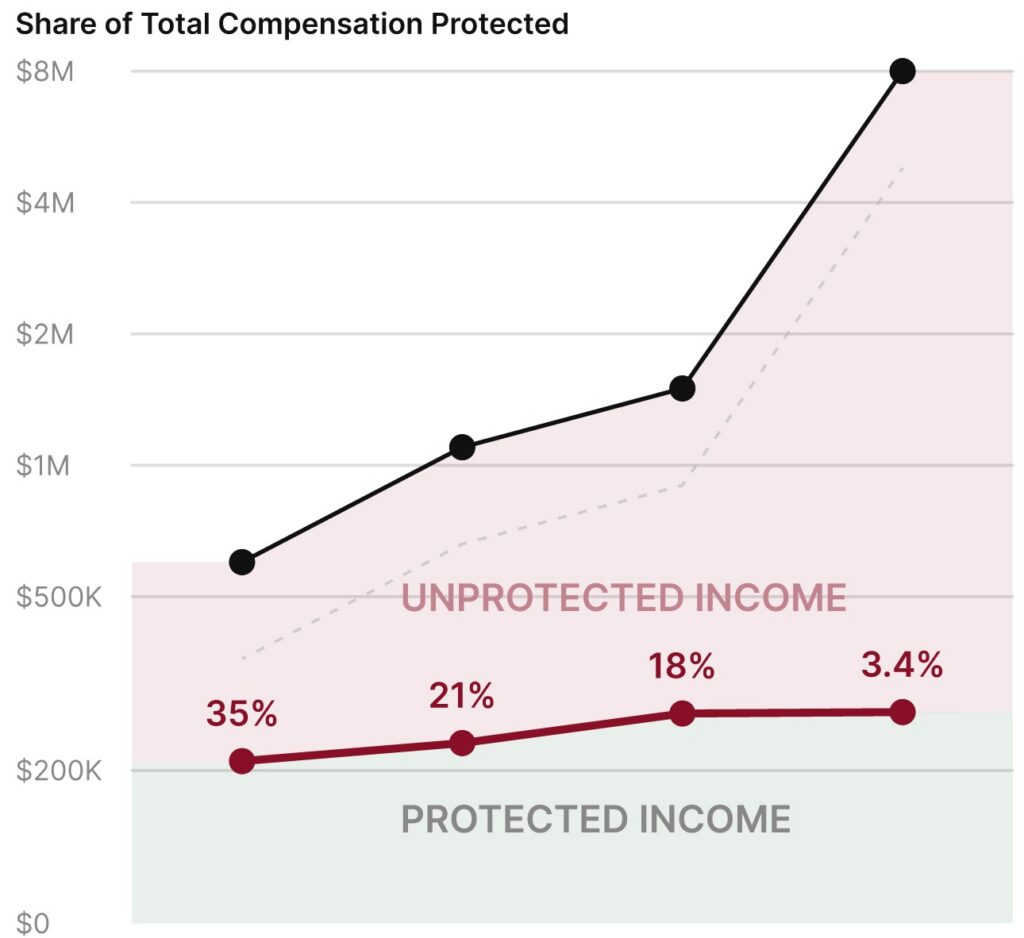

Most professionals shopping for income protection for financial services executives are healthy and years away from any claim, and they size the decision against an employee handbook that governs nothing about what their group plan pays. The handbook is a summary the employer writes, and the summary plan description filed with it is a summary as well. The group master policy is the contract that controls, and federal law lets any participant request a copy of it in writing before choosing how much individual coverage to add.
The decision point is open enrollment, or a promotion that moves compensation. A professional elects a group long-term disability benefit, reads the replacement percentage printed in the handbook, and decides whether to buy an individual policy on top of it. That benefit is described in three separate documents, and only one of them is the plan.
Three Documents Describe a Disability Plan and the Contract Governs
The employee handbook is the one document a new hire actually reads, and nothing in it binds the carrier that pays. “The handbook is a document typically produced by the employer,” said Ethan F. Abramowitz, a partner at Seltzer & Associates, P.C., who works with professionals on their disability coverage.
The summary plan description sits one level above the handbook. It is a regulated document, not an explanatory one, and the rules for how and when a plan must furnish it are published in the Electronic Code of Federal Regulations. It is still a summary, and Abramowitz points to case law holding that the summary plan description does not itself control the terms of the plan.
The third document is the group master policy, the contract between the employer and the carrier. It is the only one of the three that is not a description of something else, and it is the instrument the plan is established and operated under. Abramowitz’s own read is that “generally, the master plan is what’s going to govern,” though he notes he has not handled that specific question himself and has no case law to hand on it.
Nobody is hiding anything. The handbook orients new hires, the summary plan description exists because federal rules require a plain-language summary, and the master policy is an agreement between two institutions with no routine reason to circulate it.
The one document carrying the operative terms is the one that never arrives in the enrollment packet. That is not a filing problem so much as a sizing problem, because the number a professional builds the purchase on comes out of whichever document they happened to read.
Federal Law Entitles Plan Participants to the Disability Contract Itself
One federal statute settles who may ask for that contract and what they are owed. The Employee Retirement Income Security Act of 1974, at 29 U.S.C. 1024(b)(4), requires a plan administrator to furnish a copy of the plan’s governing instruments on written request from any participant or beneficiary. The statutory list runs to “the bargaining agreement, trust agreement, contract, or other instruments under which the plan is established or operated,” and the word “contract” in that list is what reaches the group master policy.
Two details in that sentence matter to anyone using the right. The request has to be in writing, so a verbal ask to a benefits coordinator does not count, and the administrator may make a reasonable charge to cover the cost of furnishing the copies. Both conditions sit in the statutory text published by Cornell Law School’s Legal Information Institute.
The right does not depend on a claim existing. Most professionals miss that, because the request tends to get made at the moment it is least useful, once a condition has already appeared and the coverage decision is already behind them.
Sizing Individual Disability Coverage Starts with the Governing Plan Document
The whole exercise is a single written request, sent before the coverage decision instead of after it. “Whenever I work with my clients, I request they get a copy of the actual policy,” Abramowitz said.
Three things in that contract change the size of a private policy. The covered-earnings definition sets the base the benefit is calculated on, the maximum monthly benefit caps the result regardless of that base, and the own-occupation language decides whether the material and substantial duties of a professional’s own job are the test. All three are printed in the master policy and summarized loosely, or not at all, in the handbook.
The arithmetic moves fast once those numbers are real. A financial services professional whose pay runs heavily to bonus can find the master policy calculates covered monthly earnings from base salary alone. The replacement percentage quoted at enrollment then applies to a much smaller number than total compensation.
Timing is what makes the request worth making. Asking for the contract after electing a benefit tells a professional what they already bought. Asking for it first tells them what to buy.
So the answer to whether a financial services professional should request the plan contract before buying or increasing individual disability coverage is yes, and the reason is arithmetic instead of caution. Private coverage is sized against whatever the group plan does not replace, and that figure cannot be derived from a handbook or a summary. One written request, plus whatever reasonable charge the administrator sets for copies, is the difference between a coverage decision made on the governing contract and one made on a description of it.