Lawyers don’t buy for long term disability insurance for attorneys themselves. Their firm’s HR department takes care of it.
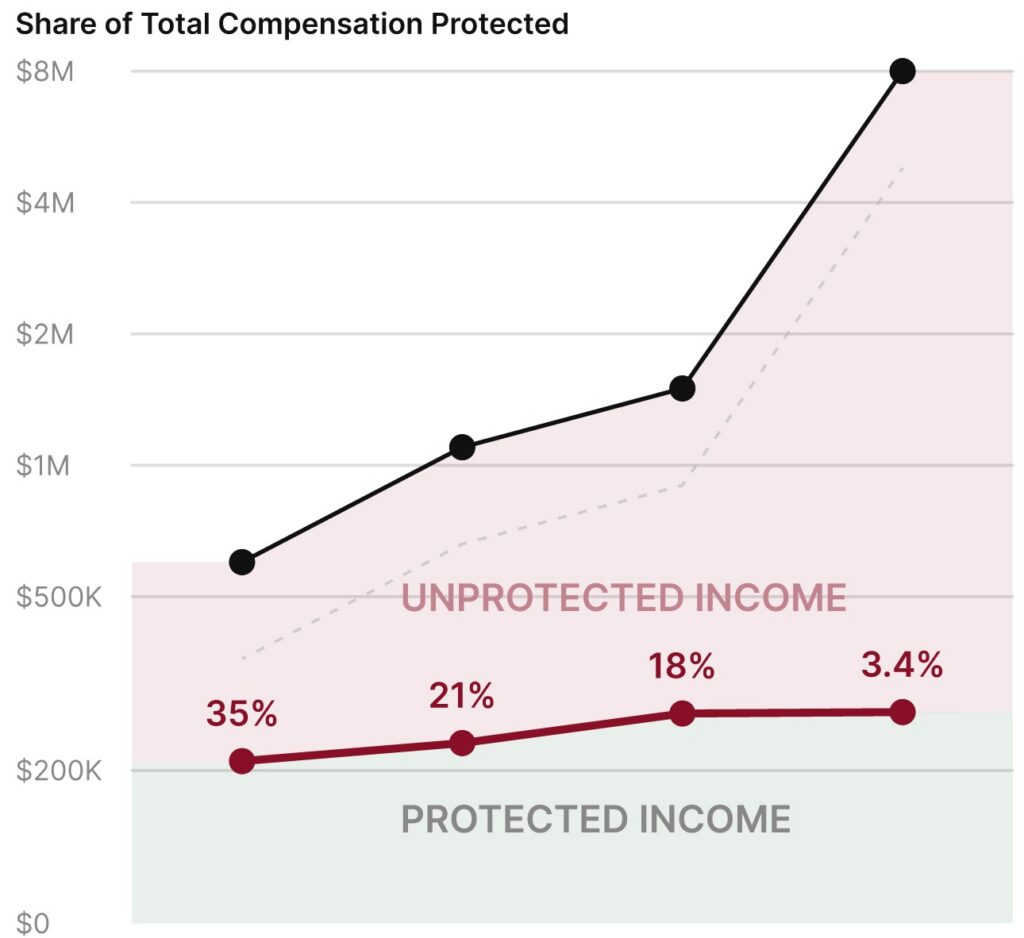
But whatever the legal practice’s group plan does cover, that benefit is probably a small fraction of what they actually take home each month.
Group LTD plans priced for an entire law firm, rather an individual plan for a partner or a senior associate, just don’t measure up, since group plans define covered income as base salary and ignore bonus and origination pay.
By the time an attorney files a claim, the shortfall between what they used to earn and what the group policy actually pays can reach tens of thousands of dollars a year.
Let’s say for example a partner develops a neurological condition, a litigator loses the stamina for trial work, or an associate is injured on the ski slopes, and read the group LTD plan document for the first time.
What they assumed was full income protection during open enrollment turns out to be a slice of their base pay (usually 60%), with monthkly benefits not exceed a certain amount, and that benefit is pre tax money.
Individual disability insurance for lawyers works much differently, depending on who owns the policy and how it defines the work being protected, and those two details are what pretty much decide everything about a claim, including why an employer-owned policy can turn into its own separate legal fight.
Group Disability Plans Come Up Short for High Earning Lawyers
A group long term disability plan usually calculates benefits from a figure called covered monthly earnings, which is the slice of pay the insurer agrees to count when it sizes a benefit. For most lawyers that figure is base salary alone. Bonus, origination credit, and partnership distributions, the pay that separates a senior attorney’s real income from a first year associate’s, frequently fall outside the definition entirely.
Ethan F. Abramowitz, a disability insurance attorney at Seltzer and Associates in Philadelphia who represents professionals in denied and disputed disability claims, described the trap on the Income Protection Journal Podcast.
“It’s crucial to look at the definition of covered monthly earnings. More often than not it says your base salary, excluding bonus and all other compensation, so for a high earner that production income is excluded when they calculate your monthly benefit.”
Ethan F. Abramowitz, disability insurance attorney at Seltzer and Associates
Layered on top of that, group benefits are usually taxable when the firm pays the premium, so a plan advertised as replacing 60% of income delivers far less. A lawyer earning most of their money through production can end up with a benefit that covers a fraction of the lifestyle and obligations that income supported, and even a plan that does pay something for reduced-hours work rarely pays enough to notice.
Group Own Occupation Coverage for Attorneys Often Expires After Twenty Four Months
The second shortfall is about how the plan defines disability itself. The strongest definition is own occupation, which means the policy pays when a covered condition prevents you from performing the duties of your own profession, even if you could earn a living doing something else. Most group plans offer a weaker version that changes after a set period.
“The biggest hole often overlooked is that many group policies have a 24 month limitation on own occupation coverage. For the first 24 months you’re covered for your occupation, and thereafter it converts to any gainful occupation.”
Ethan F. Abramowitz, disability insurance attorney at Seltzer and Associates
For an attorney the consequence is severe. A trial lawyer who can no longer withstand the demands of litigation might still be able to review documents or teach, so once the plan converts to an any occupation standard at month twenty four, the benefit can stop even though the career that generated the income is over. Group long term disability plans are also governed by the Employee Retirement Income Security Act, a federal law the U.S. Department of Labor administers, which places the appeal process and much of the burden of proof on the claimant in a way individual state regulated policies do not.
An Individually Owned Disability Policy Follows the Attorney Rather Than the Firm
An individual policy answers both problems because the attorney owns it rather than the firm. Benefits are based on documented income rather than base salary alone, a true own occupation definition can be written to last the full benefit period instead of expiring at twenty four months, and a policy paid for with post tax dollars generally pays benefits tax free. Because the lawyer owns the contract, it also travels between firms and cannot be reduced or canceled by an employer during a lateral move or a downturn.
That own-occupation language is not abstract. Guardian’s individual disability contract defines it in one sentence: “Total Disability or Totally Disabled means that, solely due to Injury or Sickness, You are not able to perform the material and substantial duties of Your Occupation. You will be Totally Disabled even if You are Gainfully Employed in another occupation so long as, solely due to Injury or Sickness, You are not able to work in Your Occupation.” (Guardian Specimen Contract) Nothing in that sentence converts after 24 months, and nothing in it depends on whether some other kind of work still exists.
That portability matters most at the moment attorneys tend to ignore coverage, which is early in a career when health is easy to underwrite and premiums lock in low. A lawyer who waits until a diagnosis appears may find the individual market closed. The practical step is to read the firm plan for its covered earnings definition and its own occupation period, then decide whether an individual disability policy for attorneys should sit alongside the group benefit to cover the income the group plan leaves exposed.
None of this makes the firm plan worthless. It makes it a floor rather than a ceiling. For a professional whose entire earning power rests on a specific and demanding kind of work, the difference between a group plan and an owned own occupation contract is the difference between a partial cushion and coverage that actually matches the career it is meant to protect.