
Podcast: Play in new window | Download (Duration: 39:38 — 90.7MB) | Embed
Subscribe Apple Podcasts | Spotify | RSS | More
Most practice owners have never priced what it would cost to keep a practice’s bills paid if the owner could not work. In 2020, Maxwell Schmitz’s mother needed a lung transplant. For decades she had run the underwriting and case-management side of the family’s insurance agency, the person who reviewed every application before it went out the door, and her family had to decide, in the middle of that, what happened to her paycheck.
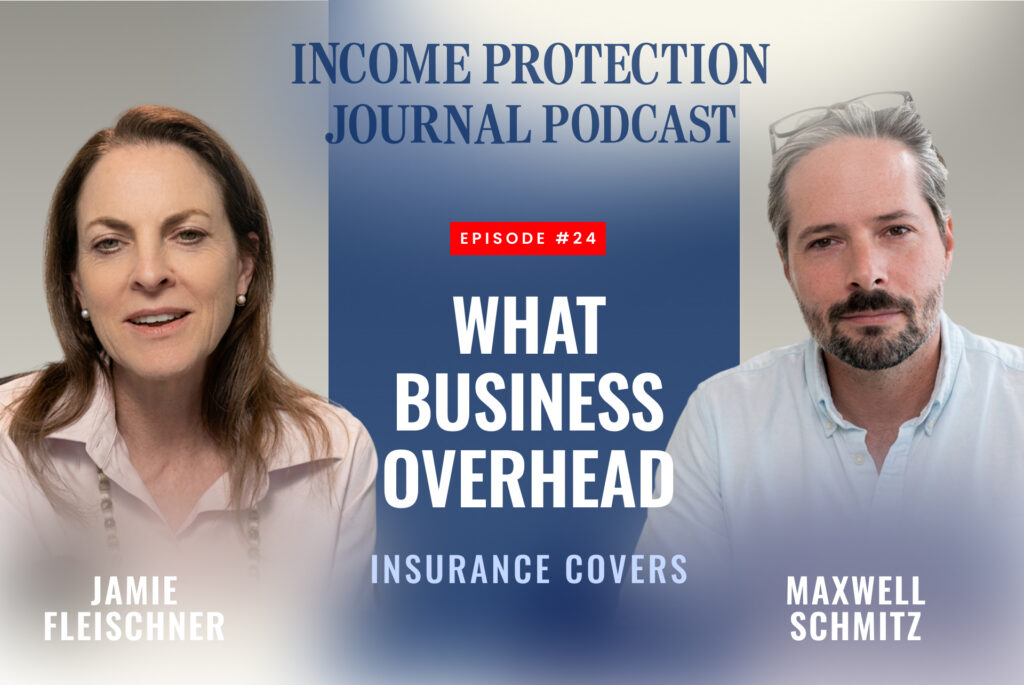
I talked through that decision with Maxwell Schmitz, President of Yetworth Insurance Solutions, a wholesale disability brokerage his family has run for three generations out of San Rafael, California, and a past president of the International Disability Insurance Society, on this episode of the Income Protection Journal Podcast. His mother’s own individual disability policy meant the agency never had to pull her salary out of the business to cover her. That money stayed in, and the family used it to hire someone new and automate some of the work she used to do by hand. What her family did not have, and what most business owners in the same position still do not have, is a second policy built to cover everything else a practice needs to keep running while the owner is out.
The Difference Between an Individual Disability Policy and a Business Overhead Expense Policy
Maxwell told me the mix-up he runs into most often is between two products that sound alike but pay two different bills.
Key person typically denotes that this is going to be a non-owner employee, and then that you know, if they go down, if that non-owner employee goes down, the benefits are paid to the business to then find a replacement… The key person policy, whereas a business overhead expense policy is designed to just protect the business owner. If that person can no longer operate the business, then it will come in and pay the salaries, the benefits, keep the lights on, the mortgage or the rent, you know, and any other sort of regular equipment that the firm or practice or clinic needs to keep operations running smoothly.
Maxwell Schmitz, President of Yetworth Insurance Solutions, a wholesale disability brokerage his family has run for three generations, on the Income Protection Journal Podcast
The distinction matters because owners often assume one policy does both jobs. It does not. An individual disability policy, which is what covered his mother, replaces the income the owner would have earned. A separate overhead expense policy for the practice pays the practice’s own bills instead, rent, payroll, malpractice premiums, and equipment, while the owner recovers. Maxwell has watched the two get confused often enough that a business owner ends up asking a carrier for what is really a key person benefit, and the reverse happens just as often. They are not interchangeable, and a practice that buys only one of the two still leaves the other side uncovered.
What a Solo Practice Loses Without Overhead Expense Coverage
Maxwell walked me through why overhead expense coverage matters most for small, owner-dependent practices, the kind with one clinician and a small staff behind them.
If you can’t have the dentist seeing people, then of course revenue is going to dry up, and when revenue dries up, you can’t pay the employees, and those employees are going to have to go work for the dentist down the street.
Maxwell Schmitz, past president of the International Disability Insurance Society, on the Income Protection Journal Podcast
That is not a hypothetical for Maxwell. His own family’s agency runs on five people, and he watches the same math inside his own business. A practice does not lose revenue gradually when the person who generates it stops working. It stops close to immediately, and staff without a paycheck do not wait around to see whether the practice recovers before they take a job somewhere else.
Why the Individual Disability Policy Comes First
Given how much of Maxwell’s own work is designing overhead expense cases for advisors, I expected him to lead every conversation with the product he sells the most. He told me the opposite is true.
Instead of leading straight to the business overhead expense conversation… What gets overlooked, I think, in the BOE conversation is how relevant and important the individual disability insurance policy is.
Maxwell Schmitz, MSFS, CLTC, DIA, on the Income Protection Journal Podcast
His reasoning traces back to his own family’s experience. His mother’s individual disability policy did more for the business than either of them expected going in, because it meant her paycheck never had to come out of the agency’s revenue in the first place. Business overhead expense insurance is worth what it costs, Maxwell said, but it solves a narrower problem than most owners assume, and it should never be the first conversation a practice owner has about disability coverage.
Maxwell’s family found out, in the middle of an actual medical crisis, exactly which policy did what. Most practice owners find out the same way, after something has already gone wrong. If a practice’s disability coverage has never been checked against the specific bills an overhead expense policy is built to pay, rent, payroll, malpractice premiums, and the loans and equipment leases that do not pause just because the owner is out, that is the conversation worth having before there is a real deadline attached to it.