
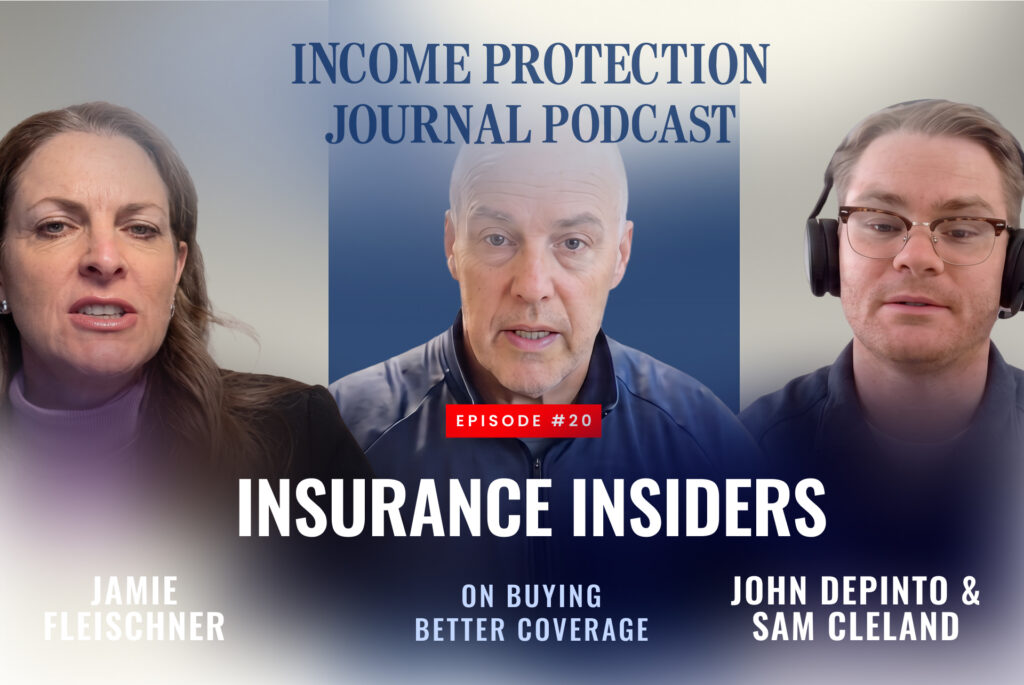
Podcast: Play in new window | Download (Duration: 1:03:24 — 145.1MB) | Embed
Subscribe Apple Podcasts | Spotify | RSS | More
The state makes you insure your car, the bank makes you insure your house, a lease makes you insure a rented apartment. The one insurance coverage nobody requires you to carry is the protection on the income that pays for all of it. Stop that paycheck and every required insurance policy behind it begins to lapse, one bill at a time.
The coverage that protects the paycheck itself has a name. Income protection insurance pays a monthly benefit when illness or injury stops the earnings, and no law, lender or landlord requires anyone to carry it.
That dependency is what I wanted to examine from the property and casualty side, so on the Income Protection Journal Podcast I sat down with two brokers who watch it play out every day. John DePinto is Executive Vice President of Alkeme Insurance, a 30-year veteran who spent his first six years handling auto-injury and income-loss claims at Progressive in the mid-1990s before running his own Colorado agency until Alkeme acquired it in 2026.
Sam Cleland is a producer at Alkeme in Denver, roughly two months into the business, new to the industry, and the third generation in our family’s Colorado insurance line. He is also my nephew.
John and I do not sell the same thing, and he is quick to say so. His world is homeowners, auto, liability, umbrella, professional liability and cyber. Mine is income.
He described the arrangement as two sides of the same coin, part of what he calls a financial village where each specialist stays in a lane, and he was blunt that disability, life and long-term care are not his lane. That honesty matters, because the person selling you the coverage the state demands is rarely the person thinking about the coverage no one demands.
Here is the claim I want a reader to be able to carry out of this piece whole. Health insurance pays the hospital, not the mortgage. The medical coverage on an auto policy pays only when a car is involved.
Employer disability coverage belongs to the employer and stays behind the day the job ends. Whether the paycheck comes from a surgical schedule, a law practice or a business a client built, it is the one asset no required policy was written to replace.
Income Protection Sits Outside the Coverage Others Require
Every policy a working professional carries was put there by someone with authority over the purchase. The income policy is the exception, and that is exactly why it gets skipped. Sam described the disconnect from the vantage of someone who was buying his own coverage for the first time not long ago.
Everything is connected in a way that people don’t realize. They view insurance as just another box they have to check, something they have to carry, and they don’t realize how intertwined it can be with your income, with your job, with your living.
Sam Cleland, a producer at Alkeme Insurance in Denver who entered the property and casualty business in 2026, on the Income Protection Journal Podcast
The connection he means runs straight to income. Take away the paycheck and the client cannot pay the auto premium, the homeowner’s premium or the renter’s coverage that the state, the bank and the lease all demanded in the first place. Without the income underneath it, the whole structure comes down in order.
Employer Disability Coverage Answers Less Than Buyers Assume
The most common reason a professional skips an individual policy is a belief that work already handles it. John spent his early years on the claims side, watching what actually happened to a person’s income after a serious accident.
Small employers make accommodations for a while, he told me, then they have to fill the position and move on. What is left is often Social Security disability, a benefit built for a different purpose and a fraction of a professional’s earnings.
The coverage an employer provides belongs to the employer, not to the worker. Change jobs and it stays behind.
Get hurt in a way the group plan’s definition does not recognize and it may never pay at all. This is the exact question I answer when a client asks how a policy they own would sit against the plan at work, and it is worth reading how an individual policy compares with an employer’s group plan before assuming the plan at the office is enough.
John’s rule after three decades of watching claims is simpler than any actuary’s table.
If you’re depending upon somebody else’s coverage to make sure you have enough money in case you can’t work, that’s a fool’s errand in my opinion. You need to make sure you’re protecting yourself and not rely on other people, hoping that they have the proper coverage, because in a lot of circumstances that’s simply not going to be the case.
John DePinto, who ran his own independent Colorado property and casualty agency for more than two decades before Alkeme Insurance acquired it in 2026, speaking on the Income Protection Journal Podcast
Depending on an at-fault driver’s limits, or on an employer’s plan, is a bet that some other party bought enough coverage for your life. From the claims desk, John watched how often they had not.
Claims Desk Lessons on Protecting Your Own Income
Two of the sharpest exchanges in the episode came from Reddit, where I pulled real posts off the r/Insurance forum and asked John to answer them. The first came from a government worker who carries full health insurance and employer disability coverage and could not see why he would pay for uninsured motorist, income-loss or medical coverage on his auto policy.
The second, from a New York driver, said he could not think of a single scenario where extra income-loss or personal injury protection would ever make sense. John has spent time on the claims side of exactly these files.
The elements that go into an uninsured motorist claim, the potential exposure to medical bills, lost wages. What happens if you’re so disabled that you can never work again? What happens if there has to be modifications to your home because now you’re in a wheelchair?
John DePinto, Executive Vice President of Alkeme Insurance, who spent his first six years handling auto-injury and income-loss claims at Progressive, on the Income Protection Journal Podcast
His answer lands because the auto claim and the health plan both have edges the buyer never reads. Health insurance may cover 10 chiropractic visits when the accident calls for 60. The at-fault driver may carry a Colorado minimum of $25,000, total, not per month.
None of it replaces a paycheck for the years a real disability can last. Sam put the reframe in one line built for a billboard.
Insurance isn’t your enemy, it’s your protector.
Sam Cleland, third-generation Colorado insurance producer in his first months at Alkeme Insurance, on the Income Protection Journal Podcast
That is the shift I want every professional to make before the worst day arrives, not during it. I have sat with clients who walked into a hospital certain it would never be them.
Their required policies were all in force. The one that would have replaced the income was the one no one had ever made them buy.
I keep coming back to a plain idea. You do not want to rely on the government or an employer for the money that runs your life. Buying income protection is the one insurance decision that is entirely yours, and it is the decision that keeps every other policy paid on the day a paycheck stops.
Editor’s note. Sam Cleland is my nephew and the third generation in our family’s Colorado insurance business.