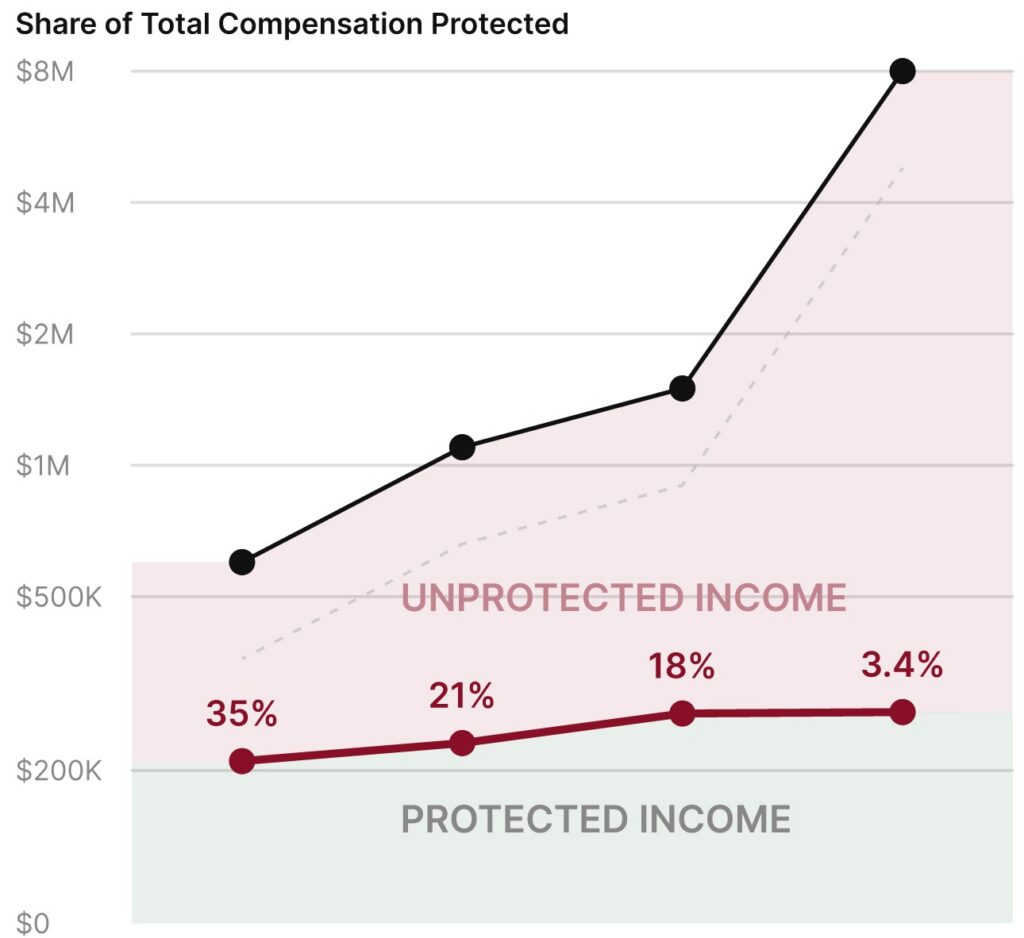

An interventional cardiologist who tears a cervical disc can still round on inpatients, read echocardiograms, and run a full clinic schedule. That physician is not totally disabled, yet the catheterization and ablation work that built the practice, and most of its income, is gone. Whether a disability policy pays in that situation is decided by its occupational definition and its residual terms, not by the size of the paycheck that stopped.
That sequence, procedural capability lost long before a physician meets any definition of total disability, is the specific risk that separates disability insurance for cardiologists from coverage written for non-procedural doctors. A widely cited survey of interventional cardiologists found that 19.5 percent had sustained orthopedic or musculoskeletal injuries tied to lead-apron weight, prolonged standing, and radiation exposure. Injuries like these rarely end a career outright.
They end the procedural portion of it first, which for an interventionalist is the portion that pays. A back or shoulder condition that would be a workable limitation for a clinic-based internist can remove the exact capability a cardiologist is paid the most to perform.
For many physicians, the decision to step back from the table is clinical before it is financial.
“I never want someone out there practicing medicine when it’s no longer safe for them to do it, because they’re putting their financial stability ahead of what’s right.”
Ethan F. Abramowitz, disability insurance attorney at Seltzer & Associates, on the Income Protection Journal Podcast
How Occupational Class Shapes Disability Insurance for Cardiologists
Every major carrier classifies physicians by medical specialty, and the class assigned to a cardiologist sets both the premium and the strength of the definition before a claim is ever filed. General cardiologists, whose work centers on clinic care and non-invasive diagnostics, usually qualify for the strongest medical class a carrier offers. Interventional cardiologists carry the physical risk of catheterization-lab work, so carriers weigh that procedural exposure when they assign a class and price the contract.
The same logic explains why The Standard breaks surgeons out into a separate 4S class rather than pricing them alongside non-procedural physicians. The comparison below shows how the five carriers Set for Life Insurance most often places physician contracts with structure that classification, alongside the provisions that decide a claim once procedural ability is lost.
| Carrier | Classifies physicians by specialty | Top physician class | Procedure / hands-on own-occupation provision | Residual (partial) income-loss trigger |
|---|---|---|---|---|
| Guardian (Berkshire Life Insurance Company of America) | Yes, full specialty listing | 6M | Pays the full monthly benefit when the insured loses the ability to perform any procedures, even when procedures were a small share of income | Income-loss formula, no explicit percentage floor |
| Ameritas | Yes, within M classes | 6M | Hands-on Patient Care and Surgical Procedure enhancements confirm specialty own-occupation | 15 percent income loss, among the lowest thresholds available |
| MassMutual | Yes, split among 5P, 4P, 3P | 5P | Specialty own-occupation confirmed for a single recognized medical specialty | Extended Partial rider, proportional to income loss |
| Principal | Yes, extensive M-class specialty listing | 6M | True own-occupation available as an add-on | Enhanced Residual rider, 20 percent income-loss trigger |
| The Standard | Yes, split among 5P, 4P, 4S for surgeons, 3P | 5P | Three-tier residual structure layers partial protection | Basic, Enhanced, and Short-Term residual options |
The distinction that matters for an interventionalist sits in the two right-hand columns. The occupational class sets the price.
The own-occupation and residual language decides whether a cardiologist who can no longer stand at the table, but can still see patients, collects anything at all. It is the reason two cardiologists with similar incomes can hold policies that behave very differently at claim time, depending on which carrier wrote the definition and how the specialty was classified at issue.
Policy Terms That Pay a Cardiologist Who Stops Doing Procedures
True own-occupation coverage, the strongest definition available to a physician, classifies a cardiologist as disabled when they cannot perform the duties of their cardiology specialty, even if they remain able to work in another role. Guardian applies that principle at its most concrete. Under its physician contract, a cardiologist who performs ablations part of the week and sees clinic patients the rest of it, and who loses the ability to perform any procedures, receives the full monthly benefit.
The share of total income the procedures represented does not change the result. The loss of the procedural duty itself is what triggers the benefit.
For cardiologists who keep some procedural work but at reduced volume, residual disability coverage answers a different question. It pays a proportional benefit when income falls because capability falls, without requiring a period of total disability first. Ameritas begins residual benefits at a 15 percent income loss, one of the lowest thresholds in the market, and every major carrier now allows residual benefits to start without a prior total-disability period.
Because medical billing often lags the work by 90 days or more, carriers measure a residual claim on both income received and hours documented, which lets a cardiologist whose case volume is falling collect while the decline is still underway rather than only after it settles. The same procedural logic drives specialty-specific protection for radiologists, whose interventional work carries a comparable risk profile.
Buying Cardiologist Disability Coverage Before the Interventional Transition
The classification that carries the lowest premium is easiest to obtain before procedural duties expand. A physician who secures disability insurance for cardiologists while still practicing general cardiology often locks a stronger class and a lower premium, then keeps that specialty own-occupation protection as interventional work begins. Future Increase Options preserve access to higher benefit limits as cardiovascular compensation climbs, without new medical underwriting.
A non-cancelable contract holds that premium for the life of the policy, so a class secured early is not repriced when the physician moves into the catheterization lab. For a cardiology fellow or a new general attending, that timing is the single most consequential decision in the contract, because the class and definition secured at issue travel with the policy for decades.
About 1 in 4 of today’s 20-year-olds will become disabled before age 67, according to the Social Security Administration. Across roughly 47,000 practicing cardiologists nationwide, those odds vary by subspecialty, but the structure of the risk does not. Procedural income stops before total disability does, and only the occupational class and the definition written into the contract decide what that interruption costs.