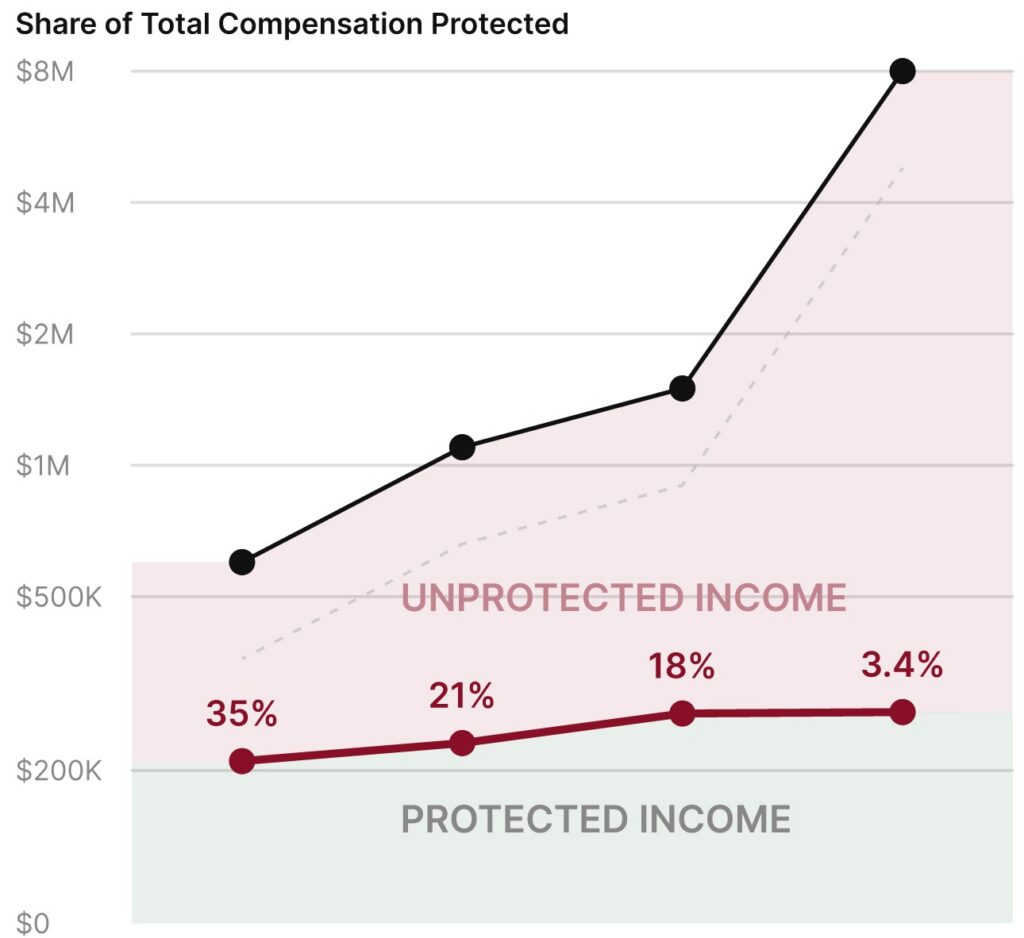

Chase Bisontis was the 34th player selected in the 2026 NFL Draft, an offensive lineman now on the Arizona Cardinals’ roster with a four-year contract worth $13.25 million. The player selected two picks earlier, at number 32, received a fully guaranteed contract worth $16.7 million. Those two picks and the structural difference between them define the largest proportional disability insurance gap in the draft.
For players and advisors working through individual disability coverage for NFL players at this tier, the distinction is not a rounding error. Round 1 contracts are fully guaranteed.
Round 2 contracts, starting at pick 33, are partially guaranteed. The signing bonus is locked in at execution, but the base salaries that follow are not protected the same way.
The income protection market for professional athletes prices coverage based on what the contract actually guarantees, not on its headline value. At pick 34, those two figures are different.
What the Guarantee Structure Means for Disability Insurance at This Tier
Bisontis’s $13.25 million contract with Arizona includes a $6.1 million signing bonus, which is guaranteed at signing. The remaining value of the deal, spread across four years of base salaries, is subject to the partial guarantee structure that governs all Round 2 contracts.
The difference between Bisontis’s contract and the one signed two picks earlier is not primarily a dollar difference. It is a structural one.
The player at pick 32 received $16.7 million with every dollar guaranteed. The player at pick 34 received $13.25 million with a meaningful portion contingent on staying healthy and on the roster.
The CBA’s Injury Protection Benefit, capped at $2.1 million for the current league years, provides a floor when a player is injured and cannot complete his contract. For a first-round player on a $16.7 million fully guaranteed deal, that $2.1 million is supplemental. For a second-round player on a $13.25 million partially guaranteed deal, the same $2.1 million is covering a proportionally larger share of the unprotected portion of the contract, while the total benefit remains capped at the same amount.
The fifth-year team option, which gives first-round players a bridge toward their second contract, is not available at pick 33 and beyond. A player drafted in Round 2 who develops into a starter completes his four-year rookie deal and enters free agency without the extension runway that first-round picks receive.
That compressed timeline is not a CBA issue alone. It is the window in which a career-ending disability event leaves the player with no additional contract to fall back on.
Why Disability Coverage for Early Second-Round Picks Has a Different Starting Point
PTD coverage is available to all drafted players, and Bisontis qualifies. The insurance conversation for a player at this tier is not whether coverage exists but when the conversation happens and how the product is sized.
Players in the picks 33-65 range often wait until year three or four of their rookie deal before engaging the specialty market. Eric Chenowith, chief executive of Leverage Disability and a specialty broker with 13 years of placement experience across all six Lloyd’s coverholders in the United States, describes the PTD conversation for second-round picks as one that belongs at signing but rarely happens there.
The reasoning is practical: players want to establish themselves on the roster before committing to premiums, and PTD pricing for a professional offensive lineman runs $8,000 to $10,000 per million of coverage, a meaningful expense against a Year 1 base salary of $2.4 million. The consequence of that delay is that years two and three, the window of maximum uninsured exposure before the player is established, pass without coverage in place.
Loss-of-value coverage is not available to Bisontis at the rookie stage. LOV requires demonstrated market value, which second-round players do not have at signing.
That conversation opens in year four, if the player has developed into a starter whose market value is documentable and his next contract is imminent. At that point, a specialty underwriter sets a loss threshold based on what a player of that caliber commands on the open market. If the player then signs a contract below that threshold because a covered injury reduced his earning power, the policy pays the difference up to the benefit maximum purchased.
For an offensive lineman who plays four years of productive football, that window is real. For a player whose career is disrupted by a shoulder injury in year two, the LOV conversation never happens.
The underwriting timeline runs approximately two weeks with complete records and closer to a month in practice. The bottleneck is athletic training records from the player’s team, not the underwriting decision itself. A player who wants PTD coverage in place before his second season needs to initiate the process in the offseason, not after training camp begins.
The Second Contract as the Real Uninsured Exposure
The disability insurance conversation for a player like Bisontis is not primarily about the $13.25 million rookie deal. A career-ending injury in year two would trigger the CBA benefit, the guaranteed signing bonus is already paid, and the PTD policy would pay its lump-sum benefit on top of that.
The financial floor exists. How that floor is constructed across every draft tier in 2026 is covered in the disability insurance gap facing every player drafted in the 2026 class.
What is not insured at the rookie stage is the second contract.
A starting interior offensive lineman who completes his rookie deal has built market value in the $10 to $20 million per year range. That is the contract a career-ending injury in year three eliminates entirely. No product in the specialty Lloyd’s market is sized to replace $40 to $80 million in second-contract earnings at the rookie stage.
The PTD lump sum, sized to what the player can afford to purchase in years one through four, is the available tool. It produces a financial floor.
It does not replicate what the second contract would have been. At the quarterback tier, the second-contract gap runs into the hundreds of millions, and the specialty market’s ceiling against it is a specific, documented figure.
The players most exposed at this tier are not the ones who fail to develop. They are the players who develop into starters, who play well enough that the second contract is real and the stakes are highest, and who did not initiate the disability insurance conversation until year three or four.
By then, years two and three have passed uninsured. The window of maximum exposure, when career option value was high and coverage was absent, has already closed.
The gap at picks 33 to 65 is not one that a single policy solves. It is the combination of a partially guaranteed rookie contract, no fifth-year option, no LOV at the rookie stage, and a second contract that disability insurance cannot reach.
Each piece is manageable individually. Together, they make this the tier where the arithmetic of coverage versus exposure is hardest to close.