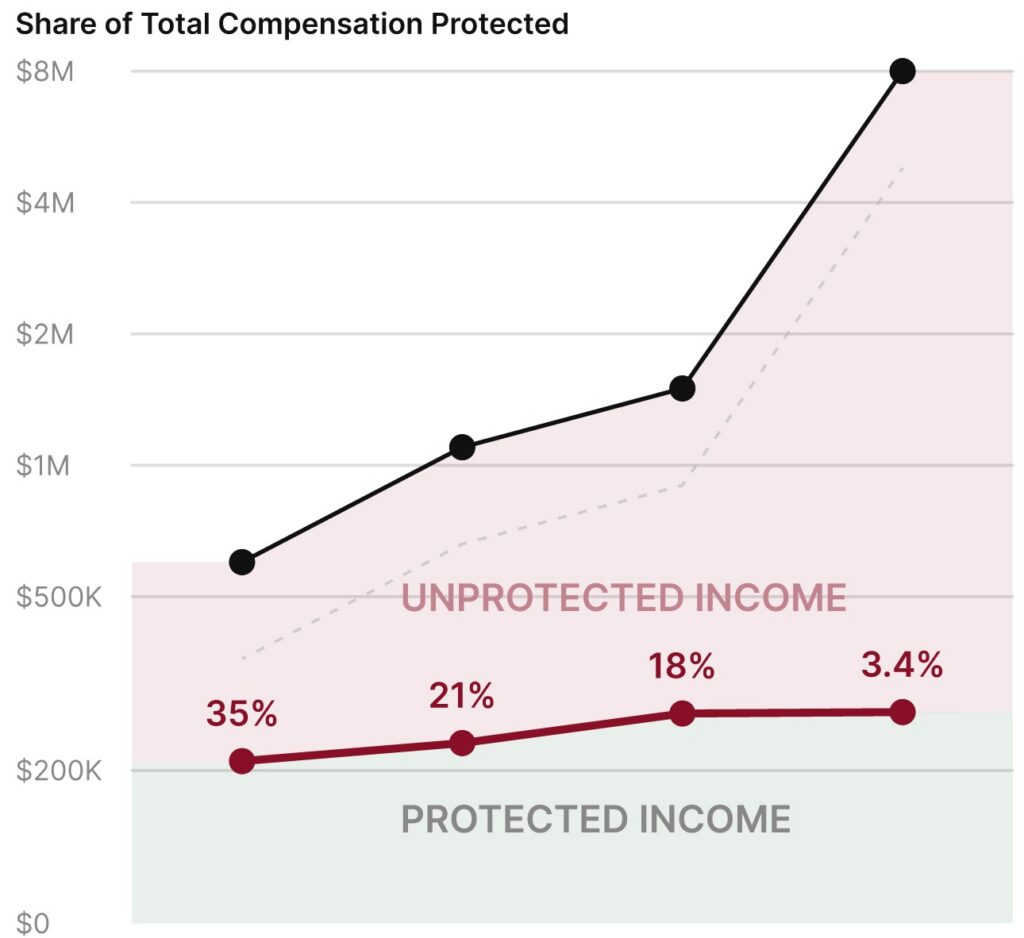

A franchise quarterback who blows out his knee loses something that guarantees on his contract don’t cover. His rookie money may be protected. But what vanishes are any hopes of a contract extension.
That second contract, for a starting franchise quarterback entering his prime, projects at $250 million to $400 million. The specialty Lloyd’s market offers disability insurance for NFL athletes specifically built for this exposure. None of it is sized to replace that number.
The tools the market offers for second-contract exposure are specific, sequenced, and capped. For anyone working through income protection for professional athletes at this level, that ceiling is the first thing to understand.
What the Rookie Contract Leaves Exposed
The rookie contract framework for first-round NFL picks is documented in unusual public detail. A number one overall pick in 2026 signs a fully guaranteed four-year deal worth approximately $54.6 million, with a fifth-year team option projected in the $25 to $35 million range depending on performance triggers.
The signing bonus arrives at execution. The guarantees are enforceable.
In a career-ending injury scenario during the first two years of that deal, nearly all of the rookie contract is already paid or legally owed. The CBA’s Article 45 Injury Protection Benefit, capped at $2.1 million for the 2025 to 2026 league years, provides additional support, though its annual cap is a fraction of any first-round rookie contract total. The financial loss from the rookie deal itself, in this scenario, is relatively contained.
The exposure that is not contained is the second contract.
The franchise quarterback second-contract market is anchored by the largest extensions in recent NFL history. Patrick Mahomes signed a 10-year, $450 million extension with the Kansas City Chiefs in July 2020, with cap hits escalating to $68.6 million by 2026. Joe Burrow signed a five-year, $275 million extension with the Cincinnati Bengals in September 2023, with $219 million guaranteed and an average annual value of $55 million.
Those figures define where a successful first-round quarterback lands after his rookie deal. A career-ending injury in year two or three of the rookie deal eliminates not the rookie contract, which is largely secured, but the second contract entirely.
No disability insurance product in the specialty Lloyd’s market is sized to cover $250 million to $400 million in projected second-contract earnings. Underwriters would not write it. The cost-benefit math does not support it at the application stage, and the specialty market does not offer policy amounts at that scale for individual athlete applicants.
What the Specialty Market Offers
Two products in the specialty market address second-contract exposure, and they are designed to work in sequence. The disability insurance gap during the rookie years that precede that second contract, across every round of the 2026 draft, is covered in how the 2026 draft exposed the disability insurance gap for every rookie in the class.
Permanent total disability insurance is the first tool, purchased at or near rookie contract signing. Eric Chenowith, the chief executive of Leverage Disability, whose firm has placed specialty disability coverage for professional athletes across all six Lloyd’s coverholders in the United States, describes the largest quarterback package he is aware of as $25 million in permanent total disability coverage combined with $2 million in critical injury benefits and $5 million in loss-of-value coverage, placed for an Alabama quarterback before a bowl game.
That package protects against a career-ending disability event and provides a benefit on specific named injuries. It does not replace the second contract. It provides a financial floor sized to the highest coverage amounts the specialty market currently places for a quarterback at the pre-professional stage.
Loss-of-value coverage, purchased in year four of the rookie deal as the player approaches free agency, is the second tool. It covers the gap between what the player was projected to earn on his next contract and what he signs for after an injury has reduced his market value. A wide receiver with two 1,000-yard seasons who suffers a knee injury late in his rookie deal and can only sign a one-year contract at significantly below his market rate might collect loss-of-value benefits sized to the difference between projected market value and the contract value he received.
The ceiling matters here. The maximum loss-of-value coverage available for a top-five pick today is $5 million. Only three of the six current coverholders in the specialty market offer loss-of-value coverage at all, and those three structure it differently from one another.
One uses a two-page appendix of specifically named injuries: the player must suffer a listed injury and then fall past the draft threshold. A second requires any injury or illness that causes the player to miss at least 60 days, followed by a fall past the offer threshold. Both structures share the same basic constraint: the slide must be tied to an injury or illness.
A player cannot collect simply because teams lost interest or because he played poorly. The threshold itself has grown more conservative over the past decade as underwriters absorbed a high volume of claims.
Thirteen years ago, a player projected in the top five who fell to pick 15 in contract value might have collected. Today, the threshold is set at falling out of the first round entirely before any benefit triggers.
The maximum loss-of-value coverage available for a top-five pick is $5 million. The second contract it is meant to protect is priced in the hundreds of millions. The gap between those two figures is the uninsured portion of a successful NFL career.
Most players at the top of the current draft are bypassing loss-of-value coverage in favor of the combination of permanent total disability and critical injury coverage, which pays on a named injury without requiring both a clinical event and a subsequent contract shortfall. That shift reflects a market that has made loss-of-value coverage harder to collect on while critical injury coverage has become more accessible and produced more claims. What that ceiling means for specific players whose careers ended before a floor was secured is documented across five career arcs and one tier the specialty market cannot reach at all.
The Year-Four Coverage Decision
The standard sequencing in the specialty market starts with PTD at rookie contract signing, then adds loss-of-value coverage in year four when market value is established and the second contract is imminent. The logic is that PTD protects the rookie deal, while LOV is timed to protect the second-contract window.
The failure mode is the player who reaches year four without any coverage in place, because the advisory conversation never happened at signing or was deferred until the situation felt more urgent. In that scenario, the window of maximum uninsured exposure in years two and three has already passed. The PTD conversation belongs at signing.
Year four is when the LOV conversation begins. Those are two separate events, and they require two separate advisory actions at two different points in the rookie deal.
For players who want to understand how income protection for professional athletes is structured across the arc of a professional career, the second-contract exposure is where the largest gap sits. The market ceiling for that exposure is $5 million in loss-of-value coverage for a top-five pick and $25 million in permanent total disability coverage for a franchise quarterback. Against a $54 million rookie deal, those figures provide partial coverage. Against the contract a career-ending injury cancels, they do not close the gap. The advisory gap that keeps most players from having this conversation at signing is a separate problem. How the specialty disability insurance products available to NFL players are structured determines the ceiling on every conversation that does happen.
Three years into a franchise quarterback career, a torn ACL ends everything. The tools the specialty market offers produce a financial floor.
They do not replace the contract. The arithmetic does not close.