
The disability insurance question for a professional football player is a very specific actuarial problem: when a career ends through critical injury, there’s always an income floor in place, but how low is it? The specialty career-ending disability insurance for NFL players answers that question when a policy gets sold. But what it doesn’t do is answer retroactively.
Earl Campbell’s career produced 2,187 rushing attempts across nine NFL seasons, a 1977 Heisman Trophy at the University of Texas, a first-overall selection by the Houston Oilers, and a Pro Football Hall of Fame induction in Canton, Ohio in 1991.
But that field time also resulted in a severe case spinal stenosis, chronic inflammatory demyelinating polyneuropathy, and five back surgeries since 1999 that left him using a wheelchair, a walker, and a cane.
Doctors who reviewed his imaging said that by modern medical standards, he never should have been cleared to play. Whether an income floor was in place is the question his situation raises, which is the exact same question every career-ending disability event raises for every football player in the specialty market.
Four Career Arcs and the Insurance Coverage Question
Earl Campbell
Earl Campbell played in an era before modern spinal imaging protocols, before the Collective Bargaining Agreement offered the disability benefit structure that exists today, and before routine pre-participation assessments of the kind that might have flagged his spinal condition as disqualifying.
His diagnoses are physical and orthopedic in origin, not neurocognitive. A career-ending disability claim of this type, permanent total disability arising from spinal and neurological deterioration directly attributable to the demands of his position, would not be excluded under the standard mental and neurocognitive disorders provision that appears in modern Lloyd’s athlete disability policies. His conditions fall clearly within the physical disability definitions that PTD coverage is built to address.
The income protection question in Campbell’s case is direct. A permanent total disability policy sized to a fraction of his career contract value, paid out at career end, would have created an income floor that remained intact regardless of what happened to his physical condition in the decades that followed.
The policy cannot reverse spinal stenosis. It cannot undo the five surgeries.
What it can do is ensure that the financial consequences of a physically destroyed career are separated from the medical ones. The former running back with a body the game consumed has a source of income that did not require him to keep playing.
Bernie Kosar
Bernie Kosar filed for bankruptcy in 2009. At various points in his post-career life, he was providing financial support to between 25 and 50 families. A private accounting revealed that his father had been siphoning money from him for personal expenses and held a secret $1 million side arrangement with the Cleveland Browns.
A costly divorce compounded the losses. His financial story was documented in the ESPN 30 for 30 film “Broke” in 2012.
His health situation is separate from his financial story, though both involve consequences of his playing career. Kosar has spoken publicly about concussion-related symptoms including insomnia, slurred speech, and persistent ringing in his ears. His condition has not been formally diagnosed as chronic traumatic encephalopathy in public reporting.
The insurance implication in Kosar’s case is specific. A permanent total disability policy produces a lump-sum payment at the time of claim.
That payment belongs to the policyholder. It cannot be redirected through family financial arrangements. It is not accessible to someone holding a side agreement with the player’s former team.
It does not flow through the investment accounts and financial structures that mismanagement tends to run through. Coverage does not prevent the betrayal. It creates one protected pool of capital that exists outside the channels through which the rest of the money disappeared.
RG3
Robert Griffin III was selected second overall by Washington in the 2012 NFL Draft and won the Associated Press Offensive Rookie of the Year award that season. His career-ending knee injury came in the 2013 NFC Wild Card game against the Seattle Seahawks: a torn anterior cruciate ligament, torn lateral collateral ligament, and torn meniscus sustained in a single play in the fourth quarter. He never recovered the explosiveness that made him a consensus top pick.
His career cycled through Washington, Cleveland, and Baltimore before ending. He is now an active broadcast personality, working as an NFL commentator.
Whether Griffin held private disability coverage during his career is not part of the public record. It should not be stated as fact in either direction.
What is part of the public record is the outcome: a player who suffered one of the most publicized career-ending knee injuries in recent NFL history rebuilt a professional life in a second field. His post-career stability illustrates what the specialty disability insurance market aims to produce: a player who can make choices from a position of financial stability after a career-ending injury, rather than from a position of financial necessity.
Whether insurance was the mechanism that made that possible in his case cannot be confirmed from outside his advisory circle. His value as a case study is in the contrast: the outcome looks like what coverage is supposed to protect, regardless of whether it was coverage that produced it.
Johnny Manziel
Johnny Manziel won the 2012 Heisman Trophy at Texas A&M University, becoming the first freshman in the award’s history to win it. He was drafted 22nd overall by the Cleveland Browns in the 2014 NFL Draft. His career ended by 2016 through conduct violations and addiction, not through physical disability.
The disability insurance market has no product for this outcome. Disgrace insurance exists in the specialty Lloyd’s market, but it does not function as standalone player income protection. It is a loan security product.
When a player takes out a hard money loan from a private lender to purchase a vehicle, real estate, or other assets, the lender requires three policies as conditions of the loan: disability insurance, life insurance, and disgrace insurance. All three exist to protect the lender if the player cannot repay the loan.
The disgrace coverage triggers when the player engages in disqualifying conduct and misses more than half a season as a result. The beneficiary is the lender, not the player.
No product in the specialty market pays a benefit directly to a player whose career ends through conduct violations or addiction. A college permanent total disability policy, which might have been in force during Manziel’s time at Texas A&M, would have terminated at the signing of his rookie contract with the Browns.
At the moment he became a professional, his college policy ceased. By the time his conduct history became the defining story of his career, no coverage product in the specialty market applied to his situation.
Manziel’s case is not evidence of a coverage product he should have purchased but did not. It is evidence of where the market stops.
The specialty disability insurance market covers income that is lost through covered physical disability. It does not cover income lost through conduct.
That boundary is not a design flaw. It is the actuarial reality of what income protection can and cannot address.
What the Pattern Establishes
Four players. Four different endpoints.
Three of them involve bodies that could not continue, with financial consequences that followed directly or indirectly from that physical reality. One involves a career ended by choices the market was never designed to insure.
A fifth case sits outside the four-arc structure but belongs in the same conversation. Ryan Shazier was a Pittsburgh Steelers linebacker whose career ended during a nationally televised game against the Cincinnati Bengals in December 2017 from a spinal cord injury.
The immediate question after the injury was whether he would walk again. Zach Brunner, founder of Flurry Sports, an NFL analytics and fantasy platform, described the financial reality plainly: “From a financial standpoint, he really didn’t make that much money in his professional career.
And in an instant, that was all taken away from him. He was high-profile enough that he’s been able to do speaking opportunities.
But if he didn’t have that platform, if he wasn’t able to get paid for his experiences, he would be in pretty tough times,” Brunner said. The income Shazier has built after football depends on celebrity sufficient to generate paid work. Most players who suffer career-ending injuries at that career stage do not have it.
Practice squad players represent an additional tier of exposure the four-case structure does not capture. A practice squad player in the NFL is employed by a team, subject to the same physical risks as active roster players, and can be released by Tuesday with no guaranteed income.
The CBA disability benefits that provide a floor for vested players do not apply. The specialty Lloyd’s market requires Day 3 picks and lower-tier players to make the 53-man active roster before PTD coverage is available.
For a practice squad player who never reaches that threshold, neither private coverage nor any meaningful CBA benefit applies. The career can end on any practice snap, and the financial protection available at that moment is approximately zero. For players who do make the cut, the coverage sequencing is covered in how Day 3 quarterbacks navigate PTD and critical injury coverage after satisfying the 53-man roster condition.
The specialty disability insurance market is built for the physical cases: the torn ACL that becomes a career end, the spinal condition that accumulates over nine seasons, the knee injury that eliminates the projected second contract before it is ever signed. PTD covers the career-ending event.
Critical injury covers named severe injuries before they become career-ending. Loss-of-value coverage addresses the contract gap when an injury reduces a player’s next-contract market value.
None of those products cover everything, and none of them are designed to. They do not cover neurocognitive conditions in the way orthopedic injuries are covered. They do not replace a $350 million second contract with a $350 million payout.
What they provide is an income floor at the moment when a career ends, the moment that determines whether the following decade is a recovery or a descent. For a full map of how that floor is constructed for every player entering the league from the 2026 draft, the starting point is the income protection gap facing every 2026 NFL rookie across all seven rounds.
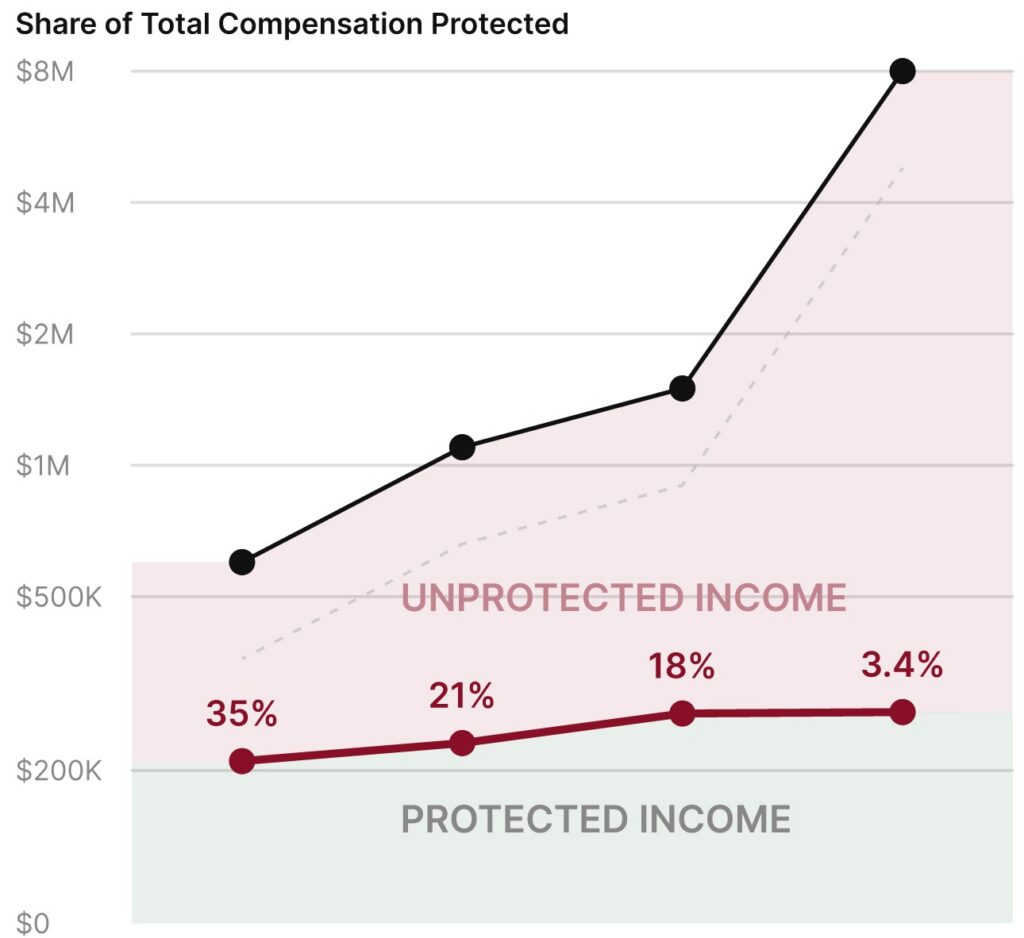
For players entering the league without that floor, the fallback is the CBA benefit structure, which includes an Injury Protection Benefit capped at $2.1 million for vested players and a narrower set of options for rookies who have not yet reached three credited seasons. Those benefits have a ceiling well below the exposure the specialty market was built to address. And whether a player ever connects with the specialty market depends on factors outside the player’s direct control.
2,187 carries. The number does not change. The income floor that should have followed the career, sized to what nine seasons at the top of the game were worth, is the number that mattered most when the carrying stopped.
The individual income protection for professional athletes market exists to make that number real. Whether it does depends on decisions made years before the career ends.