
Most NFL rookies sign their first professional contract within hours of being drafted. The contract value is public within minutes.
The guaranteed money is itemized on public trackers before the ink dries. What is not arranged at the signing table is a disability insurance policy, and for most rookies, that gap is not noticed until much later, if it is noticed at all.
The contract is public. The protection is not. Income protection for professional football players covers the guaranteed money a rookie has not yet earned and the seasons that may never arrive.
The channel through which disability insurance reaches professional football players does not run through the player, the team, or the union. It runs through a financial advisor with knowledge of the specialty Lloyd’s market, to a specialty broker with coverholder relationships, to a policy that may or may not reflect what the player’s exposure requires. Whether any given rookie ends up with disability insurance for NFL players depends almost entirely on who is in his advisory circle and how thoroughly that person understands a market most general insurance professionals have never encountered.
The Market Does Not Come to the Player
The income protection for professional athletes is not sold through player agents, teams, or the NFLPA. It is sold through a small channel of specialty brokers who access the Lloyd’s of London market on behalf of clients.
Those brokers work almost exclusively with financial advisors, not directly with players or with the agents who negotiate their contracts. Pro Financial Services, a Lloyd’s coverholder based in California, specializes specifically in athlete contracts and offers split-dollar and roster-bonus structures for undrafted free agents and lower-tier players who do not qualify for standard PTD products.
The path from the specialty market to the player runs through a series of handoffs. A specialty broker at a Lloyd’s coverholder receives an inquiry from a financial advisor.
The financial advisor, if she has encountered this product category before, initiates the disability conversation as part of the broader financial onboarding process for a new professional client. If she has not, or if her practice does not specialize in athlete finances, the conversation may not happen at all.
Player agents are the people who negotiate the contract. In general, they are not the people who raise the disability insurance question in a substantive way. The specialty market for athlete disability coverage is not structured to be accessed through the negotiating layer.
It operates through the advisory layer. A player whose agent does not proactively connect him to a financial advisor with knowledge of the Lloyd’s market may complete his entire rookie deal without a coverage conversation happening at all.
Zach Brunner, founder of Flurry Sports, an NFL analytics and fantasy platform, describes the dynamic as more common than most observers assume. “There are players who truly are hands off. They think they are here to play sports, the agent is here to handle business.
It is surprising that some players really do throw their hands in the air and give up full responsibility of negotiating, even when they are in the NFL and negotiating a new contract. They say, ‘Agent, go find me the best deal, and I will play wherever it pays the most money, and I trust you.’ That is more common than not,” Brunner said. For a player who has outsourced all financial decisions to a single representative, the probability that disability coverage is ever discussed in depth depends entirely on whether that representative knows to raise it.
Whether any given rookie ends up with disability coverage depends almost entirely on who is in his advisory circle and how well that person understands a market most insurance professionals have never encountered.
This is not a failure of product availability. The specialty Lloyd’s market is active. There are six specialty coverholders in the United States writing athlete disability coverage today, and Eric Chenowith, the chief executive of Leverage Disability and a specialty broker who has placed policies across all six coverholders over 13 years, expects five or six critical injury claims from clients in the current year alone.
The three products the specialty insurance market offers NFL players exist and are being purchased by players at every draft tier. The gap is not supply. It is the advisory connection between the supply and the player.
How College Programs Fill the Coverage Gap Agents Leave Open
One part of the advisory landscape has historically stepped into this gap: college athletic programs.
Schools recruiting highly-rated draft prospects have an incentive to demonstrate awareness of the player’s professional earning potential. Arranging disability coverage for a top-rated player before his final college season is a concrete demonstration of that awareness, and it has been used as a recruitment tool at programs competing for elite talent. The player who was covered by a PTD policy arranged through his program has had the conversation managed on his behalf before he ever met a specialty broker.
The implication for players is that the initial coverage decision is sometimes made by people other than the player himself. Whether the coverage was sized correctly, whether the product was sized correctly for his exposure, and whether he understands the policy terms when he enters the draft are separate questions that require someone to revisit the conversation.
College PTD policies are designed to terminate at the earlier of two events: the signing of a rookie contract, or August 1 following the draft. Once a player signs his rookie deal, the college policy is no longer in force.
The window between the end of the college policy and the beginning of any professional policy is where the gap is most acute. A player who was covered through his program, who did not have anyone arrange professional coverage at signing, is uninsured during that transition.
That window is not theoretical. It is the window in which a training-camp injury could end a career.
Financial Literacy and Who Initiates the Coverage Conversation
The NFL has invested in financial literacy programming for players, and the NIL era has accelerated financial education for college athletes who engage CPAs and financial advisors earlier than previous generations. Players who arrive at the professional level with a financial advisory relationship already in place are more likely to encounter a disability insurance conversation in a structured way. The challenge is that financial advisor quality and specialty knowledge vary as widely as advisor relationships do.
Disability insurance in the specialty Lloyd’s market is not standard financial planning territory. Most financial advisors who work with professional athletes have not placed a PTD policy with a Lloyd’s coverholder.
Those who have understand the product mechanics, the underwriting timeline, the critical injury benefit structures, and the loss-of-value threshold conservatism that has reshaped the market over the past decade. Those who have not are unlikely to initiate the conversation clearly enough for a player to act on it.
An industry figure suggesting approximately 40 percent of NFL players carry private disability insurance has circulated since at least a 2015 industry publication, but it has not been independently verified and cannot be confirmed from current market data. The six specialty coverholders in the market do not share placement data, and no comprehensive survey of active NFL players has been conducted to produce a current figure.
Specialty brokers who observe adoption patterns in this market put the share well below 40 percent. Chenowith’s direct observation, shaped by more than a decade of placements, is that most players are more interested in purchasing houses and other assets than disability insurance, and that coverage tends to happen only when a specific advisor explains it clearly and advocates for it consistently over time.
The absence of public reporting on this subject makes the advisory problem harder to solve from the outside. “I don’t think there really is much reporting on a widespread basis about what this means for this player group, and if this happens, that happens.
I don’t think that really exists,” Brunner said. The information vacuum runs from the media to the players to the advisory circle, which means a player who has not had the conversation with a knowledgeable advisor has almost no other route to encountering the information.
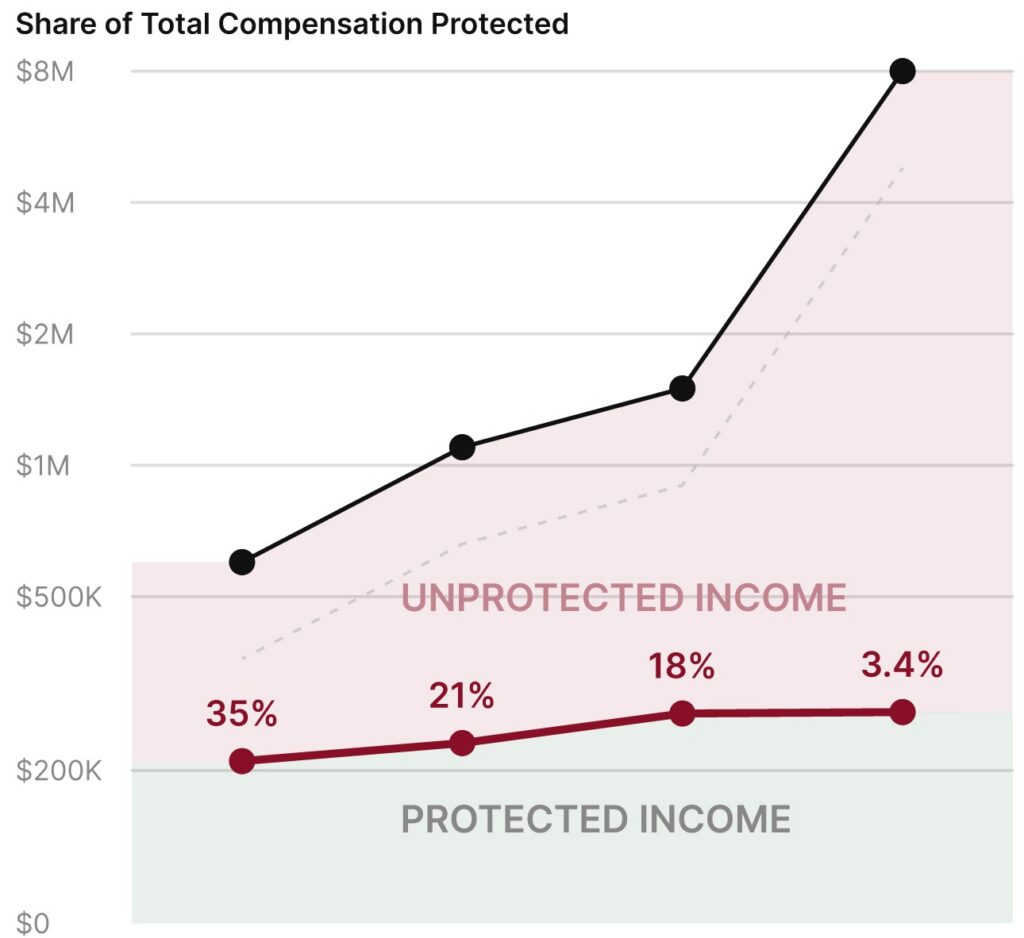
That advisory failure is most consequential in the early second round, where partial guarantees and no fifth-year option leave players with the largest proportional uninsured exposure in the NFL draft.
For players who want to understand income protection before a career-altering event occurs, the first step is finding the right advisor. Not the specialist who explains what the product is in general, but the person who can access the specialty market, size the coverage to the actual exposure, and complete the underwriting process before the season starts.
Most rookies sign their first contract without that person in the room. The disability insurance gap those contracts leave open runs across all four draft tiers, from the first pick to the last.