
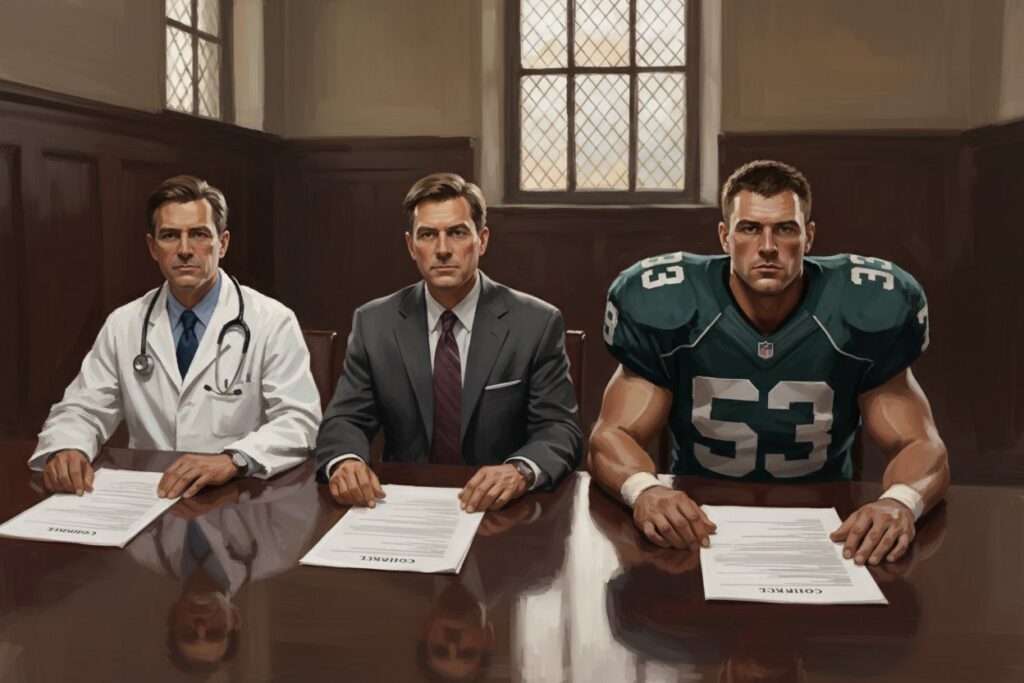
The disability insurance most high earners buy is not sold to professional football players. Those actuarial tables, designed for doctors and lawyers, assume a long career, instead of just three seasons.
That mismatch is the whole market. Disability insurance for NFL players is written in a specialty market because standard actuarial tables were never built for a career measured in seasons.
Standard disability policies just aren’t written to account for income that arrives mostly as a signing bonus at age 22. First rounders got an average signing bonus of $30.5 million at the 2026 NFL Draft.
But football player insurance, which prices the risk of a career-ending injury that can happen in any game, does. An underwriter at a standard carrier, presented with a professional football player’s application, has no product to offer.
The income protection available to NFL athletes comes from a specialty underwriting system built for exposures the mainstream market cannot price. That system operates through Lloyd’s of London syndicates, accessible through a small number of specialty coverholders in the United States. Understanding how it works is the first step in understanding what disability insurance for professional football players looks like in practice.
Why Standard Carriers Turn Away This Risk
Disability insurance is priced by occupational class. A surgeon sits in one class, an attorney in another, a C-suite executive in a third. Each class embeds assumptions about income, injury likelihood, and career longevity.
Those assumptions drive premium rates and eligibility decisions. Professional football players fall outside every existing class because the relevant variables sit beyond the ranges any standard table assumes.
The career duration problem alone is disqualifying. A three-season career is not a standard actuarial event.
A signing bonus arriving at age 22, followed by high annual salaries for a few years and then nothing, cannot be priced against a standard 20-year benefit period. The per-season risk of permanent disability sits orders of magnitude above what any white-collar occupational classification assumes.
The specialty Lloyd’s market was built for this. It operates through six active specialty coverholders in the United States: Petersen International Underwriters, Exceptional Risk Advisors, Pro Financial Services, Tokyo Marine HCC, and Hanley Insurance.
A sixth firm was active as of April 2026 but not identified by name in reporting. Each coverholder operates different policy wording, pricing structures, and product lines.
Eric Chenowith, chief executive of Leverage Disability, has placed coverage across all six over 13 years. He describes the variation as large enough that a policy from one coverholder is not interchangeable with a policy from another.
These six firms and their contracted brokers are the only channel through which disability insurance reaches professional athletes. A player who pursues coverage outside that channel is working in the wrong market. What that channel looks like at the rookie signing table, and where it fails to reach the players who need it, is examined in how that channel reaches players in practice and where it breaks down for NFL rookies.
The Three Products the Specialty Market Offers Football Players
Three core disability insurance products exist for professional football players today. Their relative importance has shifted substantially over the past decade.
Permanent total disability insurance is the foundational product. It pays a lump-sum benefit when a career-ending disability prevents the player from competing professionally. Every drafted player at every round can apply.
Day 3 picks and undrafted players must first make the 53-man game-day roster before coverage becomes available. Pricing for professional athletes runs $8,000 to $10,000 per million of coverage. College athletes price at $7,000 per million.
Loss-of-value coverage has declined sharply as a practical product, according to Eric Chenowith of Leverage Disability, who has tracked the market across all six coverholders over 13 years. Underwriters pulled thresholds back after absorbing a high volume of claims over the past decade. Thirteen years ago, a player projected in the top five who fell to pick 15 could collect.
Today, the threshold for that same player is falling out of the first round entirely. The maximum loss-of-value coverage available for a top-five pick is $5 million. The policy requires both a qualifying injury or illness and a subsequent drop past that threshold.
Only three of the six specialty coverholders offer loss-of-value coverage at all. Most top prospects are bypassing it.
Critical injury insurance is now the dominant product in this market. It pays a named benefit on a specific covered injury without requiring the injury to be career-ending. A player who tears an ACL in week four and returns the following season can still file a qualifying critical injury claim.
The product stacks with permanent total disability coverage. Chenowith expected five or six critical injury claims in 2026 alone, far more than any loss-of-value claims. Critical injury has grown because it pays on a clinical event rather than requiring both an injury and a financial outcome.
How Critical Injury Insurance Is Priced
Critical injury coverage is priced by named injury type, not by a per-million structure. The benefit amounts are fixed: $50,000 for a torn hamstring, up to $1 million for an ACL tear, Achilles tear, or Tommy John surgery.
A player buys coverage that pays the listed amount if the listed injury occurs. There is no variable based on position, career duration, or income trajectory.
Permanent total disability pricing for football players runs $8,000 to $10,000 per million of benefit. How position affects that rate is a point of disagreement between sources in this market. Eric Chenowith says pricing is based on age and sport only.
A kicker and a linebacker of the same age pay the same rate. A background source at one specialty coverholder described a position-based pricing hierarchy, with kickers and punters at the low end and running backs and linebackers at the high end.
The discrepancy may reflect different pricing structures across individual coverholders rather than a uniform market standard. Chenowith, who has placed coverage across all six coverholders, describes the age-and-sport rule as the standard he encounters throughout the market.
What affects coverage size for both products is the player’s projected career earnings. Underwriters assess how much benefit fits the player’s realistic earning potential. The amount purchased scales with the individual.
For most players, the disability insurance conversation that should happen at draft signing does not happen because the specialty market has no direct connection to the player. That gap is its own subject.
For the 2026 draft class, how that gap scales from the first pick through Day 3 is documented pick range by pick range. The products exist.
Whether any given player is connected to a broker who can access them is a separate question. For players seeking individual disability coverage for professional athletes, the entry point is a specialty broker with coverholder relationships, not a domestic carrier, not a generalist agent, and not the player’s sports agent.
When all medical records from the athlete’s training staff are submitted promptly, specialty underwriters can complete the underwriting process in approximately two weeks. In practice, most cases take closer to a month. The bottleneck is records collection from athletic training staff, not the underwriting decision itself.