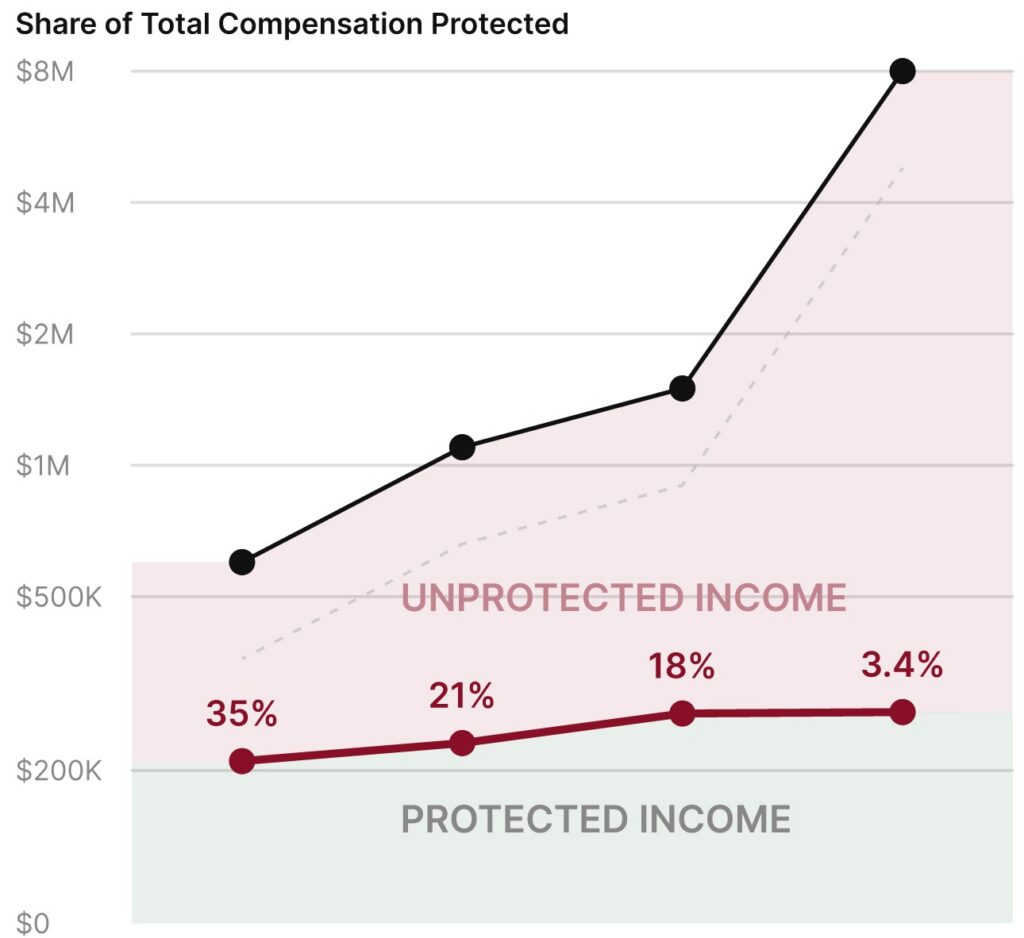

A first-round pick at the 2026 NFL Draft will sign a contract worth between $16.2 million and $54.6 million, with every dollar guaranteed. The Collective Bargaining Agreement adds a rookie-year disability floor capped at roughly $3.15 million, and the league’s most meaningful career-ending protections are not available to a first-year player at all. That arithmetic, repeated in different proportions across seven rounds, defines the shape of disability insurance for NFL athletes entering the league.
Rookie contracts are among the most publicly modeled financial instruments in American sports. Spotrac and Over The Cap publish slot-by-slot projections within minutes of each pick, and guaranteed money is itemized on public trackers before the pen leaves the paper.
But the protection layer behind those contracts is narrower than the published numbers suggest. Every drafted rookie in this class, from the number one pick to the last played drafted (aka Mr. Irrelevant), every single football player comes into the league with disability backstop protection that is smaller, more conditional, and more front-loaded than anyone ever talks about.
The contract figures and draft slots below are drawn from public mock drafts, Spotrac and Over The Cap modeling, and the 2020 to 2030 NFL Collective Bargaining Agreement as published by the National Football League Player’s Association.
How the CBA Shapes Disability Insurance for NFL Athletes
A rookie is not a vested player. Under the CBA, a player must accrue three Credited Seasons to vest under the Bert Bell/Pete Rozelle NFL Player Retirement Plan, which is the retirement and benefit plan jointly administered by the NFL and the NFL Players Association.
Vesting is what unlocks the league’s most meaningful disability benefits. Until that happens, they’re essentially playing football with no shoulder pads.
Those benefits include the Total and Permanent Disability (T&P) benefit, the Line-of-Duty benefit, and the full suite of career-ending protections the NFL and NFLPA reference when discussing player welfare. Rookies do not have them. They will not have them until after their third NFL season, if they make it that far.
What a rookie does have is guaranteed money written into the signed contract and their signing bonus. The Article 45 Injury Protection Benefit, capped at $2,100,000 for the 2025 to 2026 league years.
The Extended Injury Protection Benefit, capped at $1,050,000 for the 2025 to 2026 league years and available once in a career. State workers’ compensation, which varies dramatically by jurisdiction and is often limited for professional athletes.
Every drafted rookie signs a four-year contract. Undrafted rookies sign three-year deals. Slot-by-slot values are effectively fixed by formula and indexed to the salary cap, which the NFL and NFLPA set at $301.2 million for the 2026 league year, with a rookie minimum base salary of $885,000.
First-round picks have fully guaranteed four-year contracts and a team option for a fifth season. After pick 32, the guarantee structure changes sharply.
The cliff is steep. Pick 32 projects to approximately $16.2 million over four years, fully guaranteed. Pick 33 projects to approximately $12.9 million, only partially guaranteed, with no fifth-year option.
Every pick in Round 1 is fully guaranteed. Every pick after Round 1 is not. That single fact produces the non-linear gap profile the rest of this piece traces.
Four league benefits matter for a first-year player, and the dollar mechanics of each one are where the gap opens.
The Article 45 Injury Protection Benefit pays a player who is injured one season, fails a physical the next, and is released for reasons related to that injury, up to 100 percent of his Paragraph 5 base salary for the season following the injury. The cap rises to $2,180,000 for the 2027 to 2028 league years and $2,260,000 for the 2029 to 2030 league years, the NFLPA says.
Guaranteed salary already owed under the contract offsets Article 45 dollar for dollar. If the base is already guaranteed, the benefit does not stack.
The Extended Injury Protection Benefit pays up to $1,050,000 if the player’s inability to play continues a second full season past the injury and other criteria are met. It is available once in a career.
The Total and Permanent Disability benefit, administered by the Bert Bell/Pete Rozelle Plan, pays monthly for career-ending disability, with minimum “Active Football” T&P benefits of $4,000 per month and annual figures reaching into the mid-six figures depending on category and credits. It is not available to rookies.
The Line-of-Duty Disability benefit pays a partial benefit for substantial disablement arising from NFL football activities. It is not available to rookies either.
The realistic cash floor from the CBA for a first-year player in a career-ending injury is therefore the Article 45 IPB (up to $2.1 million, offset by guaranteed money already owed) plus the Extended IPB (up to $1.05 million in narrow fact patterns). Everything else on the disability side of the CBA requires vesting.
A rookie’s entire CBA disability floor in a career-ending scenario adds up to roughly $3.15 million in additional benefits, against projected career earnings that can reach nine figures for a top prospect.
For a top-five pick, the floor is large in absolute terms because the entire contract is guaranteed. For a second-round pick, the floor is a large fraction of the rookie deal itself.
For a Day 3 pick, the CBA benefits can exceed what remains on the contract. The disability insurance conversation is different in every case.
Where the Athlete Disability Insurance Gap Is Largest
The eight prospects below are drawn from the current New York Times top-100 board for the 2026 draft. Board ranking reflects evaluative talent. It is not the same as projected draft slot.
Positional need, positional value (quarterback, edge, offensive tackle, and cornerback command premium slots), and draft-day trades all move players around relative to talent boards. Projected slots below are estimated from current consensus mocks.
Tier 1: Top of the Draft
Fernando Mendoza, QB, Indiana, projected number one overall. The Heisman winner and reigning national champion is the consensus top pick, with betting markets pricing him at prohibitive favorite for Las Vegas at number one. Projected contract at pick one: approximately $54.6 million over four years, fully guaranteed, with a fifth-year team option projected in the $25 million to $35 million range depending on Pro Bowl performance triggers. Signing bonus in hand at signing: approximately $36 million.
In a career-ending rookie-year injury, the $54.6 million is protected by guarantees. Article 45 is largely absorbed by those guarantees.
T&P is not available. What is not protected is the fifth-year option and, far more importantly, the projected second contract.
The franchise-quarterback second-contract market is anchored by Patrick Mahomes’s 10-year, $450 million extension with the Kansas City Chiefs signed in 2020 and Joe Burrow’s five-year, $275 million extension with the Cincinnati Bengals signed in 2023. A successful number one overall quarterback earning his second deal in the current market is pricing in the $250 million to $400 million range.
If a career-ending injury occurs in year two or three of the rookie deal, most of the rookie contract is paid and the nine-figure future contract never materializes. No CBA benefit covers this gap.
Arvell Reese, Edge, Ohio State, projected pick 2 to 5. Reese is regarded as one of the top two or three non-quarterback prospects in the class, battling David Bailey of Texas Tech for first edge rusher off the board. Projected contract in the 2-to-5 range: approximately $42 million to $50 million over four years, fully guaranteed, with a fifth-year option around $18 million to $22 million.
The protection profile is structurally similar to Mendoza’s. Rookie deal is guaranteed, CBA benefits are largely redundant with those guarantees, fifth-year option and second contract are exposed.
Top edge rushers are commanding $25 million to $40 million per year on second contracts. A career-ending injury in year two puts more than $100 million of expected future earnings at risk.
Tier 2: Mid-to-Late First Round
Kayden Procter, OT, NYT board #19, projected pick 15 to 25. Offensive tackles remain a premium position. Projected contract in the 15-to-25 range: approximately $18 million to $24 million over four years, fully guaranteed, with a fifth-year option in the $18 million to $22 million range.
The rookie deal is protected. The fifth-year option is valuable but not guaranteed until exercised.
The second contract, where elite left tackles now command $25 million to $30 million per year, is entirely exposed. Tackle careers also tend to run longer than some skill-position careers, which shifts loss-of-earnings math.
Chris Johnson, CB, NYT board #24, projected pick 20 to 30. Corner is one of the deepest position groups in this class. A corner ranked 24 on a talent board could land anywhere from the mid-first to the early second round depending on teams’ boards and positional runs.
If Johnson lands in the first round (picks 20 to 32), his deal is fully guaranteed in the $17 million to $20 million range with a fifth-year option. If he falls to the early second (picks 33 to 40), he signs an $11 million to $13 million contract with partial guarantees and no fifth-year option.
Johnson is the first prospect whose coverage need changes materially based on draft-night outcome. Pre-draft loss-of-value coverage is designed specifically for this kind of uncertainty.
Tier 3: Early Second Round
This is the tier where the rookie-year disability insurance gap is most acute for NFL athletes, and the tier the content industry most often under-explains. Part of the reason is how contracts are reported. “Media is reporting these contracts completely incorrectly when they say it’s guaranteed money, when it’s only partially guaranteed, or when they report the full value of a contract where only a very small amount is guaranteed,” said Zach Brunner, founder of Flurry Sports, an NFL analytics and fantasy platform.
“I think the media reporting of a contract is confusing fans, athletes, everyone involved.” When a five-year, $90 million deal carries $20 million in actual guarantees, the headline is $90 million. The disability insurance exposure in a career-ending scenario is the portion that has not yet been paid.
Chase Bisontis, G, NYT board #34, projected pick 33 to 45. Interior offensive linemen often slide below their board ranking as tackles get picked ahead of them. Projected contract in the 33-to-45 range: approximately $11 million to $13 million over four years. No fifth-year option. Not fully guaranteed. Signing bonus plus year-one base are typically guaranteed. Years three and four are often not guaranteed for skill.
In a career-ending rookie-year injury, guarantees are paid out. Article 45 IPB provides up to $2.1 million for year two, reduced by any year-two guaranteed money. Extended IPB potentially adds up to $1.05 million for year three.
After that, the player is not vested, has no T&P eligibility, and has lost the non-guaranteed years of the rookie deal plus the projected second contract. Starting interior linemen earn $10 million to $20 million per year on second deals across five to six years. A career-ending year-two injury puts $50 million to $100 million of expected career earnings at risk against roughly $3 million of CBA floor.
Jacob Rodriguez, LB, NYT board #40, projected pick 40 to 55. Off-ball linebackers have been devalued in the modern draft, which pushes them into the mid-second round. Projected contract: $9 million to $11 million over four years. Signing bonus: $4 million to $5 million. Limited guarantees beyond year one. No fifth-year option. Linebacker second contracts for starters land in the $15 million to $25 million per year range, so the gap profile tracks Bisontis and, because rookie-deal guarantees are even thinner here, the CBA benefits represent a larger share of total rookie-deal value.
Tier 4: Day 3
Garrett Nussmeier, QB, NYT board #81, selected 77th overall in Round 3 by the Tampa Bay Buccaneers. Contract: approximately $5 million to $6 million over four years. Signing bonus: $800,000 to $1.5 million. Rookie-minimum base salaries. Guarantees are typically limited to the bonus and a portion of year-one base.
The profile is different here. The rookie contract itself is close in total value to the Article 45 cap. In a career-ending rookie-year injury, the Article 45 IPB plus Extended IPB cover a large share of what remains, not because those benefits are generous but because the contract is small.
The insurance conversation shifts from protecting the rookie deal to protecting the option value of the career itself. Day 3 quarterbacks occasionally outperform their slot and become franchise players on second contracts. That path is statistically unlikely and financially enormous when it happens.
Daylan Everette, CB, NYT board #98, projected pick 130 to 200. Corners in the late middle rounds typically sign four-year deals at or near the rookie minimum, with signing bonuses of $200,000 to $500,000 and minimal guarantees beyond the bonus. Projected contract: approximately $4.0 million to $4.5 million. The Article 45 IPB alone can cover a significant portion of the remaining rookie-deal value, and Extended IPB can add another year. The more significant risk at this tier is career attrition rather than rookie-contract loss.
The pattern across all eight prospects is counterintuitive but consistent. Top-five picks have the largest absolute earnings at risk but proportionally strong rookie-deal protection through full guarantees, so their insurance conversation is about the future. Mid-first-round picks look structurally similar with lower ceilings.
Early second-round picks have the largest proportional gap in the entire draft. Day 3 picks carry small rookie deals that the CBA benefits actually cover meaningfully, so the conversation shifts toward expected-value career protection. The gap does not track draft slot.
It tracks three things interacting: how much of the rookie contract is truly guaranteed, whether the player has a fifth-year option, and how large the projected second contract is relative to the rookie deal. By that reading, the early second round is the most exposed tier in the entire draft.
How Individual Disability Insurance for Athletes Fills the Gap
The individual disability insurance market for professional athletes is structurally similar to the high-limit market for physicians, executives, and other high-income professionals. Policies are typically written through the Lloyd’s of London market via a small group of specialty brokers, with underwriting adjusted for occupational class and career arc. Traditional domestic carriers generally will not accept cases the Lloyd’s market considers routine.
“There’s no such thing as a bad risk, only a bad premium. So we look at every case differently,” said Tom Peterson, a senior partner at Petersen International Underwriters and a specialist in Lloyd’s of London disability coverage for high-income professionals, on the Income Protection Journal Podcast. Peterson’s firm is one of the largest Lloyd’s underwriters of specialty income protection in the United States and routinely writes coverage for professional athletes, entertainers, and applicants the domestic market has declined.
The specialty Lloyd’s market offers football players three core products, and their relative standing in the market has shifted substantially over the past decade.
Permanent total disability insurance is the foundational product at every draft tier. It pays a one-time, tax-free lump sum when a career-ending disability prevents the player from competing professionally. Day 3 picks and undrafted players must first make the 53-man game-day roster before coverage is available.
Pricing is based on age and sport only; position does not affect the rate. The rate for college football players runs approximately $7,000 per million of coverage; professional-market rates run roughly $8,000 to $10,000 per million depending on the coverholder.
The occupational incapacity standard that governs PTD extends across professional sports, not only team sports. Disability insurance for individual-sport athletes — golfers, runners, and tennis professionals — runs through the same Lloyd’s market on the same policy mechanics: benefits hinge on physical inability to compete, not on income loss or ranking decline. That distinction creates a separate and under-discussed coverage gap in individual sports, where income can stop for reasons that have nothing to do with physical disability.
Critical injury insurance has become the dominant product in the specialty athlete market. “Critical injury is now the dominant product in the athlete disability market,” said Eric Chenowith, the chief executive of Leverage Disability, a specialty broker with 13 years of placement experience across all six Lloyd’s coverholders in the United States.
Unlike PTD, critical injury does not require a career-ending disability to trigger. It pays a named benefit on a specific covered injury: from $50,000 for a torn hamstring to $1 million for an ACL tear, Achilles tear, or Tommy John surgery, regardless of whether the player returns to the field. The product stacks with PTD, and Chenowith expects five or six critical injury claims from clients in the current year alone.
Loss-of-value coverage, once a standard component of first-round planning, has contracted sharply as a practical product. “The market has pulled back significantly because of a high volume of claims,” Chenowith said. “Even the projected number one overall pick now has a threshold of falling out of the first round entirely. Most players are moving away from loss of value and opting instead for permanent total disability plus critical injury, which is more accessible and pays more reliably on qualifying injuries.”
The maximum loss-of-value benefit available for a top-five pick today is $5 million, and only three of the six current specialty coverholders still offer the product. These three products stack with CBA benefits rather than replacing them.
After three decades advising physicians, executives, and other high-income professionals at Set for Life Insurance on individual disability coverage for professional athletes and related income-replacement markets, one pattern appears repeatedly in the days after the draft. The gap between the public contract value and the actual layered protection surprises everyone involved, including agents.
Every drafted rookie’s situation is specific, and the same questions apply across the board. What portion of projected career earnings is already protected by signed guarantees.
What the CBA actually provides in a career-ending scenario, given that vesting has not occurred. What the projected second-contract value is, and what the plausible range of career earnings beyond the rookie deal looks like.
What individual coverage, at what face amount, and through what structure most efficiently closes the gap between earnings at risk and layered protections. Those are the questions a specialty broker, an agent, and a financial advisor work through with the player in the days following draft night.
The 2026 NFL Draft class will produce an astonishing amount of guaranteed money over the next ten days. Mendoza and Reese will sign rookie contracts that are essentially fully protected. A handful of prospects will sign deals that still carry meaningful exposure.
Dozens more will sign contracts where the majority of projected career value is not yet guaranteed anywhere. For every one of them, the CBA provides a narrower disability floor than most observers assume, not because the NFLPA has not negotiated hard but because the richest protections are reserved for vested players, and every rookie has at least three seasons to go before reaching that status.
That gap, between what rookies have in hand and what their projected careers are worth, is where disability insurance for NFL athletes does its work. For players who leave the league without vesting, meaning without three credited seasons, the CBA’s career-ending benefit structure is largely unavailable, and what remains is narrow.
“There really isn’t an income source for them afterwards,” Brunner said. “Other than they get that small check for health and for insurance and all of that.”
That small check is the Article 45 IPB and the Extended IPB combined, a ceiling of $3.15 million in additional benefits against projected career earnings that, for a first-round pick, can reach nine figures. The arithmetic is the same as it is for any high-earning professional. Only the occupation, the numbers, and the career arc are different.
This article is for informational and educational purposes. It is not insurance, legal, financial, or tax advice. Draft projections and contract values are estimates based on public mock drafts and Spotrac and Over The Cap modeling and will differ from the actual outcomes of the April 23-25 draft.
CBA benefit amounts reflect the 2020 to 2030 NFL Collective Bargaining Agreement as published by the NFLPA. Individual coverage decisions should be made in consultation with a licensed specialty broker, a financial advisor, and a certified NFLPA-registered agent.