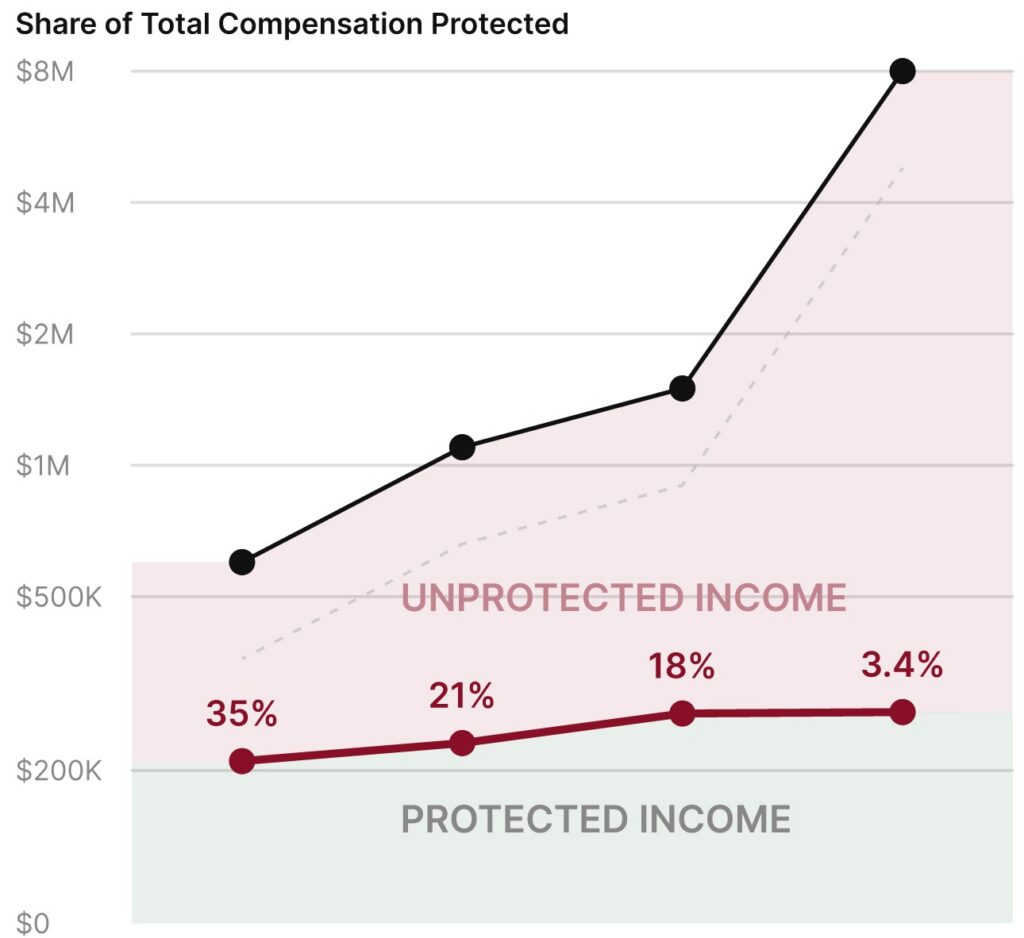

Executives with company-provided long-term disability coverage know the number their plan promises. It’s sixty percent of base salary.
The promise and the deposit are different numbers. Executive disability insurance bought individually pays its benefit tax free when the premium comes from after-tax dollars, which is exactly why the two figures diverge.
But few have ever applied their actual marginal tax rate to that percentage to see what the benefit actually delivers.
Under the Internal Revenue Code, if the employer paid the premiums, the benefit is taxable as ordinary income, and at a 40 percent combined rate, sixty percent becomes roughly thirty-six.
The rule is documented in IRC Section 104(a)(3) and Section 105 and in IRS Publication 15-A. If an employer pays group LTD premiums without including the cost in the employee’s taxable wages, any benefit the employee receives during a disability claim is taxable as ordinary income.
The benefit is not taxed at a preferential rate. It is taxed as if it were salary. For an executive in a 37% federal bracket, that means 37 cents of every disability dollar goes to federal income tax before state taxes apply.
The IRS Rule That Governs Whether Long-Term Disability Benefits Are Taxable
The IRS does not treat disability benefits as a uniform category. The tax outcome depends on the funding arrangement, and the funding arrangement is determined at the time the plan is established, not at the time of a claim.
Three scenarios produce different outcomes:
- Employer pays 100% of premiums, no inclusion in W-2 wages: Benefits received during a claim are 100% taxable as ordinary income. This is the most common arrangement for employer-sponsored group LTD plans.
- Employee pays 100% of premiums with after-tax dollars: Benefits are generally tax-free under IRC Section 104(a)(3). This applies to individually owned policies purchased outside an employer plan.
- Split premium arrangement (employer and employee each pay a portion): Benefits are taxable in proportion to the employer’s share of total premiums paid. An employer who pays 60% of the premium produces a benefit that is 60% taxable.
The distinction matters because the group LTD market is dominated by employer-paid plans. Benefits consultants and HR departments negotiate group rates and often structure the plan as a fully employer-paid benefit precisely because it appears cost-free to employees. What the summary plan description rarely explains is what “employer-paid” means when a claim is filed.
A group long-term disability plan that pays 60% of base salary and is funded entirely by the employer delivers taxable ordinary income during a claim. For an executive in a 40% combined federal and state marginal bracket, that 60% benefit becomes approximately 36% of pre-disability income after tax, below the income floor most financial planning models treat as the minimum for household stability.
The table below shows how the tax treatment affects net income replacement at three executive salary levels, assuming a standard 60% group LTD benefit and a 40% combined marginal tax rate.
| Annual Base Salary | Group LTD Benefit (60%) | Annual Gross Benefit | After-Tax Benefit (40% rate) | Effective Replacement Rate |
|---|---|---|---|---|
| $200,000 | $120,000/year | $10,000/month | $6,000/month | 36% |
| $300,000 | $180,000/year | $15,000/month | $9,000/month | 36% |
| $400,000 | $240,000/year | $16,667/month* | $10,000/month* | 30%* |
*Group LTD plans typically cap monthly benefits at $10,000 to $15,000, regardless of the calculated percentage. At $400,000 annual salary, the cap reduces the gross benefit before taxes further compress the net figure. Tax rates vary by individual circumstances, state of residence, and total income during the disability period.
How the Tax Treatment of Group LTD Compares to Individual Disability Insurance
The tax treatment of individually owned disability insurance works in the opposite direction. A policy purchased by the executive with personal after-tax dollars produces benefits that are generally excluded from gross income under IRC Section 104(a)(3).
A $15,000 monthly benefit from an individual policy arrives tax-free. The full amount is available for housing, operating expenses, and obligations, without withholding, without a quarterly estimated tax obligation, and without a year-end liability.
Peter Crane, MD, a rural family physician in Idaho and host of the Doctors Making a Difference podcast, who filed a disability claim thirteen years into practice after a sarcoma diagnosis, described the difference between individually owned and group coverage on the Income Protection Journal Podcast.
“An underwritten policy, like my own policy that belongs to me, that was written medically underwritten for me fifteen years ago, that carries a lot of weight and a lot of power, much more so than a policy that’s a group policy that comes through my employer,” Crane said.
The difference in dollar terms at the executive income level is substantial. An executive receiving $15,000 per month in taxable group LTD benefits and an executive receiving $15,000 per month from an individually owned policy are not in equivalent positions.
One is receiving approximately $9,000 in spendable income at a 40% rate. The other is receiving $15,000.
The planning response most executives consider once the tax treatment is understood is not abandoning the group plan. It is supplementing it. An individual non-cancellable disability insurance policy purchased with personal funds produces tax-free benefits, is portable across employers, and carries its own-occupation definition independent of whatever language the group plan uses.
How high-income executives structure that individual coverage, including occupational class, carrier selection, and own-occupation benefit design, determines how completely it closes the gap the group plan leaves behind. After advising high-income professionals on disability insurance for more than three decades, the pattern that holds is consistent: executives who discover the tax treatment issue after a claim has begun cannot fix it retroactively. The funding arrangement is locked at the time the plan was established.
The IRS rule does not distinguish between executives and other employees. A $65,000-per-year worker with the same employer-paid plan faces the same tax treatment.
What distinguishes the executive’s situation is scale: a 36% effective replacement rate at $300,000 in annual income leaves a gap that a household budget cannot simply absorb. For executives evaluating long-term disability coverage, the tax treatment question belongs at the start of the analysis, not as an afterthought when the benefits summary arrives.