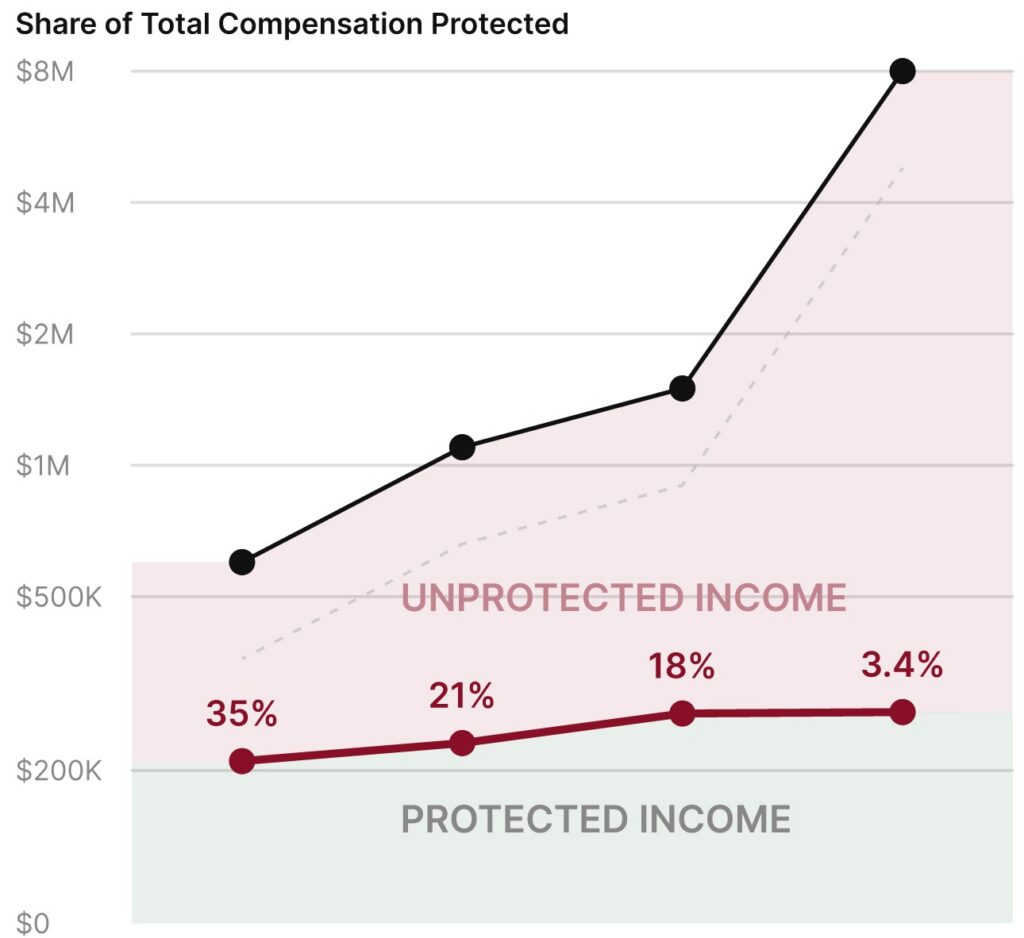

The first group long-term disability benefit statement that arrives after the elimination period tends to surprise executives.
The cap is doing the surprising. Disability insurance for executives sized on actual earnings pays above the ceiling a group plan stops at, and the statement is where an executive first meets that ceiling.
The benefit is paying, the number is real, but it’s usually much less than expected, and always less than what’s required to make ends meet.
The gap between what these plan pay versus what the executive was earning gets settled at enrollment, for plans filed under ERISA, which most executives have never even open.
The group LTD benefit structure that dominates the large employer market is a 60% formula subject to a monthly maximum.
Willis Towers Watson’s 2023 Benefits Trends Survey confirms that the 60% formula is the standard design among large employers. What the formula applies to, and where it stops, is what most executives discover after a claim begins.
The plan covers base salary. Annual bonuses, performance incentives, equity compensation (restricted stock units, options, profit-sharing allocations), and deferred compensation arrangements are excluded from the benefit formula in the large majority of employer-sponsored group plans, according to Mercer’s 2023 National Survey of Employer-Sponsored Health Plans.
An executive whose compensation package consists of $300,000 in base salary and $250,000 in annual bonus, equity, and incentive pay holds a plan that covers $300,000, not $550,000.
Why Group Long-Term Disability Benefit Caps Fail at the Executive Compensation Level
The monthly maximum further compresses what the formula produces. SHRM’s 2023 Employee Benefits Survey documents that group LTD plan caps commonly range from $6,000 to $15,000 per month across the employer market. An executive earning $300,000 in base salary has a calculated 60% benefit of $15,000 per month.
If the plan cap is $12,000, the benefit is $12,000. An executive earning $400,000 in base salary has a calculated benefit of $20,000. The same $12,000 cap reduces it by $8,000 before taxes are applied, and the tax treatment of employer-paid LTD benefits compresses what remains further still.
The table below illustrates how the cap interacts with the formula at several executive income levels, using a $12,000 monthly cap as the benchmark, a figure within the range Mercer documents as common among large employer plans.
| Annual Base Salary | Formula Benefit (60%) | Plan Cap ($12,000/mo) | Monthly Shortfall Before Tax |
|---|---|---|---|
| $200,000 | $10,000 | $10,000 | $0 |
| $300,000 | $15,000 | $12,000 | $3,000 |
| $400,000 | $20,000 | $12,000 | $8,000 |
| $500,000 | $25,000 | $12,000 | $13,000 |
This table reflects base salary only. Bonus, equity, and incentive compensation excluded from most group LTD formulas are not represented. At total compensation levels of $600,000 or more, the effective replacement rate from the group plan typically falls below 25% of total earnings.
The monthly cap on a group long-term disability plan does not scale with income. An executive earning $650,000 annually and an executive earning $180,000 annually can receive the same group LTD benefit, because both plans apply 60% of base salary subject to the same monthly maximum, and the cap is binding long before the higher earner’s formula is satisfied.
The definition switch compounds the problem over time. Mark D. DeBofsky, a shareholder at DeBofsky Law, Ltd., and an ERISA litigation attorney with more than four decades of experience challenging insurer benefit denials, described how group plan definitions work on the Income Protection Journal Podcast.
“Most group policies are not own occupation policies, or if they are, they will only cover the insured’s own occupation for a limited period, typically 24 months,” DeBofsky said. “After that, in order to continue receiving benefits, the insured would need to be incapable of working at any occupation.”
Most group LTD plans apply an own-occupation definition for the first 24 to 36 months of a claim: the executive is considered disabled if they cannot perform the duties of their specific role. After that window closes, most plans shift to the any-occupation standard DeBofsky describes: benefits continue only if the executive cannot perform any occupation for which they are reasonably suited by education, training, or experience.
A technology executive, a financial officer, or an attorney who becomes disabled and could theoretically consult, teach, or advise in a different capacity may pass the own-occupation test in month 12 and fail the any-occupation test in month 37. The group plan stops.
How Executives Calculate and Close the Long-Term Disability Income Gap
The gap between group plan coverage and total income replacement is a calculation, and it is specific to each executive’s compensation structure and plan document. The starting point is the plan’s definition of covered compensation: base salary only, or something broader. The second factor is the monthly maximum.
The third is the definition of disability the plan applies and when that definition changes. All three are disclosed in the ERISA-required plan document and the summary plan description. Most executives have not read either.
Individual non-cancellable disability insurance closes the gap with a benefit that is calculated independently of the group plan, uses a true own-occupation definition that does not switch to any-occupation after 24 months, and is portable. The policy travels with the executive regardless of employer changes, practice changes, or industry transitions. Individual DI carriers impose their own per-carrier monthly maximums, typically $15,000 to $25,000 per carrier, which means executives with incomes above $500,000 may need policies from two carriers to reach an adequate combined benefit.
This approach, holding both the group plan and supplemental individual coverage, is the standard planning structure for executives evaluating disability insurance at high income levels. The group plan contributes what it was designed to provide: coverage up to the cap for the base salary portion. The individual policy addresses what the group plan was not designed to cover: the income above the cap, the bonus and equity income the formula excludes, and the definition switch that group plans make at 24 to 36 months.
After advising high-income professionals on disability insurance for more than three decades, the pattern at the executive level is consistent: the discovery that the group LTD plan does not cover total compensation at adequate replacement rates almost always happens at claim time, not at enrollment. The group LTD benefit statement that arrives after the elimination period is the first moment most executives look at the actual number.
The number is what the plan was designed to produce. The gap is equally intentional.