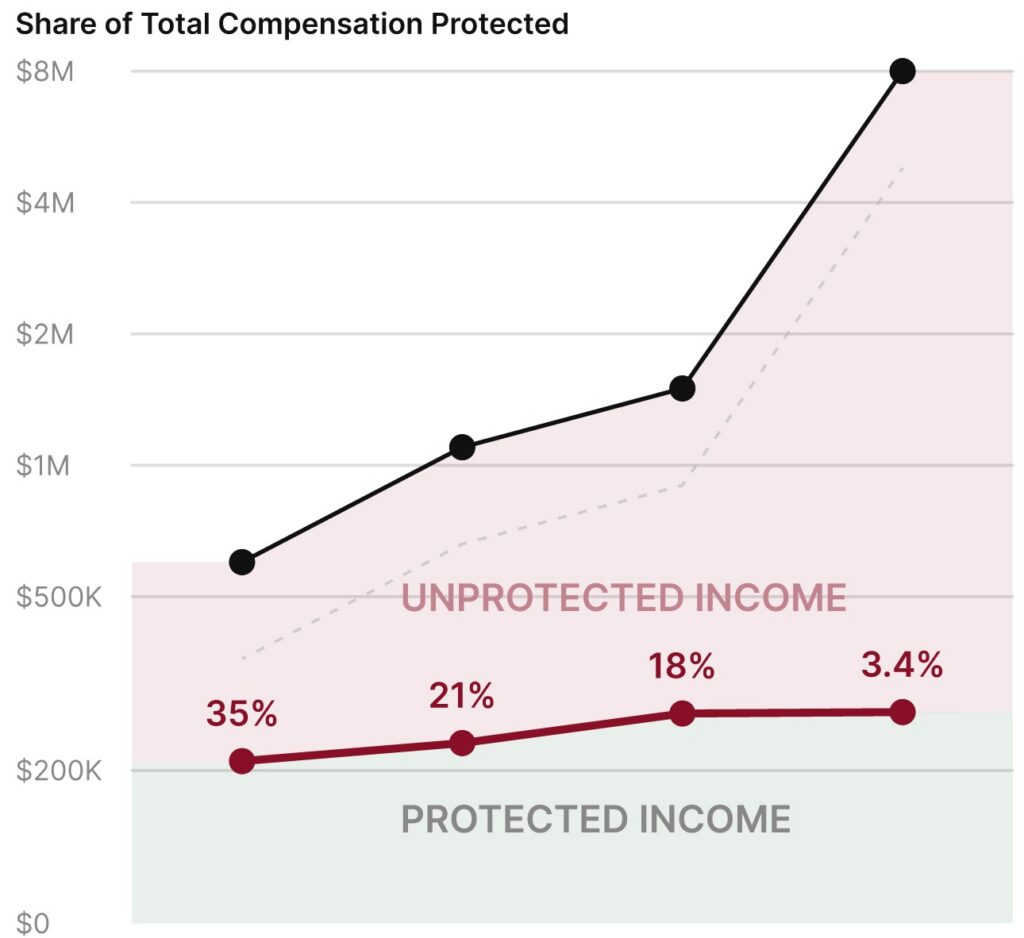

A broken wrist can disrupt a surgeon’s schedule overnight. A concussion can interfere with an attorney’s ability to litigate a case. And an orthodontist starts losing income the moment the minute fine motor control become unreliable. Disability insurance exists because income ceases faster than households can adjust their spending. What that coverage needs to do differs by profession, since a surgeon, an attorney, and an orthodontist each face different definitions of what counts as disabling.
Sick days and short leaves often run out first, then regular pay ends. Bills do not pause at the same speed. Rent, child care, and loan payments keep pulling cash from accounts, even when the only new money coming in is partial.
Many people assume another system will step in, but the replacement is often smaller, slower, and more limited than expected. Those gaps are why disability coverage stays in the background until a diagnosis, injury, or relapse makes income loss real.
Many workers reach a moment of income loss assuming coverage already exists through their job, only to learn it does not. Others discover that a plan is in place but replaces far less than expected once caps and definitions apply. “65% of the private sector workforce has no long-term disability insurance,” the Social Security Administration [PDF] reports.
What disability looks like when income depends on showing up
A long disability claim rarely begins with a dramatic accident. It can begin with a disc problem that makes lifting unsafe, a cancer treatment schedule that prevents steady shifts, or a cardiac event that pauses a high-stress job. Those scenarios can remove someone from work without fitting the movie version of disability.
Some of the most common disabling conditions are also common health problems. “Arthritis—or joint inflammation—is the most common cause of disability among adults residing in the United States,” the Centers for Disease Control and Prevention states.
The financial hit often starts before any formal definition of disability matters. A self-employed contractor may lose invoices immediately.
A commission-based worker can see variable pay vanish first, even if base pay continues for a short time. A hospital employee may still have a job on paper but no paycheck once leave banks are exhausted.
Time is the hidden cost in these stories. Recovery can be uneven, with partial returns and setbacks. That uncertainty can turn a short gap into a long stretch where a household relies on savings, credit, family help, or partial benefit payments.
Common myths about income replacement through employers and government programs
One of the most persistent assumptions many workers carry is that a government program automatically replaces income when someone cannot work. Many people assume Social Security disability benefits function like a backstop for any serious illness or injury. In reality, those benefits are designed for severe and prolonged disability, not for most work interruptions that last months or even years.
A related assumption is that workers’ compensation fills the same role. That belief often holds until the cause of income loss becomes clear.
Workers’ compensation generally applies only to injuries or illnesses tied directly to the job. A fall at home, complications from surgery, cancer treatment, or a mental health condition can remove someone from work without qualifying for those benefits, leaving income exposed during recovery.
Another common belief is that employer disability coverage is widespread and sufficient. Many workers enroll during onboarding and never revisit the details.
Others assume coverage exists because it sounds like a standard benefit. In practice, access varies widely by employer size and industry, and many workplaces do not offer long-term disability at all.
When coverage does exist, it often replaces only a portion of wages and may be subject to strict limits. Access to short-term disability plans increases sharply with employer size, leaving workers at smaller employers far less likely to have coverage, the U.S. Bureau of Labor Statistics reports.
Even among workers who do have employer-sponsored long-term disability insurance, another myth surfaces once benefits begin. The expectation is often that payments will last as long as someone cannot return to their job.
Many plans, however, limit how long certain conditions are covered or change the definition of disability after an initial period. Mental health and substance-related claims are commonly capped, and some plans shift focus from the original occupation to whether another job is possible, which can reduce or end benefits while income needs remain.
These misconceptions share a common thread. They assume income replacement systems work broadly and automatically, when most are narrow, conditional, and partial by design. The gap between what people expect to happen and what actually happens is where financial strain tends to build.
Why private disability insurance exists alongside employer and government coverage
Employer and government disability programs are designed to address income loss in broad, standardized ways. Employer plans are built to balance cost and participation across a workforce, which often results in limits on how much income is replaced and how long benefits last.
Government programs focus on severity and duration, reserving benefits for the most serious and sustained disabilities. Those design choices explain why income often drops even when some form of coverage is technically in place.
Private disability insurance exists to address the portion of income risk that those systems leave exposed. It is structured around an individual’s earnings rather than a group average and is typically written to follow income that falls outside standard payroll definitions. That distinction becomes important for workers whose compensation includes bonuses, commissions, or variable pay that employer plans may not count when calculating benefits.
Private coverage also reflects how households experience disability in real time. Employer and government benefits often begin only after waiting periods or approval processes that assume savings or other resources will carry a household through the early months. Private disability insurance policies are written with defined elimination periods and benefit structures that mirror how long income interruptions commonly last, rather than assuming a quick return to work.
The role of private disability insurance is therefore not to duplicate other programs but to complement them.
“Disability income coverage replaces a significant portion of income lost to disability, enabling disabled working Americans and their families to keep a roof overhead and food on the table – and protecting them from taking on additional debt or losing their assets,” America’s Health Insurance Plans notes.
Seen together, employer plans, government programs, and private disability insurance function as a layered system, each addressing a different slice of income risk rather than a single solution covering it all.