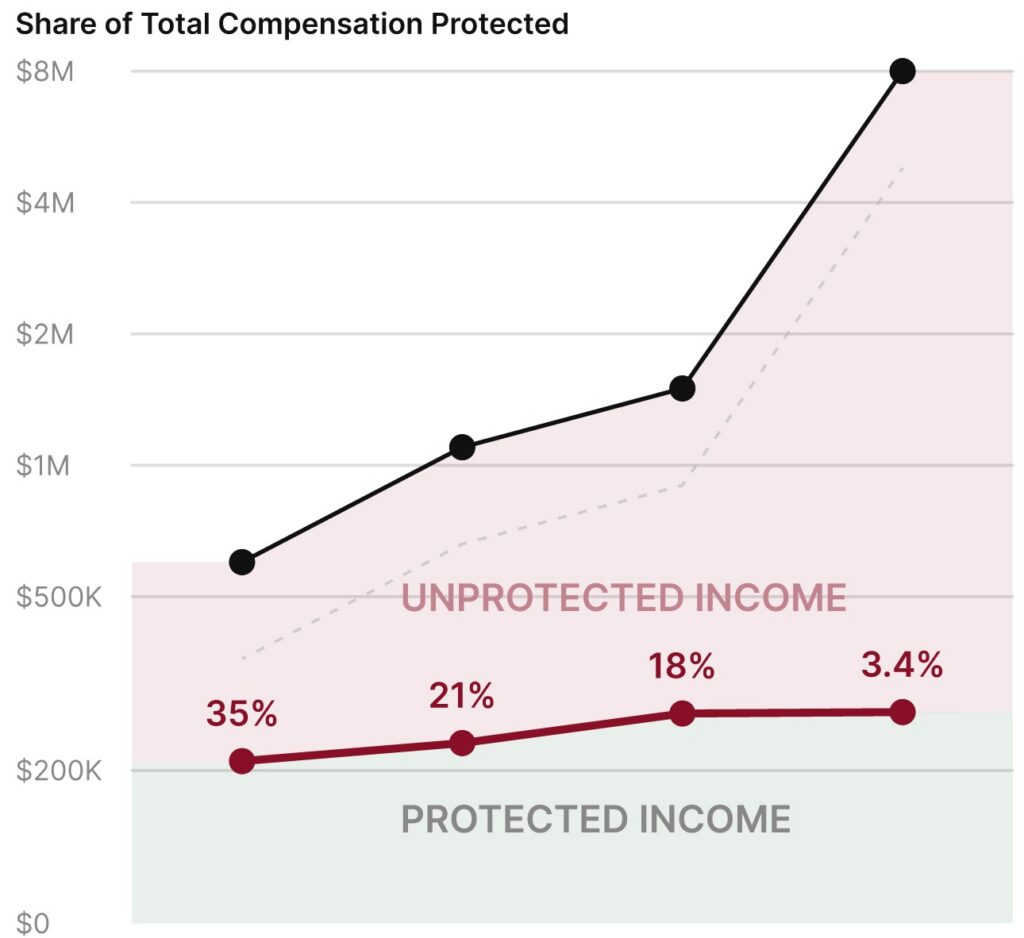

The Stripe executive applying for coverage for top-earning executives had his cardiac workup land on two underwriter desks at the same time.
He earned roughly one million dollars a year and had applied for both life insurance and individual disability insurance for executives in the same week. His physician had ordered the workup as a precaution.
The life carrier read the imaging as proof of a healthy heart. They issued the policy at the best available rate.
The disability carrier read the same imaging differently. They attached a permanent rating to the policy.
The rating is now locked into a non-cancellable contract he will carry for the rest of his career.
Non-cancellable disability insurance for executives works that way by design.
Inside the Executive’s Non-Cancellable Disability Policy
The non-cancellable disability policy is the strongest contractual guarantee available in disability insurance.
The National Association of Insurance Commissioners defines a non-cancellable contract as one the insurer cannot cancel, modify, or repremium during the policy term as long as the insured pays the scheduled premium.
Once issued, the policy’s rate, definition of disability, benefit amount, riders, and occupational classification are fixed for the life of the contract.
Group long-term disability plans, by contrast, flip from own-occupation to any-occupation at the 24-month mark.
Principal’s product guide on the Income Protector policy states the standard plainly. The policy is “non-cancelable and guaranteed renewable to age 65, 67, or 70,” and the premium rate is “guaranteed to age 65, 67, or 70, whichever is later, regardless of changes in the insured’s income, occupation, or health.”
The Standard’s Platinum Advantage product offers the non-cancellable feature as an optional rider on the base guaranteed renewable contract.
The contractual fixing matters because every underwriting variable the carrier prices at issue is the variable the executive carries for the duration of the policy.
A rating attached at age 38 for a cardiac workup does not relax at 45 when subsequent imaging is clean. An exclusion attached for a back strain at issue does not disappear when the back heals.
The same locking applies to the executive’s occupational classification, which stays with the policy regardless of how the executive’s role evolves over the rest of their career.
The single available remedy for an unfavorable rating is the adjustment application.
After one year of clean medical documentation, the insured can file an adjustment application that reopens the medical questions with the same carrier. The adjustment often removes a rating or exclusion that was added at issue.
The mechanism is broker-led.
Executive Disability Rates Lock at Application, Not at the Raise
The promotion does not reset the rate because age is the largest single determinant of disability insurance premium.
A healthy elite fifty-year-old executive pays more than a preferred twenty-five-year-old executive for the same monthly benefit, because the carrier prices the actuarial difference in remaining career years.
The carrier does not reprice the policy when the executive earns a promotion, takes a raise, or moves to a higher-compensation employer.
Chronological age governs the calculation.
The lock-in logic is widely understood among physician buyers who purchase coverage during training.
“I got disability income as soon as I was a resident, because I knew I could lock in some really good premiums, and then I’ve kept the same policy through it, because no one wants to be disabled.”
Isheet Patel, MD, co-founder of Peak Concierge Care, on the Income Protection Journal Podcast
Patel’s reasoning applies one-for-one to an executive who purchases at age 38. The premium does not reset when the executive’s income or title moves up later.
Biological age, the concept popularized by longevity research and now familiar to any executive who has done a biomarker panel, does not factor into the underwriting.
A fifty-year-old executive whose biomarkers read as forty-one is still priced as a fifty-year-old.
Life insurance uses a nearest-age rule based on the applicant’s half-birthday. A policy purchased before the half-birthday locks in the lower-age premium.
The Stripe executive who was rated for the cardiac workup illustrates the asymmetry between life and disability underwriting on the same data.
The workup itself did not make him sick. His physician had recommended the test for general due diligence, and the imaging confirmed his heart was in normal condition.
The disability underwriter rated the policy because the underwriting process treats the act of investigating cardiac health as evidence of cardiac concern, regardless of the result.
The life underwriter treated the same evidence as confirmation of good health.
Both judgments are now permanent for the policies they apply to.
Female executives face an additional locked variable.
Female disability insurance rates run nearly twice the rates for male executives of equivalent age, income, and occupational class. The differential applies at issue and follows the policy for the duration.
Female executives who delay coverage past age forty typically pay materially higher cumulative premium than female executives who lock the policy in their early thirties.
The implication for an executive considering coverage is structural.
The decision to purchase or postpone is not really a decision about whether the coverage is needed. It is a decision about which age, which biomarker profile, which medical history, and which gender-based rate the carrier will use to price the rest of the career.
The lock-in decision is also a personal-finance question.
“Which parts of your protection plan do you want to self insure, and which parts do you want to push off to the insurance company?”
Marcus Watson, brokerage director for MassMutual’s Palura Group, on the Income Protection Journal Podcast
Watson’s question is the one to bring to any policy-design conversation. The portion of the income asset the executive pushes to the insurance company at age 38 stays pushed off through retirement.
Future Increase Option riders allow the benefit amount to scale upward over time without medical underwriting. The underlying rate and definition stay locked at the age and condition the carrier saw at issue.
The Stripe executive will carry the rated disability policy for the rest of his career.
He can pursue an adjustment application after one clean year and probably have the rating removed. What he cannot recover is the locked rate at the issue age, which would have been lower for the unrated policy.
The cardiac workup added an immediate cost and locked in a future cost.
The promotion he received the following year did not reset either.