
Certified Registered Nurse Anesthetists often earn income through schedules that change with operating room demand rather than fixed weekly hours. Call rotations, extended shifts, and fluctuating case volume can alter monthly earnings even when clinical credentials and employment remain unchanged. For that reason, CRNA disability insurance centers less on rare catastrophic injury and more on how income is defined, averaged, and protected when work patterns are uneven.
Hospitals and ambulatory surgery centers regularly adjust anesthesia coverage based on staffing levels and patient volume. Elective cases may be postponed, overnight call redistributed, or anesthesia services consolidated across facilities. These operational changes can reduce billable hours without any formal job separation, creating income declines that fall outside traditional narratives of job loss.
Compensation for CRNAs often combines base pay with overtime blocks, call stipends, and shift differentials. When one component drops, total income can fall quickly. Disability insurance policies that rely on historical earnings averages may not fully reflect this volatility, especially during short periods when schedules compress.
Income protection for CRNAs therefore depends on policy language rather than physical incapacity alone, which is why understanding how disability insurers deny CRNA benefit claims matters before a claim is filed. How a disability policy measures earnings and evaluates partial work capacity determines whether reduced schedules translate into payable benefits.
Variable Work Hours and How Disability Policies Measure Income
CRNA schedules frequently extend beyond standard workweeks, with weekly hours commonly range between 40 and 60 hours, depending on facility type and call obligations, according to analysis compiled by Advance Study.
Professional guidance describes irregular work demands as a structural feature of anesthesia practice. “Fatigue in anaesthesia practice is often ignored or accepted as the norm due to persistent, high-intensity work demands and expectations,” American Association of Nurse Anesthesiology reports.
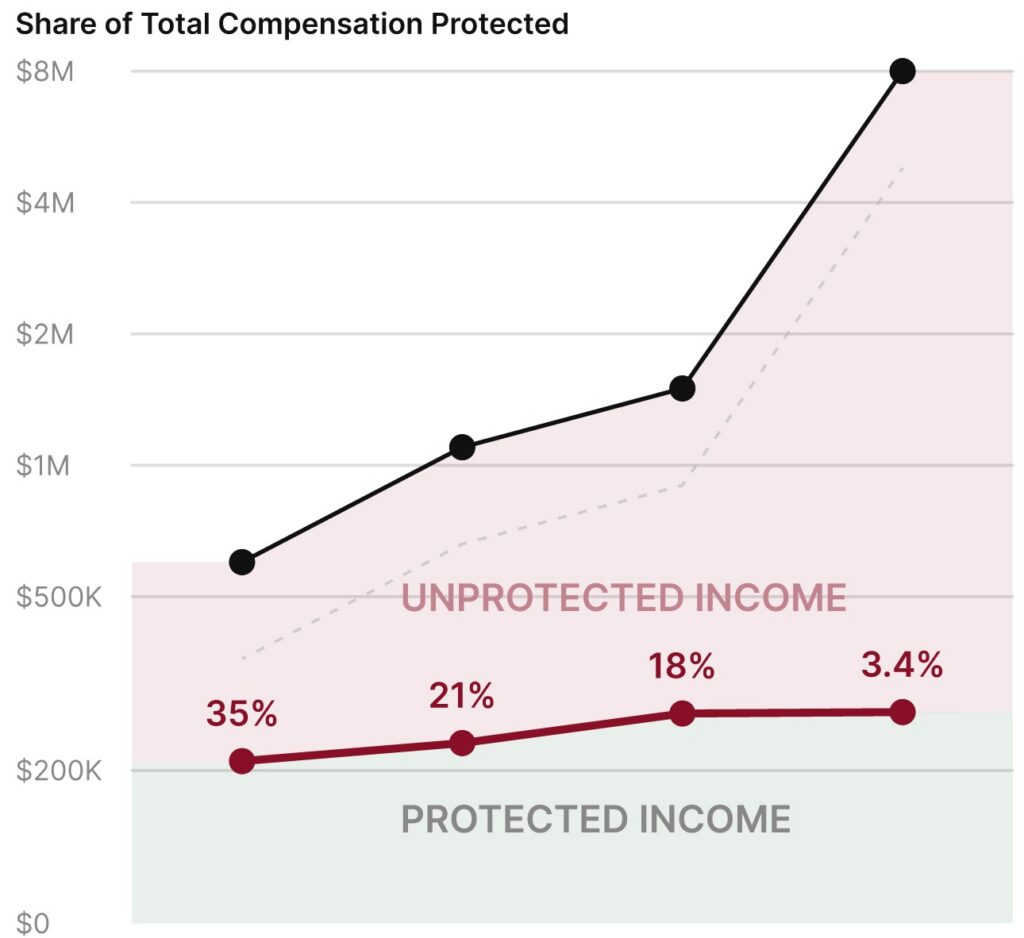
Disability insurance policies typically calculate benefits using prior income documentation, such as W-2 wages or tax returns. For CRNAs with uneven earnings, these lookback periods can smooth peaks and valleys in ways that understate earning capacity during normal operating conditions. A brief reduction in scheduled hours can lower the income baseline used to calculate benefits.
Residual or partial disability provisions become especially relevant in this context. A CRNA may remain clinically capable but unable to take overnight calls or manage longer cases.
Income loss then occurs through fewer billable hours rather than complete work cessation. Whether benefits are payable depends on how the policy measures income loss relative to prior earnings.
Own-Occupation Definitions and Professional Function
Anesthesia practice is highly specialized. Own-occupation disability definitions focus on whether a clinician can perform the material duties of their specific profession rather than any form of work. For CRNAs, those duties include anesthesia administration, airway management, and continuous intraoperative monitoring.
Some disability policies advertise own-occupation coverage but later modify definitions after a limited benefit period. This distinction matters for CRNAs who may be capable of other nursing or administrative roles but unable to perform anesthesia services at prior levels. Policy definitions determine whether income from alternative work offsets benefits.
Disability insurance disputes show that specialty-specific definitions reduce ambiguity in claims. Profession-specific disability definitions align benefit determinations more closely with functional job requirements rather than general employability.
For CRNAs with variable schedules, own-occupation language intersects directly with income measurement. If a clinician can work fewer cases or avoid calls but still perform some duties, the policy must clearly define how reduced capacity is treated. Ambiguous definitions can result in benefit reductions even when earnings decline substantially.
Benefit Periods, Riders, and Long-Term Income Stability
Benefit period length determines how long income protection remains in force during extended disruptions. Longer benefit periods protect earnings over decades, while shorter periods assume financial independence earlier. For CRNAs whose peak earnings often arrive mid-career, benefit duration shapes long-term income stability.
Cost-of-living adjustments address erosion of purchasing power during long claims. Healthcare and housing costs continue to rise year over year.
Future purchase options allow coverage amounts to increase as income grows without additional medical underwriting. This feature affects whether coverage keeps pace as compensation rises through expanded call coverage, leadership roles, or higher-acuity practice settings.
Non-cancelable and guaranteed renewable provisions control whether insurers can change premiums or policy terms. These contract features stabilize long-term costs and prevent unilateral changes as claim risk increases with age.
Income Protection Beyond Catastrophic Events
Disability insurance discussions often focus on total inability to work. Regulatory guidance frames disability coverage more broadly around income loss tied to job performance. “Disability insurance is a type of insurance that provides income if a worker is unable to perform their job duties and earn money due to a disability,” National Association of Insurance Commissioners states.
For CRNAs, income risk more commonly arises from reduced capacity, uneven scheduling, or facility-level staffing changes rather than complete work stoppage. Policies that fail to account for these realities may leave gaps during partial disruptions.
Private, individually owned disability insurance policies are often structured to address these gaps by tying benefits more closely to specialty-specific income patterns rather than standardized employment assumptions. Unlike group arrangements that rely on uniform definitions and capped formulas, individual policies can incorporate occupation-based definitions and income measures that reflect how CRNAs actually earn compensation. In this context, private coverage functions less as a backstop for catastrophic loss and more as a mechanism designed to translate uneven clinical workloads into more predictable income protection when work capacity narrows but does not disappear.
By examining how disability insurance measures income, defines occupation, and responds to reduced workloads, the focus shifts from rare catastrophic events to everyday earnings risk. For CRNAs, income protection depends less on whether work ends entirely and more on how policy language interprets fluctuating work patterns.
How Benefit Calculations Affect Variable CRNA Income [VIDEO]