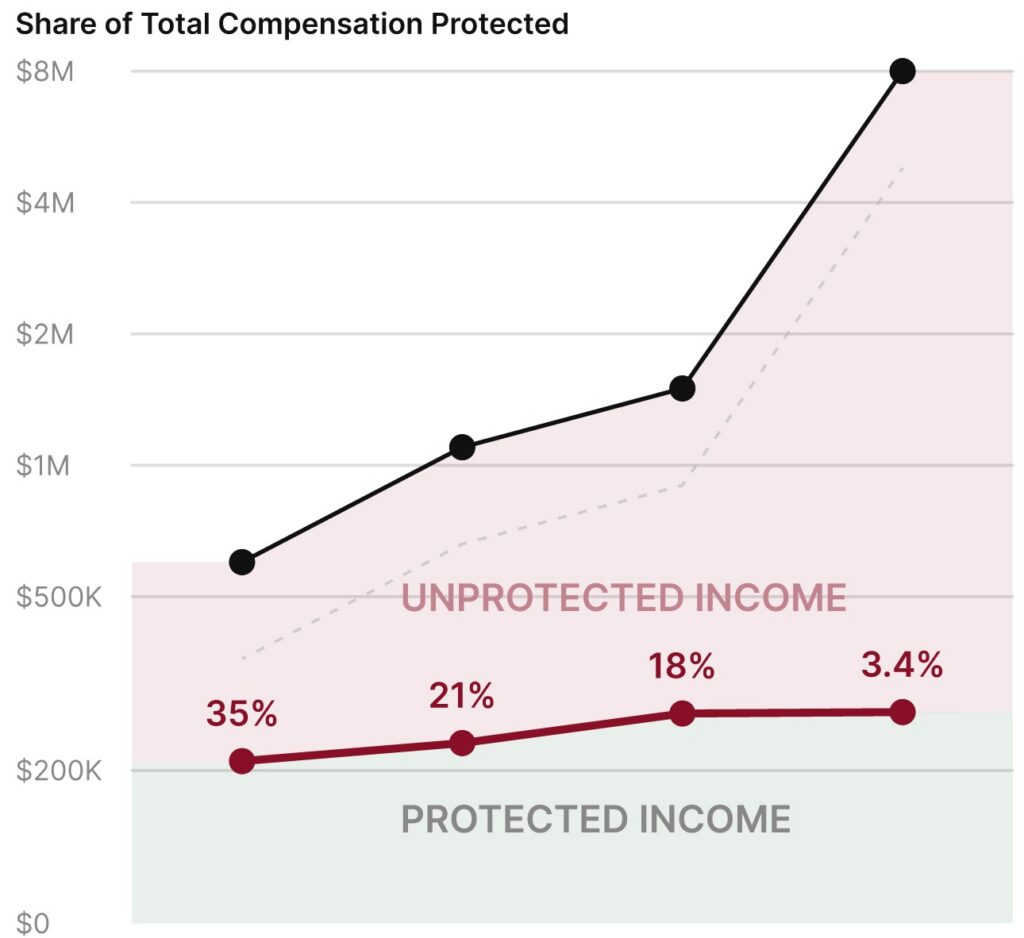

A nurse anesthetist earning well into six figures usually assumes the hospital’s long-term disability plan will replace most of that income during a serious illness or injury. The employer plan typically pays a capped percentage of base salary only, and it stops the day the clinician leaves that W-2 position. The distance between what a certified registered nurse anesthetist earns and what a group plan actually replaces is set by the plan’s structure, not by how much the clinician makes.
The hospital plan is the starting point rather than the answer. Nurse anesthetist disability insurance owned individually covers the earnings a group cap leaves uninsured.
Certified registered nurse anesthetists now earn a median annual wage of $212,650, according to Bureau of Labor Statistics occupational data. Many employer long-term disability plans cap benefits at levels fixed during earlier compensation cycles, so as wages climb the protected share of income steadily shrinks. That shortfall usually stays invisible until a claim begins.
“The biggest surprise to a lot of people that have employer-sponsored policies, when they actually go out on claim, is just how much lower the income replacement is than the income they got from their salary.”
Andy Schafer, vice president of Workplace Benefits Solutions at Principal Financial Group, on the Income Protection Journal Podcast
How Hospital Group Coverage Falls Behind a CRNA’s Income
Employer long-term disability coverage for a nurse anesthetist is built on three structural limits that operate before any claim is filed. Benefits are calculated on base salary alone, which leaves call stipends, overtime, and differential pay outside the covered amount. A fixed dollar cap then holds the benefit below what a high-earning clinician actually takes home, and because that cap is a set dollar amount rather than a percentage, it does not rise as the clinician’s pay grows, so the highest earners end up the least protected relative to their income.
And when the employer pays the premium, the benefit that does arrive is taxable, which lowers the net replacement further. The comparison below shows how those limits contrast with an individual own-occupation contract, the coverage that decides whether a CRNA disability insurance plan tracks real earnings.
| Dimension | Employer / hospital group LTD | Individual own-occupation policy |
|---|---|---|
| Disability definition | Often any-occupation or a modified definition | True own-occupation, tied to anesthesia duties |
| Income counted | Base salary only, subject to a fixed cap | The clinician’s full earnings, toward 70 percent replacement |
| Portability | Ends when the CRNA leaves the employer | Fully portable across W-2, 1099, and locum roles |
| Who controls it | The employer owns it and can change or cancel it | The CRNA owns it, with a non-cancelable premium |
| Benefit taxation | Taxable when the employer pays the premium | Tax-free when paid with after-tax dollars |
The definition row carries the most weight. A group plan that pays only when a nurse anesthetist cannot work in any occupation behaves very differently at claim time than an individual contract that pays when the clinician cannot perform anesthesia, a distinction covered in how disability insurers deny CRNA benefit claims. It is also why two nurse anesthetists with the same salary can receive very different benefits, because the group plan measures the job the employer defines while the individual policy measures the anesthesia work the clinician actually performs.
Why Individual Own-Occupation Coverage Supplements a CRNA’s Employer Plan
Every individual disability insurance policy is written on an own-occupation basis, which means a nurse anesthetist who can no longer administer anesthesia collects the benefit even while working in another role. Individual coverage also counts the clinician’s full earnings rather than base salary alone, and because the CRNA owns the contract, it stays in force through changes of employer.
“You can go through underwriting to provide additional income replacement, and in most situations, get your income up as high as 70% of your pre-disability earnings. If your employer policy doesn’t provide that much coverage, or if there’s a maximum in place, consider some individual disability insurance to supplement your income replacement.”
Schafer, on the Income Protection Journal Podcast
Because the individual policy is paid with after-tax dollars, the benefit arrives tax-free, so a smaller face amount can replace the same take-home pay that a larger taxable group benefit would. For nurse anesthetists whose careers move between hospital employment and contract work, that portability matters as much as the dollar figure, since a policy tied to the clinician rather than the job does not lapse at each transition.
A nurse anesthetist who leaves a hospital staff position for independent contracting keeps the individual policy unchanged, while the employer coverage ends with the final paycheck. That continuity is why brokers place the individual contract early, when the clinician is youngest and healthiest and the premium is lowest, rather than waiting until a job change exposes the shortfall.
What a CRNA Should Confirm Before Relying on Group Coverage
The practical review is short. A nurse anesthetist can ask the benefits office three questions before assuming a hospital plan is sufficient, then size individual coverage against the answers.
First, whether the disability definition is own-occupation or any-occupation, because that single term decides most contested claims. Second, whether the monthly benefit is capped, and where that cap sits against current total earnings including variable pay. Third, whether the coverage is portable, since most group plans are not.
Where the answers reveal a shortfall, individual own-occupation coverage restores the protected share, and pairing it with the employer plan is often less expensive than clinicians expect. Coordinating the two is the same planning step that lets a CRNA disability policy cut premiums by 30 percent through occupational class and carrier selection.
Rising compensation does not automatically widen financial protection. The mechanics of the policy, rather than the size of the paycheck, determine how much income stays stable when a nurse anesthetist cannot work.
For a profession whose earnings continue to climb, confirming that coverage tracks income is the difference between a plan that looks adequate and one that pays. The review itself costs a nurse anesthetist nothing beyond a short conversation, and a broker can place the employer plan next to individual own-occupation quotes from several carriers so the size of the shortfall is visible well before a claim ever tests it.