
Physician Disability Insurance
Protecting medical professionals for over 30 years.
Disability Insurance Quotes for Doctors
Disability Insurance for Doctors
Own-occupation specialty-specific disability insurance plans for surgeons, cardiologists, neurologists, dermatologists, orthopedic surgeons, anesthesiologists, radiologists, pathologists, ophthalmologists, gastroenterologists, pulmonologists, oncologists, psychiatrists, obstetricians, and other medical specialists.

Customize Your Physican Disability Insurance Quote
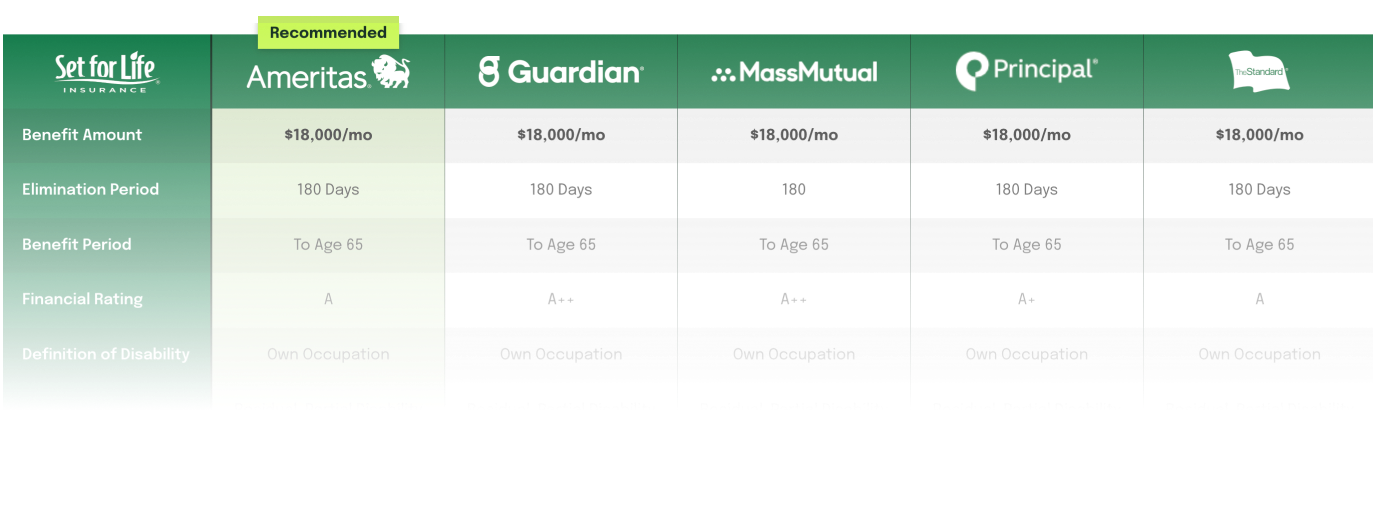
Compare Physician Disability Coverage Side-by-Side
Get Your Customized Physician Quote
"*" indicates required fields

She made updating my files with each life event stress-free. I watched colleagues struggle to communicate with insurance companies, but not me. One email to Jamie and everything is taken care of. My family is protected and done so with ease, all thanks to Jamie. I highly recommend Set For Life!!!
Physician Disability Insurance Brokers
How Physician Disability Insurance Works
Physician disability insurance protects your income if injury or illness prevents you from performing the material and substantial duties of your medical specialty. Unlike most employer group plans, an individual policy is personally owned, portable, and non-cancellable as long as premiums are paid.
When applying, insurers evaluate your specialty, income, and medical history to determine eligibility and benefit limits. A strong policy includes a monthly benefit amount, an elimination period, a defined benefit duration, and, most importantly, a true own-occupation definition tailored to physicians. Because medical careers are highly specialized, the structure of the policy should reflect how you actually earn your income.
High-income professionals across many fields rely on income protection coverage. In addition to physicians, disability insurance for dentists, and own occupation disability insurance for attorneys, specialized policies such as disability insurance for athletes are also used to protect professional sports income.
What to Look for in an Own-Occupation Policy
Not all own-occupation policies are structured the same way. Physicians should look for a true own-occupation definition that pays full benefits if you cannot perform your specialty, even if you work in another role.
Key features to evaluate include:
-
- True Own-Occupation Definition
-
- Residual or Partial Disability Rider
-
- Future Increase Option (FIO)
-
- Mental/Nervous Coverage Limits
-
- Non-Cancellable and Guaranteed Renewable Provisions
Physicians in procedural or surgical specialties should pay close attention to how the policy defines disability relative to hands-on patient care and surgical duties.
How Much Disability Coverage Physicians Typically Buy
Coverage amounts vary by income level and career stage. Residents and fellows often begin with smaller policies, sometimes through guaranteed standard issue (GSI) programs, while attending physicians typically structure coverage to replace a meaningful percentage of income.
High-income specialists may layer policies or increase coverage over time as earnings grow. The objective is to align protection with long-term income potential, tax treatment, and any existing group benefits, not simply to purchase the maximum available amount.
Ready to compare? Jump to the quote request form.
High-income specialists typically need disability insurance coverage that replaces 60 to 80 percent of gross income, which translates to monthly benefits between $8,000 and $15,000 for most practicing physicians. Orthopedic surgeons, anesthesiologists, cardiac surgeons, and neurosurgeons often carry coverage limits up to $25,000 monthly given earning potential that can exceed $400,000 annually.
Coverage needs also track how a physician practices. Employed physicians generally focus on replacing personal income alone. Practice owners must additionally cover business overhead expenses during a disability, and solo practitioners typically need the highest combined coverage since no partner absorbs the practice’s fixed costs.
Location matters too. Specialists in high-cost markets such as California or New York often carry higher benefit amounts, while rural physicians may need a lower absolute benefit paired with a higher income-replacement percentage, since fewer local alternatives exist if a specialty career ends early.
 |
Ameritas Life Insurance Corp. 4501NC · Enhanced Residual Rider (AERES) |
Guardian Berkshire Life Insurance Co. of America ICC16 18ID · Provider Choice + Enhanced Partial Rider |
Lloyd’s Petersen International Underwriters PDI111521 · Optional Residual Rider |
Mass Mutual Massachusetts Mutual Life Insurance Co. ICC15-XLIS-RC · Extended Partial Disability (EPR) |
Principal Principal Life Insurance Company ICC22-800-IDI · Income Protector |
The Standard Standard Insurance Company B180(7/17) · Platinum Advantage + Residual Riders |
|---|---|---|---|---|---|---|
| Lowest income-loss threshold to trigger residual benefits, tested across all six carriers below: Ameritas sets the mark at 15% of prior monthly earnings. | ||||||
| Income Loss Threshold That Triggers Residual Benefits | ||||||
| Minimum income loss required % of prior earnings that must be lost before residual benefits begin |
15% loss of monthly earnings (Specimen) One of the lowest thresholds available. Rider text states: loss must be “at least 15% of your prior monthly earnings” due to sickness or injury. |
Loss of Income due to disability (Specimen) Guardian’s Enhanced Partial rider defines “Loss of Income” as the difference between Prior Income and Current Income attributable solely to the Injury or Sickness. No explicit percentage floor in the base rider, benefit scales proportionally with income loss. Must be Gainfully Employed. |
Optional rider, threshold per rider terms (Specimen) Base Lloyd’s specimen (PDI111521) notes “Residual Disability is an optional benefit that only applies if the rider was purchased.” Rider text not included in this specimen. Typical Lloyd’s/PIU residual riders require income loss and inability to perform all material duties. |
20–80% loss of Predisability Earnings (Standard) EPR benefit is payable when Monthly Earnings fall to 20%–80% of Predisability Earnings. Below 20% earnings remaining triggers full benefit. Above 80% earnings remaining, no EPR benefit is paid. |
Loss of Earnings from own occupation (Specimen) Principal’s Residual Disability Benefit Rider requires a loss of Earnings due to Disability. The specimen confirms “Earnings” excludes unearned income. No explicit minimum percentage floor, benefit scales pro-rata with the earnings loss ratio. |
20% loss of Predisability Earnings (Enhanced); 15–20% for Short-Term version (Specimen) Specimen lists Basic, Enhanced, and Short-Term Residual riders. Enhanced Residual: benefit payable when Monthly Earnings are 20%–80% of Predisability Earnings. |
| Monthly Benefit Calculation Formula | ||||||
| Residual benefit formula How the monthly residual check is calculated |
Residual Monthly Benefit = (Loss of Monthly Earnings / Prior Monthly Earnings) x Base Monthly Benefit (Specimen) First 6 months minimum: The greater of (a) 50% of base monthly benefit OR (b) the formula result. 75%+ loss rule: If loss exceeds 75% of prior monthly earnings, treated as 100% loss and full base benefit is paid. Prior earnings: Average of highest 12-month or 24-month period before disability, indexed annually for CPI-U after year 1. |
Partial Disability Benefit = (Loss of Income / Prior Income) x Monthly Benefit (Specimen) Prior Income: Average monthly income for either (a) last 24 calendar months, or (b) the two calendar years with highest earnings in the three years before disability, whichever is greater. Current Income: All income for services during disability, excluding pre-disability earned-but-not-yet-received income. Full benefit floor: If loss of income is 100% or more of Prior Income, full monthly benefit is paid. |
Proportional formula, rider required (Specimen) Rider language not included in this specimen. Lloyd’s/PIU residual riders typically use a proportional income-loss formula: (income loss / pre-disability income) x base benefit. Confirm with current rider filing. |
EPR Benefit = [(Predisability Earnings – Monthly Earnings) / Predisability Earnings] x Monthly Benefit (Standard) Full benefit if earnings are less than 20% of predisability earnings. No benefit if earnings are greater than 80% of predisability earnings. Prior earnings: Average of the 24 months before disability began. |
Residual Benefit = (Loss of Earnings / Prior Earnings) x Maximum Monthly Benefit (Standard) Prior Earnings: Average monthly Earnings for the 12 months before disability. Current Earnings: Earnings during the disability period, excludes passive/unearned income. Minimum benefit: Typically 50% of base benefit for first 6 months. |
Residual Benefit = [(Predisability Earnings – Monthly Earnings) / Predisability Earnings] x Basic Monthly Benefit (Standard) Full benefit trigger: If Monthly Earnings are less than 20% of Predisability Earnings, full Basic Monthly Benefit is paid. Basic Residual Rider: Flat 50% of base benefit when qualifying criteria met. Enhanced Residual Rider: Proportional formula above; includes Recovery Benefit. |
| Prior Total Disability Requirement, Can Residual Trigger Independently | ||||||
| Independent trigger Does residual require a prior period of total disability, or can it trigger on its own? |
Fully independent, no prior total disability required (Specimen) Ameritas AERES rider states benefits begin the later of: (1) the day after the end of the Elimination Period, OR (2) the day following a period of total disability for which benefits have been paid. Either path is valid. Days of both total and residual disability satisfy the elimination period. |
Fully independent, no prior total disability required (Specimen) Guardian’s Enhanced Partial Disability Benefit Rider uses its own Elimination/Accumulation Period. The insured must satisfy the Accumulation Period but does not need to first be Totally Disabled. Residual days count toward satisfying the Elimination Period. |
Rider-dependent, verify current rider (Specimen) Lloyd’s specimen confirms residual is an optional rider. The base policy elimination period can be satisfied by successive periods of Total Disability or Residual Disability, but rider must be reviewed for independence trigger language. |
Fully independent, no prior total disability required (Standard) MassMutual’s EPR rider allows residual disability claims to trigger directly after the elimination period without a prior total disability period. Both total and partial disability days satisfy the elimination period. |
Fully independent, no prior total disability required (Standard) Principal’s residual/partial disability rider triggers after the elimination period regardless of whether any total disability period occurred. The elimination period can be met by residual disability days alone. |
Fully independent, no prior total disability required (Standard) Standard’s Enhanced Residual Disability Benefit Rider triggers after the Benefit Waiting Period is satisfied, independent of any total disability. Days of Disability during the Benefit Waiting Period need not be consecutive. |
| Benefit Period for Residual Disability | ||||||
| Residual benefit period Maximum duration for which residual benefits can be paid |
Remaining unused portion of the Total Disability Maximum Benefit Period (Specimen) The Residual Maximum Benefit Period equals the total unused portion of the maximum benefit period for total disability shown on the schedule. Combined total and residual payments cannot exceed this period. Typically to Age 65/67 when selected. |
Same Benefit Period as Total Disability, to Age 65, 67, or 70 (Specimen) Benefit Periods of To Age 70/67/65 or 10/5/2 Years are available. The Enhanced Partial rider benefit period matches the policy benefit period. To Age 70 option available for physicians, distinctive among carriers. |
Per Schedule of Benefits / rider terms (Specimen) The residual rider benefit period is set at time of issue and shown on the Schedule of Benefits (Section 1-D). Confirm with current rider. |
To Age 65 (base); Extended to Age 65 via Maximum Benefit Period Endorsement (Specimen) Specimen shows coverage end date for Extended Partial Disability corresponding to the policy’s non-cancellable period to age 65. A separate Maximum Benefit Period Endorsement is available with its own premium schedule. |
Same as base policy Maximum Benefit Period, 2 years, 5 years, To Age 65/67/70 (Specimen) Options include To Age 65, 67, and 70. Residual benefits run within this same period. To Age 70 available depending on occupation class. |
Same as base policy Maximum Benefit Period, to Age 67 in this specimen (Specimen) Maximum Benefit Period schedule applies (e.g., if disability begins at 62: 60 months; at 63: 48 months). Enhanced Residual Disability Benefit Rider matches base benefit period. |
| Recovery Benefit Provisions | ||||||
| Recovery benefit Protections after returning to work, continued payments if income remains depressed |
Explicit Recovery Benefit provision (Specimen) Triggers after a disability benefit period ends if the insured has returned to work, is performing material duties 80% or more of prior time, and still has 15% or more loss of monthly earnings demonstrably caused by the prior disability. Duration: Continues up to the residual maximum benefit period. |
Recovery Benefit, income-loss based, ongoing (Specimen) Benefits continue post-recovery as long as Loss of Income persists due to the disability. Because Guardian uses an income-loss formula, benefits naturally continue as long as Current Income remains below Prior Income due to the disabling condition. Prior Income protection: Uses the best 24-month or best-2-of-3-years average. |
Recovery benefit per rider, verify current rider (Specimen) Lloyd’s base specimen does not contain recovery benefit language. Standard Lloyd’s/PIU residual riders may include recovery provisions, but this must be confirmed against the current executed rider. |
Recovery Benefit included in EPR rider (Standard) After returning to full-time work following a disability for which EPR benefits were paid, if Monthly Earnings remain below Predisability Earnings due to the disability, a proportional recovery benefit continues. Duration: up to the remaining Maximum Benefit Period. |
Recovery Benefit, proportional, ongoing post-return (Standard) Provides recovery benefits when an insured has returned to Full Time Work but Earnings remain below prior levels due to the disability. Benefit calculated using the same proportional formula. |
Recovery Benefit included, Enhanced Residual Rider only (Specimen) The Basic Residual Rider does not include the Recovery Benefit, the Enhanced version is required. The base policy confirms premiums are waived while Recovery Benefits are payable. Short-Term Residual Rider: does not include recovery benefit. |
| Physician-Specific Nuances and Notable Provisions | ||||||
| Key nuances for physicians Provisions especially relevant to medical specialists |
True specialty own-occupation for physicians/dentists (specimen confirmed) 15% income loss threshold is the lowest tested, ideal for physicians cutting back patient load CPI-U indexing of prior earnings during claim protects against inflation eroding residual benefit Accounting method choice (cash or accrual) accommodates both employed and practice-owner physicians |
Surgical Procedure Enhancement and Hands-on Patient Care Enhancement (confirmed in specimen): If more than 50% of income comes from surgical procedures or hands-on care, total disability is triggered solely by loss of that capacity To Age 70 benefit period available Income includes business profits from privately held entities Prior Income = best 24 months OR best 2-of-3 years |
Lloyd’s specialty own-occupation language confirmed in specimen Subjective Pain exclusion applies, relevant for pain-management physicians Residual rider is optional add-on; base policy is total-disability-only Useful as excess/supplemental layer above group DI limits Expiry-date policy, not lifetime renewable in same way as Big 5 carriers |
Participating policy, eligible for dividends (not guaranteed) RetireGuard rider protects retirement contributions during disability, unique to MassMutual Own Occupation Rider available separately from the EPR, both can be elected simultaneously Short-Term Disability Benefits Rider (STR) included within the EPR structure |
Specialty own-occupation confirmed: “single professionally recognized specialty in medicine or dentistry” is deemed own occupation True Own Occupation add-on available at additional cost Annual Increase Rider (AIR): automatic 3% benefit increase, no additional cost, to earlier of 20 years or age 50 Pandemic suspension provision, unique feature allowing suspension during declared pandemic |
Specialty own-occupation confirmed: “single specialty recognized by ABMS, AOABOS, or ADA” is deemed own occupation Three-tier residual structure: Basic / Enhanced / Short-Term Family Care Benefit: pays if working reduced hours to care for a seriously ill family member, no total disability required Survivor Benefit: 3x basic monthly benefit paid to beneficiary if death occurs while benefits are payable Platinum Advantage specimen is for limited states (CT, DE, DC, FL, MT, ND, SD) |
True Own-Occupation Disability Insurance for Physicians
Own Occupation Definition Differences Across Medical Specialties
True own-occupation coverage, an individual disability insurance policy chosen at application rather than defaulted through an employer, pays full benefits when a physician cannot perform the specific duties of a medical specialty, even while remaining able to work in a different medical or non-medical role. A surgeon who develops hand tremors, for example, still qualifies for benefits despite remaining capable of teaching or administrative work.
Own-occupation protection carries a real cost. Policies with more specific definitions of disability price 15 to 25 percent higher than policies using a broader, any-occupation definition, according to the American Medical Association. True own-occupation definitions never convert to any-occupation terms; modified versions typically shift to a broader standard after two to five years.
Surgical specialists, procedure-based physicians such as interventional cardiologists and gastroenterologists, and diagnosis-dependent specialists including radiologists and pathologists each depend on a different physical or sensory skill, which is why own-occupation language has to match the specialty rather than a generic medical license. The full carrier-by-carrier comparison of these provisions appears in the carrier comparison table earlier on this page.
Doctor Disability Insurance Coverage and Why Specialized Protection Matters
The median educational debt for medical school graduates, including undergraduate borrowing, runs close to $250,000, according to the Association of American Medical Colleges. That debt load is a primary reason doctor disability insurance coverage carries higher benefit limits than policies built for the general workforce.
Physicians face higher rates of both musculoskeletal disorders and mental health conditions than many other professions, according to the American Academy of Family Physicians and the Texas Medical Association Insurance Trust. Within that picture, emergency medicine physicians, anesthesiologists, and surgeons face higher disability rates than colleagues in less physically demanding specialties, while radiologists, internal medicine physicians, and pathologists see comparatively lower rates, though vision-related conditions can still end a diagnostic career.
Physician disability insurance coverage exists for exactly this gap: it replaces income tied to a named specialty rather than requiring total inability to perform any job. Monthly benefit limits reflect the difference, commonly reaching $20,000 or higher versus the $5,000 to $8,000 caps typical of standard policies, a gap that mirrors the income and debt profile unique to medical professional disability insurance.
Short Term Disability Insurance for Physicians and Supplemental Coverage Options
Long Term Disability Insurance for Physicians and Elimination Period Mechanics
Short term disability insurance for doctors typically pays benefits for roughly 3 to 12 months, replacing 80 to 100 percent of income during a temporary condition such as surgical recovery. Long-term coverage extends the benefit period to age 65 to 67, replacing 60 to 80 percent of income but adding riders such as cost-of-living adjustments and partial disability benefits that short-term policies do not carry.
Most physicians prioritize long-term coverage, since catastrophic disability risks are what can permanently end a medical career, while short-term needs are often absorbed by sick leave or personal savings.
Elimination periods, the waiting period before benefits begin, typically run 60 to 365 days on physician policies, with 90 days the most common selection. MassMutual offers residents 60-day, 90-day, and 180-day elimination-period options, letting trainees balance premium cost against how long they can self-fund the wait. The complete benefit-period comparison across all six carriers appears in the carrier comparison table earlier on this page.
Supplemental Disability Insurance for High-Income Physicians
Physicians earning more than $300,000 annually often need supplemental coverage, since a single carrier typically caps individual disability benefits at $20,000 monthly regardless of actual income. Coordinating policies across multiple carriers can raise the aggregate benefit to roughly $30,000 monthly without violating any one company’s participation limits.
Lloyd’s of London and other surplus-lines carriers extend supplemental capacity to $50,000 monthly or higher for ultra-high-income specialists whose needs exceed standard carrier limits. An independent broker who can compare disability insurance for physicians across carriers is often the fastest way to structure primary and secondary coverage correctly, before a claim rather than after one.
Medical Professional Disability Insurance and Occupation Class Standing
Specialty-Specific Occupation Class Assignment for Physicians
Every major disability carrier classifies physicians by specialty inside its occupation-class system, not as a single undifferentiated medical category. Ameritas groups physicians within its M classes, Guardian maintains a full specialty listing in its underwriting guide, MassMutual splits physicians among 5P, 4P, and 3P tiers, and Principal and The Standard run comparably detailed specialty schedules.
Carriers label the underwriting floor for uninsurable occupations differently: Ameritas and Principal use a flat “No,” Guardian labels the category “Class 1” or “Uninsurable,” MassMutual marks it “N/A” or “IC” for individual consideration, and The Standard uses “NO.” A physician whose occupation class sits at that floor is not eligible for standard coverage regardless of income, an occupation-based medical underwriting outcome separate from any health-history review.
Practice ownership changes the underwriting picture too. Every carrier compared here offers a business-owner upgrade path, since many physicians hold an equity stake in their practice rather than working purely as an employee. Working-from-home and telehealth arrangements are addressed separately in each carrier’s guide, and hazardous-exposure rules apply to physicians in occupational medicine, EMS-adjacent, or field-based roles where the underwriting differs from standard office-based practice.
|
Ameritas Life Insurance Corp. Field Underwriting Guide |
Guardian Berkshire Life Insurance Co. of America Provider Choice · IDI Field Underwriting Guide |
Mass Mutual Massachusetts Mutual Life Insurance Co. Radius Choice · Underwriting Guide |
Principal Principal Life Insurance Company Income Protector · Disability Product Guide |
The Standard Standard Insurance Company Platinum Advantage · Product Guide |
|---|---|---|---|---|---|
| Physicians classified by specialty | Yes, within M classes | Yes, full specialty listing in Section 7-7 | Yes, split among 5P, 4P, 3P | Yes, extensive specialty listing in M classes | Yes, split among 5P, 4P, 4S (surgeons), 3P |
| Working-from-home guidelines | Yes, addressed in occupation guide | Yes, addressed in underwriting rules | Yes, separate guidelines for self-employed vs telecommuter | Yes, addressed in occupation schedule | Yes, 75% home-time threshold triggers underwriting restrictions |
| Business owner upgrade path | Yes, Business Owner Upgrade Program | Yes, Move-Up Option criterion N (5+ years ownership) | Yes, five-step income / ownership / employee matrix | Yes, three-tier income matrix (6A / 5A / 3A) | Yes, Business Owner Upgrade and Earned Income Enhancer |
| Label used for uninsurable occupations | “No” | “Class 1” or “Uninsurable” | “N/A” or “IC” (Individual Consideration) | “No” | “NO” |
| Hazardous-exposure handling | Industry-by-industry within the occupation guide | Built into Class 1 definition, heights, chemicals, fumes, extreme temps | Built into Class A definition plus special-occupation list | Built into “No” rules for hazardous occupations | Class B is the floor; anything riskier is rated “NO” |
Source: Field underwriting guides published by each carrier. Edge-case rules are subject to underwriter discretion and may vary by state. Set for Life Insurance confirms applicable rules with each carrier at the time of submission.
Individual Disability Insurance for Physicians From Guardian and Principal Financial Group
Guardian and Principal Financial Group Compared for Physicians
Guardian and Principal Financial Group are two of the six carriers compared on this page, alongside Ameritas, MassMutual, The Standard, and Lloyd’s of London, but doctors evaluating individual disability insurance for physicians ask about this specific pairing most often.
Guardian’s own-occupation definition never converts to a broader standard, matching Principal’s own pure own-occupation language, so neither carrier requires physicians to accept a lesser definition later in the policy’s life.
Guardian’s premiums run higher, with a graded-premium option that starts lower and escalates over time, while Principal typically prices more attractively for younger physicians, particularly residents and fellows who qualify for meaningful training discounts. Both carriers offer resident and fellow discounts, though Guardian’s terms carry through more favorably once a physician reaches attending status.
Guardian adds surgical specialty rider language and guaranteed standard issue access through select brokers, while Principal’s Maximize Your Benefit rider allows flexible coverage increases throughout the life of the policy. On financial strength, Guardian holds A++ from A.M. Best, the highest rating available, while Principal holds A+, still a strong rating but one notch below Guardian.
| Feature | Guardian | Principal |
|---|---|---|
| Own-occupation | Pure definition, never converts | Pure own occupation, never converts |
| Premiums | Higher cost, broad features. Graded premium option for initially lower, escalating premiums. | Lower cost for younger physicians |
| Discounts | Resident/fellow discounts that apply to future increases. Superior for established physicians | Resident/fellow discounts |
| Riders | Extra surgical specialty language. Guaranteed standard issue available through select brokers. | Maximize Your Benefit flexible increases available throughout the life of the policy. |
| Financial strength | Highest possible insurance ratings A++ (A.M. Best) | Strong at A+ but lower than Guardian |
Residual Disability Benefits and the Disability Claims Process for Doctors
Filing a Disability Income Claim as a Doctor
Filing a disability income claim starts with notifying the carrier within 30 days of the disability’s onset, which triggers a documentation process built around three categories: medical records and attending physician statements describing functional limitations, diagnostic test results supporting the diagnosis, and financial documentation, typically two to three years of tax returns and practice income statements, verifying pre-disability earnings.
Carriers evaluate the medical evidence, apply the policy’s own-occupation or any-occupation definition, and assess work capacity before deciding whether a claim is approved or denied. Standard review runs 30 to 60 days from the date a complete file is submitted; complex cases involving subjective conditions may take longer and can require an independent medical examination or a functional capacity evaluation.
Guardian, Principal, MassMutual, and Ameritas maintain physician-friendly claims practices for legitimate disability situations, though every carrier requires ongoing management once a claim is approved: periodic medical updates and financial reporting confirming the disability, and the continued functional limitation, remain in place. Physicians who apply promptly and submit a complete file the first time see faster reviews than those who submit piecemeal documentation. The full recovery-benefit comparison across all six carriers appears in the carrier comparison table earlier on this page.
Group Disability Insurance Versus Individual Disability Insurance for Physicians
Portable Coverage and Group Disability Policy Limitations for Physicians
Group disability policies through hospitals cap benefits at $5,000 to $15,000 monthly, generally require a physician be totally disabled under an any-occupation definition rather than paying partial disability benefits for a specialty-specific loss, and terminate the moment a physician changes employers. Group benefits are also taxable when the employer pays the premium, a detail many physicians overlook until a claim is actually paid.
Individual disability insurance for physicians reaches up to $30,000 or more monthly, uses an own-occupation definition tied to the physician’s specialty, and provides portable coverage that follows a doctor through every job change. Individual benefits are also tax-free when the physician pays premiums with after-tax dollars, a meaningful difference from taxable group benefits.
Portable coverage matters most at the moment of a job change: group coverage ends immediately, leaving a gap until new employer coverage begins, while an individual policy simply continues. The Standard offers a group-to-individual conversion feature for physicians leaving a group plan, though converted policies typically carry lower benefit limits and higher premiums than a new individual application secured while still employed. The complete carrier-by-carrier comparison of how independently residual benefits can trigger, without requiring a prior period of total disability, appears in the carrier comparison table earlier on this page.
Disability Insurance for Residents and Fellows
Residency Discount Programs Across Carriers
Residency discount programs reduce premiums for medical trainees across every major carrier. Guardian offers 10 to 15 percent premium reductions for residents and fellows, while Principal, MassMutual, and Ameritas price competitively for the same training years, and The Standard offers discounts at select hospitals.
Medical associations add a further layer of savings: AMA and AAFP group-discount arrangements can reduce premiums by 5 to 10 percent for qualifying residents and fellows, on top of each carrier’s own training discount.
A future increase option lets a resident lock in portable coverage at training-year rates while retaining the right to raise the benefit later without new medical questions, priced at the resident’s attained age when the increase is exercised. GSI insurance programs at more than 150 teaching hospitals nationwide add a no-medical-underwriting path for trainees who want coverage in place before residency begins.
Own-Occupation Coverage for Surgeons and Procedure-Based Specialists
Guaranteed standard issue coverage matters most for physicians whose income depends on a specific hands-on skill, since the program approves trainees in three to five business days without medical underwriting or a physical examination, protecting trainees with pre-existing medical conditions that could otherwise complicate a traditional application.
That same logic, protection tied to the ability to perform a specific specialized skill, extends beyond medicine. Surgeons rely on manual dexterity the way dental disability insurance protects procedural hand skills, disability insurance for veterinarians protects hands-on animal care, and CRNA disability insurance protects the steady hands anesthesia delivery requires.