
CRNA Disability Insurance Quotes
Compare top CRNA disability insurance policies side-by-side before choosing coverage.
Disability Insurance for CRNAs
Compare Disability Quotes for Nurse Anesthetists
CRNAs rely on precise motor skills, concentration, and physical endurance to earn their income. A back injury, hand tremor, neurological condition, or other health problem can quickly prevent a nurse anesthetist from practicing. Set for Life Insurance helps CRNAs compare disability insurance policies from top carriers using a side-by-side comparison grid, making it easier to evaluate own-occupation coverage designed for nurse anesthetists.

Get Your Customized CRNA Quote
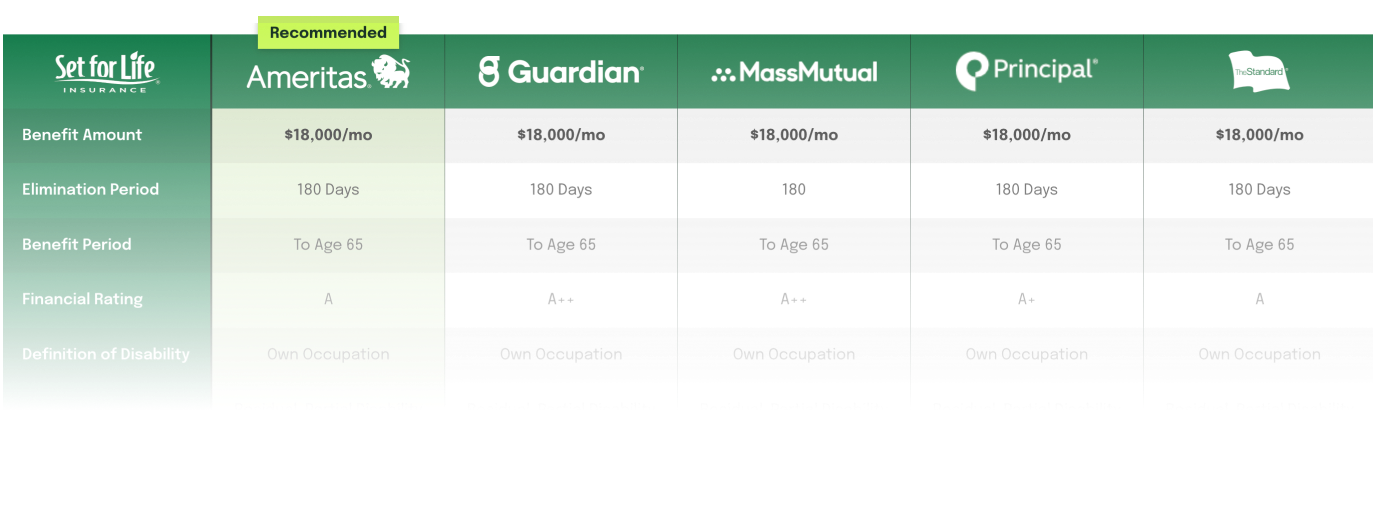
Compare CRNA Disability Coverage Side‑by‑Side
"*" indicates required fields

She made updating my files with each life event stress-free. I watched colleagues struggle to communicate with insurance companies, but not me. One email to Jamie and everything is taken care of. My family is protected and done so with ease, all thanks to Jamie. I highly recommend Set For Life!!!
Buy CRNA Disability Insurance
CRNA Disability Insurance Benefits and Coverage Structure
Occupational Risk Factors for Nurse Anesthetists
Certified registered nurse anesthetists work in physically and mentally demanding environments that raise their disability risk above the general workforce. The job requires standing for long periods, precise hand coordination for airway management, mental acuity for medication calculations, and the ability to respond quickly during emergencies.
A nurse anesthetist who develops back problems, hand tremors, or cognitive impairment can become unable to practice safely. That loss of function creates immediate income loss, which is the core risk CRNA disability insurance income replacement is built to address.
Registered nurses experience injury rates of 104.2 cases per 10,000 full-time workers, well above the rate for all occupations combined at 91.7 cases per 10,000 workers, according to Bureau of Labor Statistics data. Without adequate income protection, a CRNA’s financial security and family stability carry severe exposure to a single injury or diagnosis.
The high-stress nature of anesthesia work also raises the risk of burnout, depression, and anxiety disorders that can qualify for disability benefits. Coverage built for certified registered nurse anesthetists needs to address both physical and mental health conditions capable of ending work performance.
Benefit Structure and Elimination Period Choices for CRNAs
CRNA disability insurance benefits center on an own-occupation definition, which pays benefits when a CRNA cannot perform the substantial and material duties of nurse anesthesia, even if that CRNA is able to work in another occupation and earn an income elsewhere. That distinction protects the years of specialized training a certified registered nurse anesthetist has invested, rather than testing whether the CRNA could technically hold some other job.
Monthly benefits on CRNA disability insurance policies generally range from $3,000 to $15,000, based on income and the coverage amount selected. Carriers typically cap coverage at 60 to 70 percent of gross income to keep a return-to-work incentive in place while still delivering meaningful income replacement.
Benefit period options run from 2 years up to age 67 or a lifetime benefit, letting a CRNA choose how long monthly benefits continue during an extended disability. Elimination period choices, the waiting period before benefits begin, range from 60 days to 2 years, with a shorter waiting period trading a higher premium for earlier benefit payments.
Residual benefits pay a partial monthly amount when a CRNA’s earning capacity drops because of reduced hours or part-time status, rather than requiring complete inability to work before any benefit is paid. Cost of living adjustments increase the monthly benefit during an active claim to help the payment keep pace with inflation over a long-term disability.
Set for Life Insurance offers discounts at numerous hospitals nationwide, and because these are individual policies, coverage is portable and stays with a CRNA through an employer change or a move to a new state.
CRNA Disability Insurance Coverage and Carrier Provisions
True Own Occupation Disability Insurance Provisions by Carrier
The provisions below come from each carrier’s specimen policy language. Several were written with physicians and dentists as the named example, so each cell states plainly whether the provision’s CRNA applicability is confirmed or not yet verified in the specimen, rather than assuming it extends to nurse anesthesia practice.
 |
Ameritas Life Insurance Corp. 4501NC, Enhanced Residual Rider (AERES) |
Guardian Berkshire Life Insurance Co. of America ICC16 18ID, Provider Choice plus Enhanced Partial Rider |
Lloyd’s Petersen International Underwriters PDI111521, Optional Residual Rider |
Mass Mutual Massachusetts Mutual Life Insurance Co. ICC15-XLIS-RC, Extended Partial Disability (EPR) |
Principal Principal Life Insurance Company ICC22-800-IDI, Income Protector |
The Standard Standard Insurance Company B180(7/17), Platinum Advantage plus Residual Riders |
|---|---|---|---|---|---|---|
| True Own Occupation Disability Insurance Provisions by Carrier | ||||||
| Key provisions Notable specialty own-occupation and procedural language, and its confirmed applicability to CRNA practice |
True specialty own-occupation language is written for physicians and dentists in the specimen. CRNA applicability is not confirmed in the specimen language and should be verified case by case. The specimen’s 15 percent income loss threshold is the lowest tested among the carriers compared here. CPI-U indexing of prior earnings during a claim protects a residual benefit against inflation. Accounting method choice, cash or accrual, accommodates both employed CRNAs and CRNAs in independent practice. |
Surgical Procedure Enhancement and Hands-on Patient Care Enhancement are confirmed in the specimen. When more than 50 percent of income comes from hands-on care, total disability is triggered solely by loss of that capacity. CRNA practice, administering anesthesia and managing airways, is hands-on patient care by definition, so this provision has direct relevance to nurse anesthetists, though confirmation of CRNA eligibility for this specific rider should come from the applying CRNA’s own specimen policy. A benefit period to age 70 is available. Prior income is calculated as the best 24 months, or the best 2 of the last 3 years. |
Lloyd’s specialty own-occupation language is confirmed in the specimen. A Subjective Pain exclusion applies, which is relevant to any CRNA whose claim involves a pain-related condition. The residual rider is an optional add-on. The base policy is total-disability-only. This policy is useful as an excess or supplemental layer above group disability limits. This is an expiry-date policy, not lifetime renewable in the way the other carriers listed here are. |
This is a participating policy, eligible for dividends, which are not guaranteed. The RetireGuard rider protects retirement contributions during a disability claim and is unique to MassMutual. An Own Occupation Rider is available separately from the Extended Partial Disability rider, and both can be elected at the same time. A Short-Term Disability Benefits Rider is included within the EPR structure. |
Specialty own-occupation is confirmed in the specimen. A single professionally recognized specialty in medicine or dentistry is deemed the insured’s own occupation. CRNA applicability of this specific specialty definition is not confirmed in the specimen and should be verified for nurse anesthesia practice specifically. A True Own Occupation add-on is available at additional cost. The Annual Increase Rider adds an automatic 3 percent benefit increase at no additional cost, to the earlier of 20 years or age 50. A pandemic suspension provision allows the policy to suspend during a declared pandemic, a feature unique to Principal among these carriers. |
Specialty own-occupation is confirmed in the specimen. A single specialty recognized by ABMS, AOABOS, or ADA is deemed the insured’s own occupation. This recognition structure is built around physician and dental specialty boards, so CRNA applicability is not confirmed in the specimen and should be verified directly with the carrier for nurse anesthesia practice. A three-tier residual structure offers Basic, Enhanced, and Short-Term versions. A Family Care Benefit pays if the insured is working reduced hours to care for a seriously ill family member, with no total disability required. A Survivor Benefit pays 3 times the basic monthly benefit to a beneficiary if death occurs while benefits are payable. The Platinum Advantage specimen reviewed here is for a limited set of states, including CT, DE, DC, FL, MT, ND, and SD. |
Income Loss Thresholds for CRNA Disability Claims
|
Ameritas Life Insurance Corp. 4501NC, Enhanced Residual Rider (AERES) |
Guardian Berkshire Life Insurance Co. of America ICC16 18ID, Provider Choice plus Enhanced Partial Rider |
Lloyd’s Petersen International Underwriters PDI111521, Optional Residual Rider |
Mass Mutual Massachusetts Mutual Life Insurance Co. ICC15-XLIS-RC, Extended Partial Disability (EPR) |
Principal Principal Life Insurance Company ICC22-800-IDI, Income Protector |
The Standard Standard Insurance Company B180(7/17), Platinum Advantage plus Residual Riders |
|---|---|---|---|---|---|---|
| Income Loss Thresholds That Trigger a Claim for Residual Benefits | ||||||
| Minimum income loss required Percentage of prior earnings that must be lost before residual benefits begin |
15 percent loss of monthly earnings, per specimen. This is one of the lowest thresholds available. The rider text states the loss must be at least 15 percent of prior monthly earnings due to sickness or injury. | Loss of income due to disability, per specimen. Guardian’s Enhanced Partial rider defines loss of income as the difference between prior income and current income attributable solely to the injury or sickness. There is no explicit percentage floor in the base rider. The benefit scales proportionally with income loss, and the insured must be gainfully employed. | Optional rider, with the threshold set by the rider’s own terms, per specimen. The base Lloyd’s specimen (PDI111521) notes that residual disability is an optional benefit that only applies if the rider was purchased. Rider text is not included in this specimen. Typical Lloyd’s and Petersen International Underwriters residual riders require both income loss and inability to perform all material duties. | 20 to 80 percent loss of predisability earnings, per Standard specimen. The EPR benefit is payable when monthly earnings fall to 20 to 80 percent of predisability earnings. Below 20 percent of earnings remaining, the full benefit is triggered. Above 80 percent of earnings remaining, no EPR benefit is paid. | Loss of earnings from the insured’s own occupation, per specimen. Principal’s Residual Disability Benefit Rider requires a loss of earnings due to disability. The specimen confirms that earnings excludes unearned income, and there is no explicit minimum percentage floor. The benefit scales pro rata with the earnings loss ratio. | 20 percent loss of predisability earnings for the Enhanced rider, and 15 to 20 percent for the Short-Term version, per specimen. The specimen lists Basic, Enhanced, and Short-Term Residual riders. Under the Enhanced Residual rider, the benefit is payable when monthly earnings are 20 to 80 percent of predisability earnings. |
Independent Residual Benefits Triggers by Carrier
|
Ameritas Life Insurance Corp. 4501NC, Enhanced Residual Rider (AERES) |
Guardian Berkshire Life Insurance Co. of America ICC16 18ID, Provider Choice plus Enhanced Partial Rider |
Lloyd’s Petersen International Underwriters PDI111521, Optional Residual Rider |
Mass Mutual Massachusetts Mutual Life Insurance Co. ICC15-XLIS-RC, Extended Partial Disability (EPR) |
Principal Principal Life Insurance Company ICC22-800-IDI, Income Protector |
The Standard Standard Insurance Company B180(7/17), Platinum Advantage plus Residual Riders |
|---|---|---|---|---|---|---|
| Prior Total Disability Requirement and Whether Residual Benefits Can Trigger Independently | ||||||
| Independent trigger Does residual require a prior period of total disability, or can it trigger on its own |
Fully independent. No prior total disability is required, per specimen. The Ameritas AERES rider states benefits begin the later of the day after the end of the elimination period, or the day following a period of total disability for which benefits have been paid. Either path is valid, and days of both total and residual disability satisfy the elimination period. | Fully independent. No prior total disability is required, per specimen. Guardian’s Enhanced Partial Disability Benefit Rider uses its own elimination or accumulation period. The insured must satisfy the accumulation period but does not need to first be totally disabled. Residual days count toward satisfying the elimination period. | Rider dependent, so the current rider should be verified, per specimen. The Lloyd’s specimen confirms residual is an optional rider. The base policy’s elimination period can be satisfied by successive periods of total disability or residual disability, but the rider itself must be reviewed for independent-trigger language. | Fully independent. No prior total disability is required, per Standard specimen. MassMutual’s EPR rider allows residual disability claims to trigger directly after the elimination period without a prior total disability period. Both total and partial disability days satisfy the elimination period. | Fully independent. No prior total disability is required, per Standard specimen. Principal’s residual and partial disability rider triggers after the elimination period regardless of whether any total disability period occurred. The elimination period can be met by residual disability days alone. | Fully independent. No prior total disability is required, per Standard specimen. Standard’s Enhanced Residual Disability Benefit Rider triggers after the benefit waiting period is satisfied, independent of any total disability. Days of disability during the benefit waiting period need not be consecutive. |
CRNA Disability Insurance Cost and Underwriting Factors
CRNA Disability Insurance Premiums by Career Stage
CRNA disability insurance premiums vary based on age, health status, coverage amounts, and policy features. Certified registered nurse anesthetists typically pay annual premiums ranging from $1,200 to $6,000 for a full policy, with the cost generally running 1 to 3 percent of income for men and 2 to 4 percent of income for women purchasing in their 30s.
Age is one of the most significant cost factors. Younger CRNAs secure coverage at substantially lower rates than older applicants, with premiums potentially doubling between ages 45 and 55 for identical coverage amounts, which makes early career application valuable for long-term cost management.
Gender also affects pricing. Women tend to pay about 40 to 50 percent more than men for the same coverage, a difference carriers attribute to claims history.
Coverage amount is a direct driver of premium. Basic coverage providing $3,000 in monthly benefits typically costs 50 to 60 percent less than enhanced coverage providing $10,000 in monthly benefits, though a benefit amount that is too low can leave a CRNA with insufficient income replacement during a disability.
Elimination period selection also moves the price. Longer waiting periods before benefits begin can reduce premiums by 20 to 40 percent, in exchange for greater financial exposure during the initial weeks of a disability. Most CRNAs balance the tradeoff by selecting a 90 to 180 day elimination period.
Annual premiums generally fall into five ranges by career stage.
- Student coverage runs $800 to $1,500 annually for basic benefits during training programs, with discounts available through Set for Life Insurance.
- New graduate coverage runs $1,200 to $2,500 annually for standard benefit amounts.
- Experienced CRNA coverage runs $2,000 to $4,000 annually for a full set of benefits.
- Enhanced coverage with premium riders runs $4,000 to $6,000 or more annually for maximum benefits.
- A group supplement, coverage layered above an employer-provided benefit, runs $800 to $2,000 annually.
CRNAs who delay applying face substantially higher premiums and the risk of health-related coverage restrictions. Premium structures can be level, remaining constant for the policy term, or graded, starting lower and increasing annually during the early career years, an option students and new graduates often use to minimize initial cost while still securing meaningful protection.
Underwriting Factors That Set CRNA Premiums
Insurance carriers evaluate a set of risk factors to determine pricing and coverage availability for CRNA disability insurance. Understanding these factors helps certified registered nurse anesthetists make informed decisions about income protection while managing premium cost.
Health status is the most significant underwriting factor. CRNAs with strong health records typically qualify for preferred rates, while CRNAs with medical conditions may face premium increases, coverage restrictions, or benefit exclusions. Carriers conduct medical underwriting that includes health questionnaires, medical records review, and sometimes a physical examination.
Occupational classification also affects premiums. Most carriers classify certified registered nurse anesthetists as a moderate to high risk occupation because of the stress level, physical demands, and liability exposure inherent in administering anesthesia. Some carriers treat CRNAs more favorably than others, which is why comparing rates across every available carrier matters.
Coverage structure choices move the price meaningfully. Own-occupation definitions typically cost 15 to 25 percent more than any-occupation coverage, in exchange for stronger protection for a specialized nursing profession. Benefit period selection, from 2 years to a lifetime benefit, can double or triple the premium while extending long-term security.
Five other factors set the premium alongside age, health, and gender.
- Age at application, because younger applicants receive substantially lower lifetime premium rates.
- Health underwriting, because medical conditions can increase premiums or restrict coverage availability.
- Benefit amount, because higher monthly benefits require proportionally higher premium payments.
- Elimination period, because longer waiting periods reduce premiums but increase financial exposure.
- Optional riders, because features like cost of living adjustments add to premium cost.
Coverage amounts for certified registered nurse anesthetists typically range from 60 to 70 percent of gross income, with maximum monthly benefits often capped at $20,000 to $30,000 depending on the carrier. CRNAs with higher incomes may need multiple policies or specialized high-limit coverage to reach adequate income replacement.
Set for Life Insurance works with CRNAs to structure premiums that balance strong protection with manageable cost, evaluating health status, income level, existing group coverage, and career stage to identify the most cost-effective combination of riders and benefit design.