
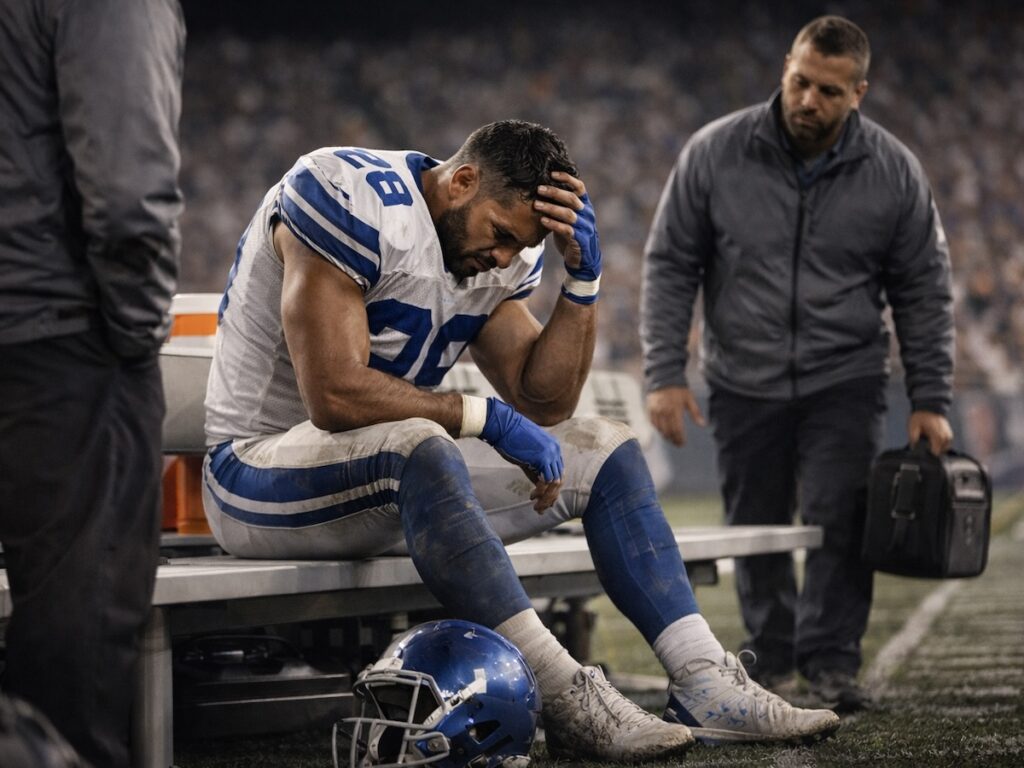
Disability Insurance for athletes sits at the center of income protection for NFL football players whose careers can end instantly after a single hit. Professional football exposes players to repeated collisions that place future earnings at risk long before most workers reach peak income years. Unlike salaried professions, NFL income depends on continued physical performance, and when that performance stops, paychecks often stop with it.
The average NFL career spans only a small number of seasons, yet many players enter the league with financial expectations tied to long-term earning potential. Contracts are frequently structured with limited guarantees, meaning injuries can terminate salary, bonuses, and roster status at once.
Studies of the NFL labor market show that severe injuries shorten careers and permanently reduce lifetime earnings, even for players who reach elite levels of performance, researchers report.
Income loss does not occur only at retirement. An ACL tear, spinal injury, or concussion history can reduce playing time, limit future contracts, or force early exit from the league. These losses often arrive without warning, leaving little time to replace earnings that were expected to last several more seasons.
Disability insurance differs from medical coverage because it is designed to replace income rather than pay treatment bills. For NFL football players, whose occupation depends entirely on physical ability, disability insurance focuses on what happens when the ability to play is lost, not just when injuries occur. That distinction becomes critical when an injury permanently ends a player’s earning capacity on the field.
NFL Injury Risk and Long-Term Threat to Player Income
Injury risk in professional football does not end when a player leaves the field for the last time. Former NFL players face elevated rates of chronic pain, joint disease, depression, and cognitive symptoms that can interfere with post-football employment. These conditions can limit a former player’s ability to earn income in coaching, broadcasting, business, or other second careers, medical researchers report.
Long-term data shows that health risks rise with additional years of play. “Having a longer NFL career significantly increased risk of cognitive impairment and depression later in life,” researchers reported, noting that “with each additional five years of play, the risk for self-reported cognitive impairment increased by 20%,” according to the Football Players Health Study at Harvard University.
Neurological symptoms create particular financial strain because they may worsen gradually rather than appear immediately after retirement. Cognitive problems, headaches, and mood instability can limit a former player’s ability to maintain steady work even when physical injuries appear manageable. These symptoms often emerge years after playing careers end, complicating income planning.
A large study of nearly 2,000 former NFL players found that about one-third believed they had chronic traumatic encephalopathy, and those players reported significantly higher rates of cognitive problems, depression, suicidality, and chronic pain than peers without those concerns, investigators reported.
NFL Disability Benefits and Limits of League Coverage
NFL players are eligible for disability benefits through plans administered by the league and the NFL Players Association. These benefits provide monthly payments under specific disability classifications and eligibility criteria outlined in plan documents. Coverage varies based on service time, medical evidence, and disability determinations.
However, league benefits operate within standardized limits that may not reflect individual earning trajectories. A player with high projected future income may receive the same benefit level as a peer with shorter expected earnings, leaving a portion of income unprotected if a career ends early.
Disability claims under league plans can also involve administrative review processes that take time to resolve. Conditions that worsen gradually, such as neurological or musculoskeletal disorders, can be especially difficult to evaluate under strict definitions of disability.
Because of these structural limits, some players rely on individual disability insurance policies that are designed around expected earnings and occupation-specific risk. These policies focus on replacing income tied to playing ability rather than providing a flat benefit unrelated to prior compensation.
Medical Evidence Links NFL Careers to Long-Term Disability Risk
Researchers studying former NFL players emphasize that many symptoms attributed to irreversible brain disease may also stem from treatable conditions.
“Many conditions common to former NFL players, such as sleep apnea, low testosterone, high blood pressure, and chronic pain, can cause problems with thinking, memory, and concentration,” said Rachel Grashow, first author of the Harvard-led study examining CTE concerns among former players.
While CTE cannot be diagnosed during life, researchers caution that uncertainty itself can create emotional and financial stress. “While we wait for advances in CTE research to better address living players’ experiences, it is imperative that we identify conditions that are treatable,” Grashow added, noting that misattributing symptoms can lead to hopelessness and worsen mental health outcomes.
From an income protection perspective, uncertainty around long-term health can directly affect employability. Cognitive symptoms, chronic pain, and mental health challenges may limit a former player’s ability to sustain post-football income, even when physical injuries appear less visible. These risks compound the financial impact of early career endings.
For NFL football players, disability insurance for athletes exists at the intersection of physical risk and financial reality. When careers end earlier than expected and long-term health remains uncertain, income protection becomes less about planning for retirement and more about managing sudden and lasting loss of earning capacity.