
A Johns Hopkins Medicine resident disabled by an intentional violent act while commuting home from a night shift at a Level I trauma center collects disability benefits beginning on the date of disability, with no waiting period, if the act of violence endorsement is present in their policy. Most residents enrolled in the GSI disability insurance program at Johns Hopkins have never read that provision. Its presence or absence is determined at enrollment and cannot be changed after the fact.
Commuting home from a shift is still on the job as far as a policy is concerned. Johns Hopkins resident GSI disability insurance covers a resident whether the injury happens on the ward or on the way back from it.
The Johns Hopkins Hospital holds Level I Adult Trauma Center designation from the Maryland Institute for Emergency Medical Services Systems, the state authority that designates and oversees trauma centers in Maryland. Level I designation means the hospital operates at the highest tier of trauma care, with 24-hour coverage across surgical specialties and sustained high volume of penetrating and blunt trauma cases arriving by ground and air. Residents rotating through emergency medicine, surgery, and critical care work directly in that environment from the first weeks of training.
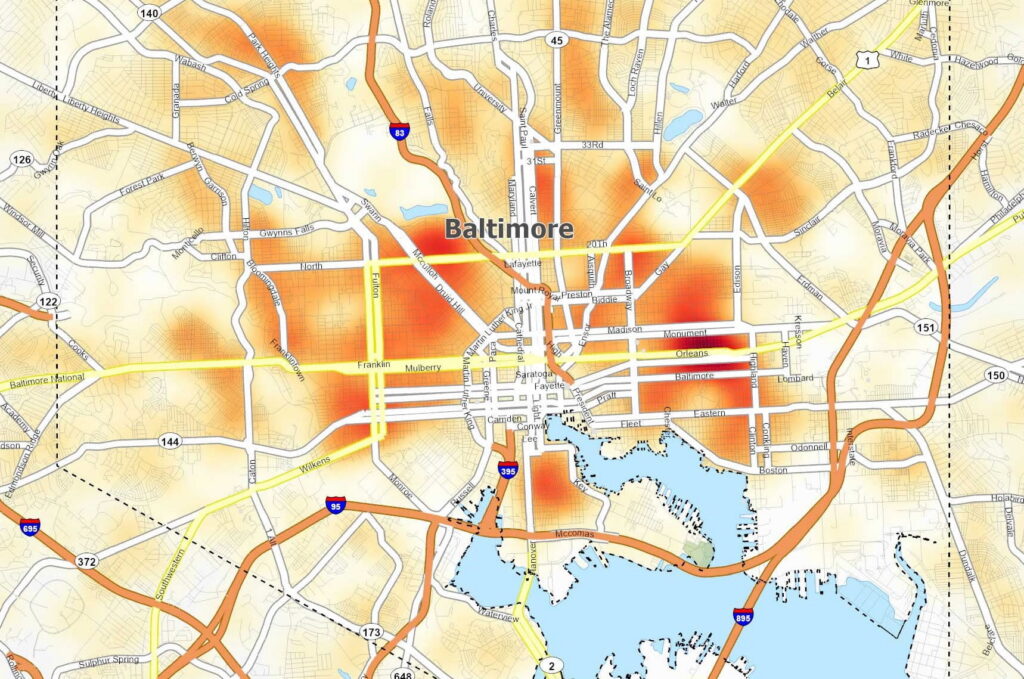
That environment extends past the hospital’s entrance. Baltimore recorded a violent crime rate of 1,606.2 per 100,000 residents in 2024, according to the FBI Uniform Crime Reporting Program. The national violent crime rate for the same year was 359.1 per 100,000. A resident commuting to The Johns Hopkins Hospital, or leaving the campus at the end of a night shift, moves through a city whose violent crime rate runs approximately 4.5 times the national average.
Johns Hopkins resident income protection during training addresses what the stipend leaves after taxes and Baltimore rent. The act of violence endorsement addresses something the stipend calculation does not reach: what happens to income replacement when the disabling event is caused by someone else’s intentional act.
What the Act of Violence Endorsement Does in a Johns Hopkins GSI Policy
The standard elimination period in a disability insurance policy is a waiting period between the onset of disability and the first benefit payment. A resident who selects a 90-day elimination period at GSI enrollment receives no payment until 90 days of continuous disability have passed. That structure is calibrated against the assumption that most professionals can carry fixed costs for a defined window using savings before benefits begin.
The act of violence endorsement overrides that assumption. When disability results from an intentional violent act by another person, the elimination period is waived and the benefit begins from the date of disability.
Day one. That same non-cancellable contract — the one that travels with a Hopkins resident to fellowship at NYP or a faculty appointment at Mass General Brigham — carries this provision into every institution the physician’s career passes through, which is why what Hopkins GME residents carry to NYP and Mass General Brigham after training and what they carry into their East Baltimore commute are questions that belong in the same enrollment conversation.
The provision does not require the resident to have been inside the hospital when the act occurred. It requires only that the disability resulted from an intentional violent act. A resident assaulted during a commute, in a parking structure, or in the surrounding neighborhood is covered by the same provision as one assaulted inside the emergency department — if the endorsement is present in the policy.
Most Johns Hopkins Medicine residents enrolled in the GSI program have never read the act of violence endorsement in their policy. Whether that provision is present determines whether a 90-day benefit delay applies to the disability category most directly tied to their work environment, and the benefit amount calibrated against Baltimore take-home pay determines what the policy pays once the elimination period clears.
The Bureau of Labor Statistics identifies healthcare workers as five times more likely to experience workplace violence than workers in other industries, a figure cited in the congressional findings of the Save Healthcare Workers Act (H.R. 3178/S. 1600), introduced in both chambers on May 5, 2025. That legislation would make assaulting a hospital worker a federal crime for the first time in U.S. history, with penalties up to 10 years in federal prison and up to 20 years when a deadly weapon is involved or when an assault occurs during a declared public health emergency. No equivalent federal protection currently exists.
A 2024 poll by the American College of Emergency Physicians found that 40% of respondents knew of an attack on a healthcare worker in a trauma center resulting in moderate to severe disability or death. That is a documented outcome rate at institutions carrying the same Level I designation as Johns Hopkins Hospital.
Bob Herum, president of the Council for Disability Income Awareness framed the broader pattern on the Income Protection Journal Podcast.
“If I knew that there was a 25 percent chance that when I crossed the road, I was going to get hit by a car, I probably wouldn’t cross the road.”
Bob Herum, president of the Council for Disability Income Awareness, on the Income Protection Journal Podcast
Why This Provision Belongs in the Hopkins GSI Enrollment Conversation
The GSI program available to Johns Hopkins Medicine housestaff issues a non-cancellable individual disability contract. Own-occupation disability coverage for Johns Hopkins GME trainees is structured with fixed terms at the time of enrollment. A provision that is absent from the policy at enrollment cannot be added after the fact.
The act of violence endorsement is not a separate product or an upgrade purchased later. It is a provision whose inclusion is established when the policy is issued.
Most residents approach GSI enrollment focused on the benefit amount, the elimination period, and the benefit period — the figures that appear directly on the enrollment form. The act of violence endorsement appears in the policy language, not on the enrollment summary. Hospital-sponsored disability coverage for residents and fellows is designed to be portable and permanent: non-cancellable, own-occupation, issued during training and carried throughout a career. The terms that travel with the policy for 30 years include the provisions a resident understood at enrollment and those they did not.
GSI enrollment window for Johns Hopkins residency programs after match addresses the timing of that decision. The period between match and program start in July is when the full structure of a GSI policy should be understood, including provisions most residents encounter only after a qualifying event. By that point, the enrollment decision has already been made.
A resident whose policy includes the act of violence endorsement and who becomes disabled as the result of an intentional violent act collects benefits from the first day of disability. A resident whose policy does not include that endorsement waits through the full elimination period before the first payment arrives. Both outcomes trace back to the enrollment form a resident completed during the first weeks of training at Johns Hopkins.