
An equipment dealer in Phoenix took on a $1.2 million working capital loan in 2024 to finance a forklift inventory expansion.
The bank required term life insurance on the loan and would not require business loan disability insurance.
Three years in, a back injury kept him out of the warehouse for 14 months.
The term life policy remained in force. The bank kept billing.
The bank’s collateral requirement was satisfied by the term life assignment, and the loan installment was due regardless of the owner’s ability to pay.
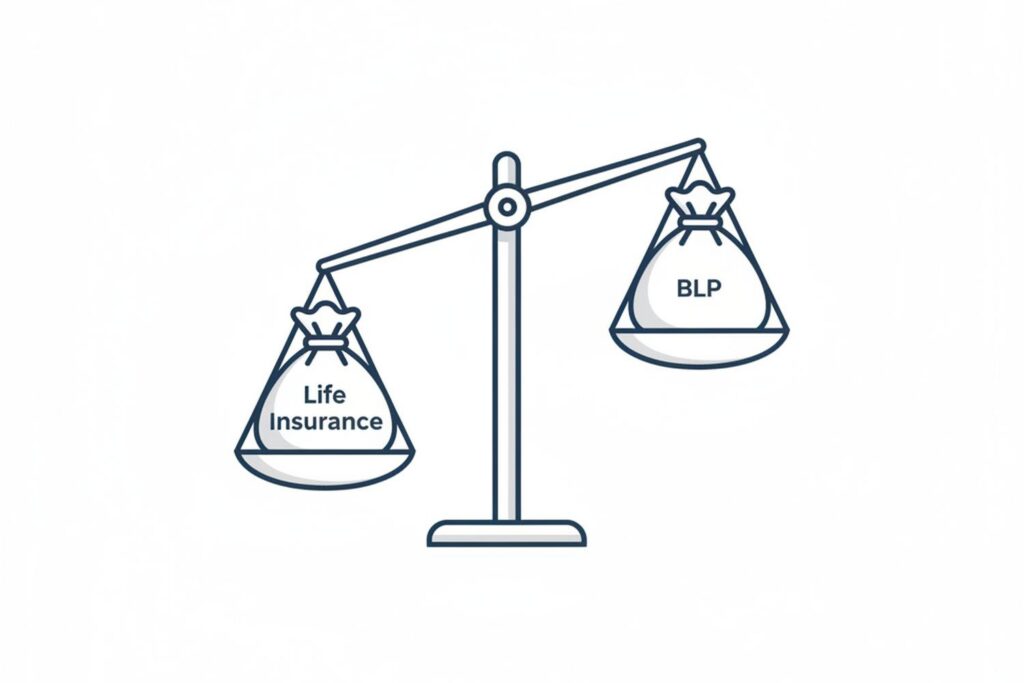
Lenders accept term life insurance and business loan disability insurance on the same loan for different reasons. The two instruments serve adjacent but non-overlapping triggers.
| Dimension | Term life insurance | Business loan disability insurance |
|---|---|---|
| Triggering event | Death of the insured | Total disability of the insured |
| Benefit shape | Lump-sum face amount | Monthly benefit matching the loan installment |
| Premium rating factors | Age, health, tobacco use | Age, occupation class, benefit period, health |
| Cost for a healthy 35-year-old, $1M face / equivalent benefit | Lower | Meaningfully higher |
| Pays at borrower’s death | Yes | No |
| Pays at borrower’s disability | No | Yes |
| Lender acceptance as collateral | Universal | Increasing, with growing carrier and lender familiarity |
The two products cover two different ends of the loan-default risk envelope. They do not overlap at trigger, and they do not substitute for each other.
The SBA accepts both instruments as collateral on 7(a) and 504 loans. Standard Operating Procedure 50 10 allows collateral assignment of term life policies and assignment of disability policy benefits to the lender.
Most commercial banks require term life on loans above a threshold. Many accept business loan disability insurance as supplemental collateral.
A growing number require both on loans where the owner’s personal income is the primary repayment source.
The disability trigger is more common than the death trigger during a typical working career. Industry actuarial data places a working-age adult’s probability of a 90-day-plus disability at roughly one in four.
The death probability over the same window is a fraction of that figure.
The owner who buys term life and skips business loan disability insurance is covering the less-likely event and leaving the more-likely event uncovered.
The carrier writes business loan disability insurance with a Total Disability definition. Principal’s ICC25 HH 802 BLE specimen requires that the insured be “unable to perform the Substantial and Material Duties of Your Occupation,” not Working, and satisfying the claim documentation.
Term life carries no equivalent test. The trigger is death of the insured, period.
The cost shapes of the two products differ.
Term life premium is rated on age and health. A healthy 35-year-old can buy a $1 million 20-year term life policy for a small annual premium.
The same buyer’s business loan disability insurance premium is meaningfully higher for the same coverage amount. The carrier prices for the higher likelihood of a covered claim during the working years.
The premium-cost differential is what drives many borrowers to satisfy the lender’s collateral requirement with term life only. The disability gap goes uncovered.
Bob Herum, president of the Council for Disability Income Awareness, frames the pattern broadly on the Income Protection Journal Podcast. Borrowers who lean on a single contingency plan often have not stress-tested it.
“I want them to confront those things that they’ll say to the agent. I’ve heard it hundreds of times through the years: I’m going to have my wife go back to work. Well, when was the last time she worked? We’re going to use savings. Well, how many months could you go on your savings?”
Bob Herum, president, Council for Disability Income Awareness, on the Income Protection Journal Podcast
Herum’s pattern applies to the borrower who answers the disability question with “I have term life.”
Term life does not pay the loan installment during a disability. The owner is alive, the personal guarantee remains attached, and the loan installment remains due.
The death trigger that would activate the term life policy has not occurred.
The collateral mix question gets settled at policy purchase, alongside the personal guarantee an SBA borrower signs at the closing table. The borrower who builds both instruments into the financial plan addresses both legs of the default risk.
The benefit-period question on the disability side is the other decision the borrower faces at policy purchase.
The carrier writes the BLP termination date matched to the loan amortization so the policy ends when the loan ends.
The borrower who chooses both term life and business loan disability insurance carries a contingency for each end of the working-life envelope.
For business owner disability insurance buyers running a commercial enterprise on borrowed capital, the cost of carrying both instruments is small relative to the cost of leaving the disability gap uncovered.
The two policies together close the loan-default risk envelope on a personally guaranteed SBA loan.
The Phoenix equipment dealer’s 14-month recovery resolved with the inventory expansion completed, the loan current, and the personal guarantee untouched.
The term life policy that the bank required remained in force throughout, and the business loan disability insurance the dealer purchased separately paid the loan installment.
The bank’s collateral file contained two instruments. The disability event triggered the second.