
Podcast: Play in new window | Download (Duration: 34:24 — 78.7MB) | Embed
Subscribe Apple Podcasts | Spotify | RSS | More
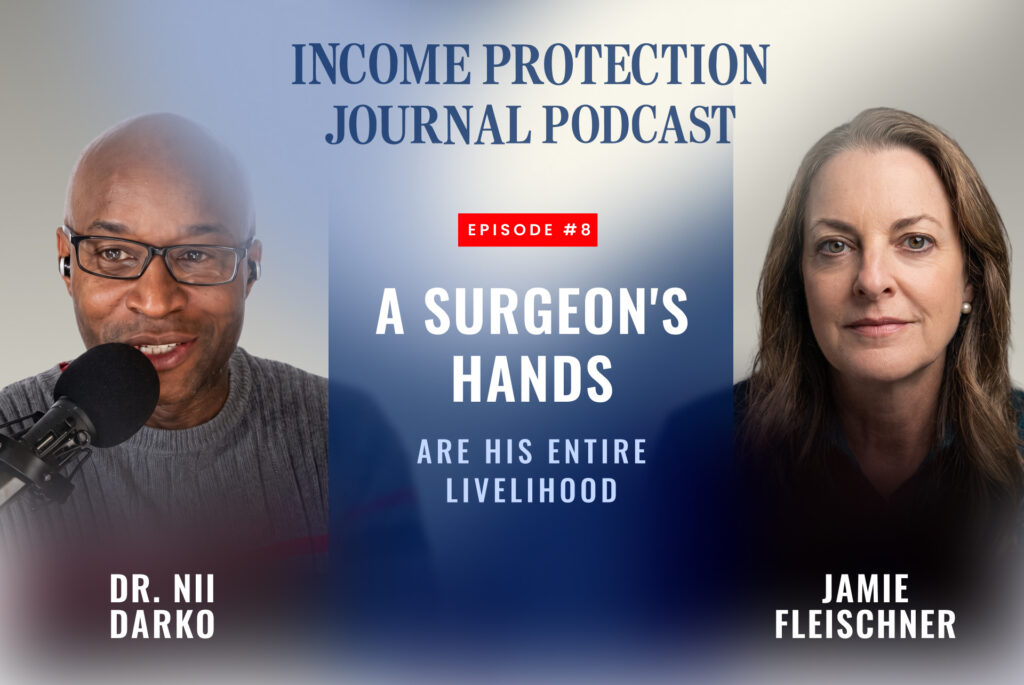
When I spoke with board-certified trauma surgeon Dr. Nii Darko, DO, MBA, FACS for this episode of The Income Protection Journal Podcast, he started with a moment humiliating in its simplicity.
The hands are the whole coverage question. Disability insurance for physicians turns on whether a policy insures the surgeon’s own specialty or merely the ability to work somewhere, and that language is chosen at purchase.
He was cutting up a hospital mattress his town’s local rubbish service wouldn’t pick up, put a little too much tension on one finger, and felt what he described as a rubber band snapping. The next day he was supposed to drive four hours for a locums assignment. Instead, he went to urgent care, learned he had torn a ligament, and was told a wire would be drilled into his finger. He could not operate for weeks.
That story lands differently when you hear it told out loud. In print, it reads like bad luck. In audio, you can hear the shift from annoyance to panic as he connects one small injury to a very large question: How do I bring in cash if I cannot do the thing I am paid to do? His torn ligament is one version of a pattern that repeats across specialties: a physician’s injury reveals how fast income can collapse when a policy does not insure the specific skill at risk.
I wanted that tension on the record because it captures what young physicians miss in the years right after training. They think the hard part is over. They assume the attending paycheck solves the problems that accumulated during residency. Then the reality arrives with two hands on their throat at once: debt and dependence on income.
Dr. Darko and his wife, an OB, started their careers with more than $600,000 in student loan debt, and when they stacked everything else on top of it, he estimated they were closer to $850,000 or $900,000 in total obligations. He did not describe that as a character-building experience. He described it as a set of constraints that quietly decided where they could live, what jobs they could tolerate, and how much freedom they actually had.
That is why the episode is not really about debt payoff, even though the debt payoff story is extreme. It is about leverage. It is about what happens when the engine behind every financial plan is one person’s ability to show up and work. Dr. Nii Darko, DO, MBA, FACS, is a board-certified trauma surgeon and the longtime host of Docs Outside the Box, a podcast he launched in 2016 to spotlight physicians building unconventional careers beyond traditional medicine
The “too expensive” policy that triggered a deeper problem
One of the most revealing parts of my conversation with Dr. Darko had nothing to do with a carrier name or a feature. It was the origin story. He told me he bought disability coverage from someone he met at a club in Miami during his last year of residency. How a resident’s choice of provider during that training window can permanently void access to guaranteed standard issue disability coverage with no medical questions asked is examined in a separate episode with Steve Crawford of Financial Balance Group. It was “way too expensive,” he said, and that was not even the most troubling part. After he got married, the advisor did not call to review beneficiaries or revisit whether the coverage still made sense. When Dr. Darko and his wife called and said the price was too high, the advisor’s response, in his telling, was essentially: budget better.
What mattered was not that he met an advisor in a club. What mattered was what happened next. The couple looked at their finances and realized they were putting more money into disability premiums and a whole life plan than they were putting into student loans and savings. That was the spark. They started asking a question young doctors rarely ask early enough: What are we paying for, and what are we not protecting?
In the episode, Dr. Darko described what many residents and new attendings feel but do not say out loud. They believe the attending paycheck turns every decision into an easy decision. He called it a naïveté. He also compared young physicians to athletes who suddenly land in the big leagues without a working understanding of money. The parallel was not meant as an insult. It was meant as a warning. High income does not create financial stability if obligations, lifestyle, and risk are misaligned.
The pivot he described was blunt. They kept income protection in place, but at a cost that made sense, and then they attacked the debt with a discipline that made other people think they were insane. They lived on his wife’s part-time salary, sent the rest to loans, and used cash for groceries. At points, they budgeted $200 a month for food. He remembered friends outside medicine looking at them like they had lost their minds.
He also remembered the interest. He described watching it fall from $3,000 a month to $1,500 to $1,000 and feeling satisfaction that he could not get from any luxury purchase. His language was not abstract. He said the interest felt like taking money and throwing it out a window. That line does a lot of work because it explains why debt is not just a number. It is pressure. It is an ongoing demand that pushes physicians into decisions they would not otherwise make.
They started in October 2014 and finished in January 2017. When he said he felt a “huge monkey” come off his back, I believed him. Then he said something that matters even more for this audience. Paying off the debt did not just change their bank account. It changed his professional posture. It changed how he negotiated and how he interacted at work. It changed what he would tolerate.
When he later moved into locums, it was not framed as a hustle. It was framed as autonomy. In the episode, he described looking at schedule and exit terms before pay, because no amount of money was worth being miserable every day. He said something else that will sting if you are on the wrong side of it: finances determine how much “BS” you will put up with.
That is a career strategy. It is also a risk strategy. The episode is worth hearing because you can detect where the lesson becomes personal instead of theoretical.
The eight-week injury that could have rewritten everything
The finger story is the point where the conversation stops being about discipline and becomes about fragility. Dr. Darko was out for about eight weeks. He could not operate. He worked out an arrangement where he took call and admitted patients while partners came in to operate, even at 2 a.m. That detail matters because it shows how physicians improvise. They will find a way to keep serving, keep earning, keep the machine moving. They will also underestimate how quickly a temporary problem becomes a financial one.
In our conversation, he admitted he started to sweat even with a healthy emergency fund because the question is never “Do I have savings?” The question is “How long does this go?” He said he called me while he was dealing with it and asked what it would mean if he did not regain flexion. He did not need benefits, but he needed to understand the mechanics. That is a gap in physician education. They learn anatomy and pharmacology. They do not learn what happens when they cannot use their hands.
He also described another exposure that young physicians rarely think about until it is staring them down. His wife underwent IVF, and because she is an OB, she understood the complications that can follow. They were keenly aware she could be out for months if something went wrong. That awareness changes how you think about underwriting, insurability, and timing. It changes how you think about the cost of waiting.
In the episode, you can hear the emotional subtext under the practical details. It is not fear of disability as an idea. It is fear of losing runway. It is fear of losing options.
I did not want this article to summarize every point we covered because the most useful part is not the list of takeaways. It is hearing how a surgeon talks when he realizes his livelihood is not his degree. It is his ability to perform.
If you listen, pay attention to how quickly the conversation moves from “protect my hands” to “protect my life.” The words are casual. The implications are not. In the episode, the pause before he describes the finger injury is as telling as the story itself. You can hear him replay the moment his confidence in continuity cracked.
Dr. Darko also offered an honest explanation for why physicians overlook income risk early. After 12 years of discipline to get through school and training, there is relief, and there is entitlement to finally live. Financial guidance that demands more discipline can sound like another residency. Some advisors respond by telling physicians what they want to hear. The harder truth is that the ability to earn is the engine behind every plan, and losing even a short period of income can derail years of work.
That is the part I want physicians to sit with. Not as a scare tactic. As a framing correction. The doctors who gain autonomy are not the ones who simply earn more. They are the ones who reduce the number of things that can trap them.
This episode is a gateway to The Income Protection Podcast in the most literal sense. It is a recorded conversation, and the audio delivers the nuance that print cannot. If you only read a summary, you miss the tone shifts that reveal what the risk feels like in real time.