
Podcast: Play in new window | Download (Duration: 55:51 — 127.8MB) | Embed
Subscribe Apple Podcasts | Spotify | RSS | More
When people apply for insurance, they expect a straightforward process. Fill out an application, answer a few health questions, and wait for an approval. But in many cases, something else happens behind the scenes they never see coming.
That review is standard practice. Underwriters for disability income insurance read the medical file before they price a policy, which is why the timing of an application matters as much as its contents.
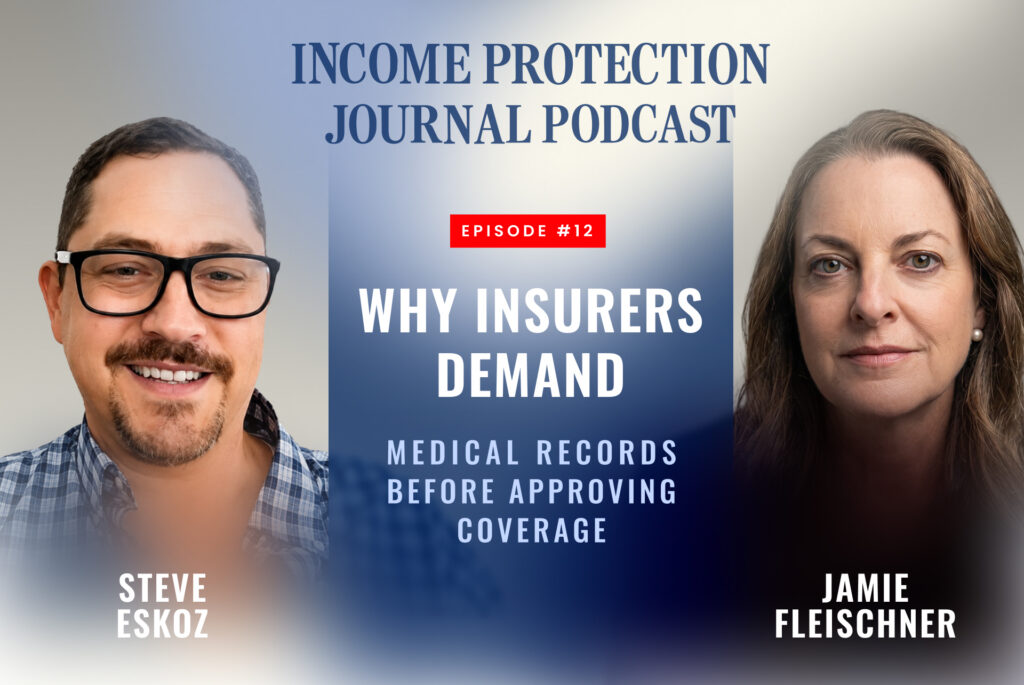
During a recent conversation on the Income Protection Journal Podcast, I spoke with Steve Eskoz about the moment many applicants realize the process is more complicated than they expected, when the insurance company asks for their medical records.
I’ve worked with Steve on thousands of insurance cases over the years, but most people outside our industry never see the part of the process he manages every day. Steve is a senior executive account manager at the Eugene Cohen Insurance Agency who has spent more than a decade navigating complex insurance cases involving life, disability, and long-term care coverage. His role involves coordinating the underwriting process that determine whether someone is approved for coverage and on what terms.
What he described during our conversation was something most people never anticipate.
Why an Attending Physician Statement Is Requested
One of the most common surprises occurs when the insurance company requests what is known as an attending physician statement, often shortened to APS. This is essentially a copy of your medical records from your doctor’s office.
As Steve explained during our conversation, the request itself is not unusual. In fact, he told me that it happens far more often than most applicants realize.
“Across all ages, I would say medical records are requested at least half the time,” Steve said. “In many cases it’s closer to sixty or sixty-five percent.”
That statistic alone tends to catch people off guard. Many applicants assume the insurance company relies entirely on the health information provided on the application. In reality, insurers often verify that information by reviewing records from physicians, hospitals, or diagnostic facilities.
This is where the timeline of an application can change dramatically.
When medical records are requested, the insurance company must wait for a physician’s office or hospital records department to release them. And those offices operate on their own schedules. According to Steve, most requests are fulfilled within a few weeks, but delays can happen.
In some cases the delay isn’t caused by the insurer at all. It may come down to something as simple as a physician working at multiple clinics or a records request being sent to the wrong facility. When that happens, the entire process can stall until someone tracks down the correct source of the records.
That investigative work is one of the parts of the process most applicants never see.
How a Medical Records Review Changes the Timeline
Even when records arrive quickly, they sometimes raise new questions.
During our discussion, Steve explained that an insurance underwriter might review a set of medical records and discover references to additional doctors or tests that were not originally included in the application.
For example, a physician’s note might mention that a patient was referred to another specialist for testing. If those results are not already included in the file, the insurer may request another set of records before making a final decision.
From the applicant’s perspective, it can feel like the process keeps expanding.
But from the insurer’s perspective, it is part of verifying the risk they are taking on.
Steve described underwriting in simple terms during the interview. Insurance companies group applicants into risk categories based on health history and other factors so they can estimate how likely claims are to occur. The better they understand that risk, the more accurately they can price coverage.
And sometimes the smallest detail in a medical file can change the way a case is evaluated.
Why Preparation Before Applying Can Matter
One of the most useful parts of our conversation was Steve’s explanation of how applicants can sometimes prepare for the process before they ever submit an application.
If someone knows their medical history is complicated, he often recommends what the industry calls pre-underwriting. Instead of immediately applying for a policy, a broker can anonymously present the key medical details to multiple insurers to see how each company might evaluate the case.
That approach can prevent unpleasant surprises.
It can also reveal something else many applicants do not realize. Different insurance companies evaluate the same health information differently.
Steve shared an example from a case we worked on together in which one company initially declined an applicant based on their medical history. After presenting the same information to several other insurers, three companies were willing to offer coverage at better terms. Armed with that information, we were able to return to the original carrier and negotiate a better outcome.
That kind of advocacy is rarely visible to the person applying for coverage.
But it is one of the reasons experienced brokers spend so much time working behind the scenes.
Why Timing Can Influence the Outcome
Another point that came up repeatedly during our conversation was timing. Many people assume the best time to apply for insurance is when they feel the need for coverage most urgently. In practice, the best time is usually earlier.
Health changes, new diagnoses, or even future medical testing can influence how a case is evaluated. Once new medical information appears in your records, it becomes part of the underwriting picture.
As Steve put it during the interview, the simplest strategy is often the best one.
“The sooner you apply while you’re healthy, the better,” he told me. What that policy actually delivers when a professional like a litigating attorney loses the ability to perform oral argument is examined in a conversation with Mike Cogdall, who spent decades on the carrier side of disability claims involving professionals whose income depends on a specific hard-won set of skills. “Your health is really what qualifies you for the policy.”
The premiums simply determine how much that protection costs.
For professionals who depend on their income or business stability, that distinction matters. A change in health history can affect approval timelines, pricing, or eligibility in ways that are difficult to reverse later.
That is why the underwriting process, and the possibility of an attending physician statement, plays such a critical role in how insurance decisions are ultimately made.
Our full conversation on The Income Protection Podcast explores the process in far more detail, including how records requests are handled, why some cases move quickly while others take months, and how experienced brokers sometimes help applicants secure coverage when a case initially appears impossible.
Listening to the conversation makes it clear how much work happens behind the curtain of an insurance application.
And why understanding that process ahead of time can make a significant difference.