Podcast: Play in new window | Download (Duration: 26:24 — 60.4MB) | Embed
Subscribe Apple Podcasts | Spotify | RSS | More
When Steven Crawford told me about the hospitals on probation, he actually got a little choked up. He was trying to choose his words carefully because what he was about to say has real consequences for thousands of medical residents and fellows who assumed the offer sitting in their inbox would still be valid when they clicked on it after Match Day.
Program instability changes the calculus for a resident. GSI disability insurance is underwritten on training status, so a program’s accreditation trouble can affect the window to buy.
Early last year, Guardian Life Insurance pulled guaranteed standard issue programs from 3 teaching hospitals, according to Crawford, with zero advance notice and no grace period.
Residents who had been planning to enroll before graduation discovered that the offer (the one that would have let them secure disability insurance before graduation with no medical questions, no exclusions, and permanent discounts of up 30%) was gone forever.
This is the part of the GSI conversation that rarely gets discussed. In Part 1 of this series, “Securing GSI Disability Insurance with No Medical Questions Asked,” I spoke with Steven Crawford about how residents accidentally void their GSI eligibility by inadvertently applying through an unapproved GSI provider first. That mistake is devastating, and it happens constantly.
But the risk I wanted to explore in this second conversation is different. It’s the risk of doing nothing wrong, and still losing access because the program got cancelled while you waited.
Steven Crawford, President of Financial Balance Group, has spent decades setting up and managing GSI disability insurance programs with Guardian. He has built nearly 200 Guardian GSI hospital programs nationwide. When he says the landscape is fluid, that’s because participation rates at individual hospitals determine whether those programs survive.
The Participation Problem Nobody Warned You About
I wanted to understand the mechanics of that instability, and what it means for any resident or fellow who is currently between Match Day and graduation, sitting on an offer they haven’t acted on yet. What we discussed on The Income Protection Journal Podcast was more unsettling than I expected, not because of what residents don’t know, but because no one can anticipate when an offer might get pulled.
Guardian requires roughly 40% participation at each hospital to sustain a GSI offer. In the podcast, Steven Crawford shared that last year, the company issued approximately 9,700 policies to residents and fellows across its hospital partnerships, representing about 39.7 percent of the eligible population. That is right at the threshold. And while the number of Guardian Life Insurance Company GSI disability offers has grown to nearly 200 programs nationwide, one major competitor dropped 20 to 25 programs in the last 2 years. Another carrier is down to less than 15.
The reason programs get pulled is straightforward. When not enough residents enroll, the insurance company absorbs disproportionate adverse risk from the smaller pool that does. The economics stop working.
So the company withdraws the offer—sometimes mid-year, without waiting for a calendar reset. Steven described hospitals where Guardian’s GSI programs were placed on what amounted to probation in 2025, where producers had to argue against having the offers revoked entirely.
For any resident thinking they can safely wait until May or June, this is the calculation that should change their mind. The offer is not guaranteed to exist until graduation.
It’s guaranteed to exist right now. Those are two very different things.
What makes this especially painful is the cost of acting. Steven walked me through the numbers for a first-year resident: a base policy of $2,500 per month with a benefit purchase rider, using graded premiums, runs between thirty and forty dollars a month.
That rider allows future increases up to $15,000 per month without additional medical underwriting. In exchange for what amounts to a modest monthly expense, a resident locks in a non-cancellable, portable individual disability insurance policy—own occupation, with Guardian’s surgical specialty language—that follows them through every career transition for the rest of their working life.
The group long-term disability coverage that hospitals provide during training, which Steven acknowledged can be excellent at some teaching institutions, disappears the day you graduate. Every resident knows they need individual coverage eventually. The question is whether they secure it while the GSI window is open or gamble that the window stays open long enough for them to get around to it.
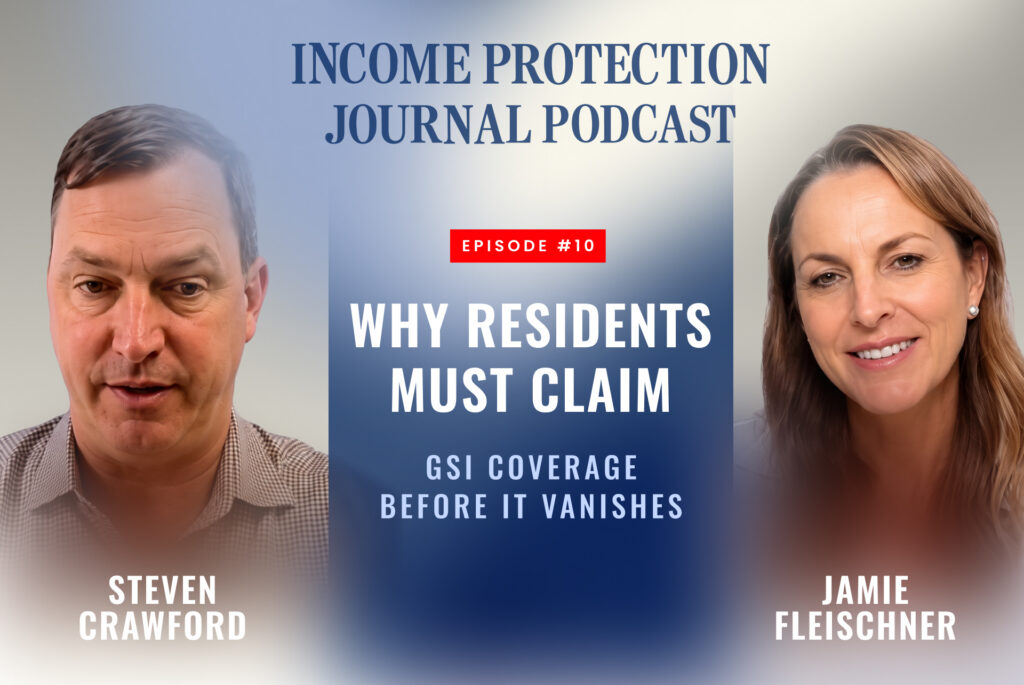
*Steven Crawford explains why GSI disability insurance timing around graduation is more precarious than most residents realize.*
Match Day and the 90-Day Clock
The timing rules around graduation are more precise than most residents expect, and in the episode, Steven’s specificity on this point was striking. Guardian allows enrollment during training and for ninety days after graduation, but only at a hospital where a GSI offer is actively in place.
Ninety days does not mean the end of the third calendar month. It means exactly ninety days.
If you graduate on June 30, your window closes around September 27, not September 30. Miss it by a day and there are no exceptions.
Steven also described a strategic opportunity around Match Day that most residents never hear about. If a medical student or resident matches to a hospital with an active Guardian GSI program, they can apply before they physically start training. They submit the application using their current address and request an effective date of their first day at the new institution.
The policy cannot be issued until they are employed, but the application secures their place. For residents transitioning from a program without GSI to one with it, this is the one moment to act.
The inverse scenario is equally important. A resident currently training at a hospital with GSI who matches to a fellowship program without it has a shrinking window to enroll before they lose access entirely. Steven’s advice was unequivocal: take care of it while you have the opportunity, because once it’s gone, it’s gone forever.
What I found most revealing in our conversation was Steven’s candor about the industry itself. He described online platforms where physicians seek disability insurance advice and where some of the people involved knowingly recommend carriers that don’t offer GSI, even when they know the resident’s hospital has a guaranteed standard issue program available. He called it morally reprehensible.
In the recording, you can hear the shift in his voice when he says it. That moment lands differently when you hear it than when you read it on a page.
According to Milliman, roughly half of people who believe they’re healthy receive some form of modification—an exclusion, a rating, a limitation—when they apply for disability insurance through full medical underwriting.
For a surgeon, an exclusion on hands or elbows isn’t an inconvenience. It’s a gap in coverage precisely where the risk is highest. GSI eliminates that entirely, the study says.
Standard rates. No exclusions.
No possibility of being declined. And for residents with conditions ranging from ADHD medication to pregnancy complications to prior injuries, it is their only realistic path to comprehensive individual coverage.
Steven emphasized a point that bears repeating: the GSI policy from Guardian is the same contract as the fully underwritten version, with only three differences.
- The age-seventy benefit period option is not available on GSI.
- The serious illness supplement is not available.
- Mental nervous coverage is limited to two years for all specialties, whereas some specialties can receive unlimited mental nervous protection through full underwriting.
Otherwise, the contract language, the own occupation definition, the surgical specialty provision, and the premium structure are identical, Steven Crawford says.
The difference is not in what the policy covers. The difference is in who can buy one. How that same coverage window plays out in dentistry is examined in a conversation with Dr. Eric D’Hondt, a dental practice owner who secured a policy before daily procedures created the thumb arthritis that would have excluded his hands under full underwriting.
I asked Steven what he would tell a resident who has ten minutes and just needs to know what to do. His answer was surprisingly simple: Google your hospital name and “GSI disability insurance,” find a producer who actually has access to the program, fill out the three-page pre-application, and in most cases, the policy can be issued within forty-eight hours. During peak graduation season it might take a week.
The process, he said, is so much easier than residents think it is. And once it’s done, they never have to think about those hundreds of emails from insurance agents again.
But only if the program still exists when they finally decide to act.