
Medical students and residents at Washington University School of Medicine are entering training at a moment of institutional transition and financial uncertainty. But most trainees still assume their biggest risk is academic performance rather than long term income disruption. The reality is that career trajectory changes, funding shifts, and health events can alter earning potential long before a physician reaches full income.
Institutional transition does not pause the coverage clock. Washington University resident GSI disability insurance runs on the training calendar, independent of whatever else is changing around it.
Bruce D. Levy’s appointment as dean of WashU Medicine arrives at a time when academic medicine is navigating pressure from research funding constraints, reimbursement changes, and evolving care delivery models.
Those forces shape not only institutions, but also the career paths of the physicians training inside them. For trainees, the risk is not just whether they complete residency, but how stable and predictable their future income will be.
After advising physicians on disability insurance for more than three decades, one pattern appears repeatedly. The moment when a trainee’s career path feels most secure is often when their financial exposure is least understood.
Disability insurance for WashU residents is tied to timing, not just need
Residents rotating through Barnes-Jewish Hospital residency programs often first encounter physician disability insurance during onboarding or early training. Some programs introduce guaranteed standard issue disability insurance for WashU residents, which allows eligible trainees to secure coverage without medical underwriting.
Medical underwriting is the process insurers use to evaluate health history before issuing a policy. Once that process begins, outcomes can include exclusions, higher premiums, or denial of coverage. Guaranteed standard issue programs remove that step entirely, but only within a defined eligibility window tied to training status.
The constraint is simple but frequently misunderstood. Eligibility for underwriting-free disability insurance for WashU residents exists only during active participation in WashU Graduate Medical Education programs. Once training ends, that access disappears.
This creates a timing issue that many trainees do not recognize until it is too late.
Why WashU medical residents lose access to GSI disability insurance
The most common mistake is not failing to apply. It is applying in the wrong order.
Residents often explore fully underwritten disability insurance first, especially as income rises or specialty plans become clearer. That decision can unintentionally close the door on the WashU resident guaranteed issue disability program.
Once an application requiring medical underwriting is submitted, the insurer records the outcome. Any exclusions or ratings attached to that application may carry forward and eliminate eligibility for guaranteed standard issue disability insurance tied to the residency program.
The sequence matters more than the decision itself.
This is particularly relevant for WashU medical residents eligible for GSI disability insurance, where institutional access creates a temporary advantage that does not exist later in a physician’s career.
The WashU GSI disability insurance options available during training reflect a structure that is designed around timing rather than income level.
Financial risk begins before income peaks
It is easy to assume that disability insurance becomes important only after attending level income is reached. In practice, the financial exposure begins much earlier.
Training delays, illness, or injury during residency can interrupt progression through Washington University School of Medicine residency programs. That interruption affects not only immediate income, but also long term earning trajectory.
The Association of American Medical Colleges tracks physician workforce trends and consistently highlights the extended training period required before physicians reach peak earnings. That prolonged pathway increases the window during which income risk exists without full financial protection.
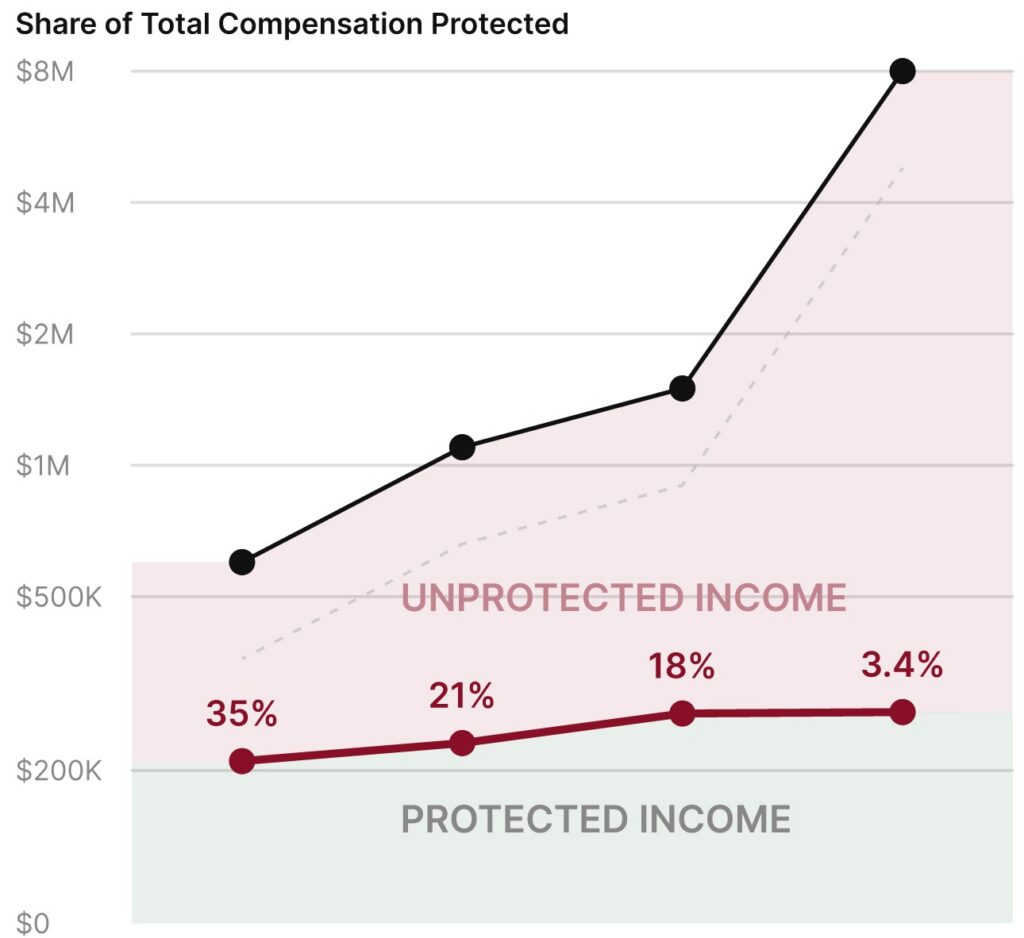
Coverage obtained during residency is typically limited in monthly benefit. Most carriers offer between $1,000 and $2,500 per month for trainees.
That amount is not designed to replace attending income. It is designed to protect continuity during training.
More important is how that initial coverage evolves.
Policies issued during residency often include a future increase option for WashU GSI policies. This allows physicians to expand coverage as income rises without additional medical underwriting.
The value is not the initial benefit. It is the ability to scale protection later under the original health classification.
That structure reflects a broader principle in physician disability insurance available during WashU residency. The earliest decisions tend to have the longest financial impact.
What changes under new leadership may mean for trainees
Leadership transitions in academic medicine rarely affect day to day training immediately. Their impact appears over time through changes in funding priorities, clinical expansion, and institutional strategy.
Levy’s background in integrating large academic systems and managing research driven departments suggests continued emphasis on scale and collaboration. At the same time, external pressures such as federal research funding uncertainty and reimbursement shifts remain outside institutional control.
For trainees, that combination introduces variability into what has historically been viewed as a predictable career path.
Career outcomes for physicians are still strong relative to most professions. But the path to those outcomes is becoming less uniform. Subspecialty demand, geographic distribution, and institutional funding all influence income progression.
That is where own-occupation disability coverage for WashU residents becomes relevant. These policies define disability based on the ability to perform the duties of a specific medical specialty. If a physician cannot perform that specialty, benefits are paid even if they can work in another capacity.
The distinction matters because specialty defines income.
A resident training in a procedural specialty faces a different risk profile than one in general internal medicine. The insurance structure must reflect that difference, even before the specialty path is finalized.
The decision most trainees delay
Most residents do not reject disability insurance. They postpone the decision.
The delay is usually rational. Training schedules are demanding.
Financial priorities feel distant. Income is limited.
But the decision is not simply whether to purchase coverage. It is whether to preserve access to specific types of coverage.
Disability insurance enrollment during WashU residency training is one of the few points in a physician’s career where underwriting can be bypassed entirely. That condition does not repeat later.
Once residency ends, the process becomes more restrictive.
The consequence is not immediate. It appears years later, when higher income levels justify larger coverage amounts and underwriting outcomes begin to matter more.
At that point, the earlier decision cannot be reversed.
A structural risk most physicians only recognize in hindsight
The WashU leadership transition highlights a broader truth about medical careers. Even at top institutions, long term outcomes are influenced by factors outside an individual physician’s control.
Training programs, research funding, institutional strategy, and health all interact to shape earning potential. Disability insurance exists to protect against one specific outcome within that system. Loss of the ability to practice medicine at the expected level of income.
The mechanism is straightforward. The timing is not.
For WashU physician trainee disability insurance, the critical variable is not whether coverage is eventually obtained. It is when the initial eligibility window is used and how the application sequence is handled.
That is the rule most trainees overlook.
And it is the one that tends to matter most later in their careers.